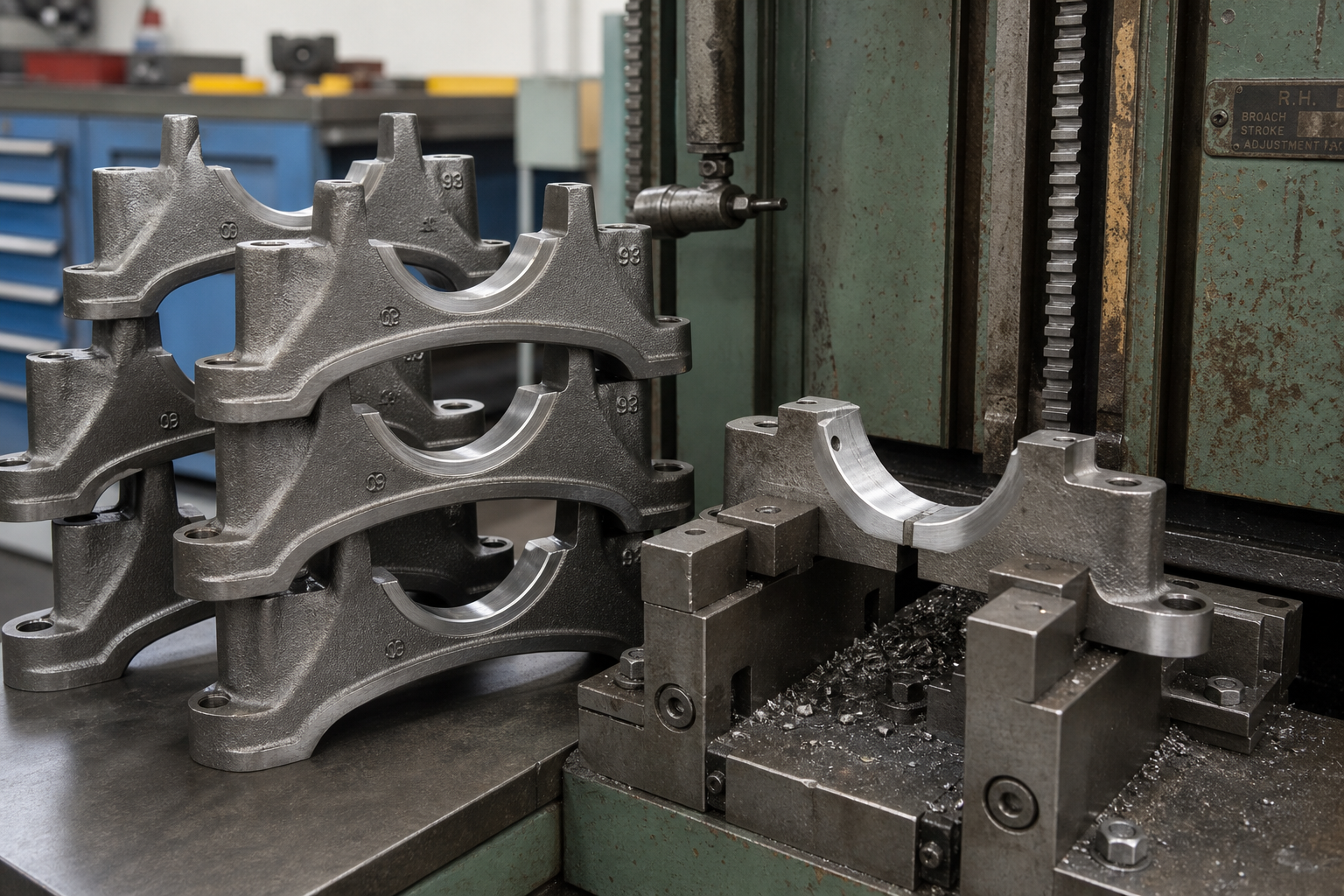
Drilling and broaching are two of the first hole-making processes most engineers learn, and they are often confused in online discussions — to the point that you will sometimes see broaches described as “broaching drills.” That term is a red flag: a broach is not a drill of any kind. The two tools remove metal by entirely different mechanisms, run on entirely different machines, and produce entirely different geometry. Understanding where one process ends and the other begins is the key to planning any part with a bore in it.
The shortest possible summary is this: drilling is a rotary process that creates a round hole in solid material using one or two cutting edges. Broaching is a linear process in which a multi-toothed tool passes through or across the work to produce a finished profile — a keyway, spline, hexagon, or any of countless other forms, with the round hole being just one special case.
Notice what that summary implies: these are not strictly rival processes. On most parts that get broached, drilling comes first — the bore that the broach later forms must be pre-drilled or pre-bored before any broach can enter it. We will return to that “drill first, broach second” partnership later in this article, because it is how the vast majority of keyed, splined, and polygonal parts are actually made.
Broaching vs. Drilling at a Glance
Before going deeper, here is the ground-level comparison:
- Primary motion: drilling rotates the tool (or workpiece) with axial feed; broaching drives the tool in a straight line, with no rotation at all.
- Cutting action: a drill cuts continuously with one or two edges engaged; a broach cuts progressively, with dozens of teeth each taking a small, fixed bite.
- Hole shape: drilling produces round holes only; broaching produces virtually any internal profile — round, square, hexagonal, keyed, splined, or gear-toothed.
- Starting condition: drilling starts from solid material; internal broaching requires a pre-made hole, which is usually drilled or bored.
- Tooling economics: drills are inexpensive, standardized, and interchangeable; broaches are custom-engineered, dedicated to one geometry, and represent a real capital investment.
For a full picture of the linear side of that comparison, our overview of what broaching is and how it works covers tool anatomy, machine configurations, and typical applications.
How Each Process Cuts: Rotation vs. Linear Progression
Drilling: rotary motion, continuous cutting
A drilling operation combines two motions: the tool spins about its axis (the primary cutting motion) while feeding along that axis into the material. The workhorse tool is the twist drill, a cylindrical cutter with two helical flutes, two main cutting lips at the point, and — at the very center — a short chisel edge that spans between the lips. The flutes carry chips out of the hole; the lips do the cutting; and the chisel edge, which has a near-zero cutting speed, mostly smothers and extrudes the material at the center rather than shearing it cleanly.
That chisel edge explains much of drilling’s character. It generates high axial thrust, it demands a rigid setup, and it makes a drill prone to walking on an uneven surface — which is why machinists spot-drill or center-drill before committing a twist drill to a precise location. It also explains why a drilled hole is dimensionally only a starting point, a point we return to under accuracy below.
Broaching: linear motion, progressive teeth
Broaching inverts the drill’s logic. There is no rotation. The broach — a long, slender tool carrying rows of teeth along its length — is pushed or pulled straight through (or across) the work in a single stroke. Each tooth stands slightly taller or wider than the tooth ahead of it; this rise per tooth means every tooth removes a thin, predetermined slice of stock. The first teeth do the roughing, middle teeth semi-finish, and the final teeth carry the exact finished profile, sizing and burnishing the surface in the same pass.
In effect, a broach is an entire roughing-and-finishing sequence compressed into one tool. Instead of one cutting edge doing all the work continuously, dozens of edges each take one small, controlled bite — which is why a broaching machine can remove a large volume of material and finish the surface in one stroke, without demanding extreme spindle power or multi-step setups. The geometry lives in the tool itself, not in machine kinematics, so the machine only needs to supply straight, forceful motion.
Round Holes vs. Formed Profiles: The Capability Boundary
This is the decisive difference between the processes, and it is absolute: a drill can only produce a round hole. A cutting tool that spins about its own axis while feeding along it will always generate a circular cross-section — that is geometrically all it can do. Square holes, hexagons, keyways, splines, and internal gear teeth cannot be drilled. There is no drill bit, however cleverly ground, that cuts a square hole through a block of steel.
That limitation is precisely why broaching exists. Because the broach’s teeth carry an arbitrary profile and translate that profile through the work, the process can generate any internal outline that can be pulled or pushed through the part: hexagonal and square bores for fittings and shaft connections, keyway slots in pulleys and gears, involute spline bores in transmission components, internal gear teeth, and countless custom forms. Externally, surface and pot broaching shape flats, slots, and profiles on part exteriors in the same single-pass way.
The round hole, far from being excluded, is one of the profiles broaching handles well — a round broach sizes and finishes a bore to close tolerance in one pass, and round broaching is a staple of high-volume bore production. Our complete guide to round broaching treats it in detail. Round holes are simply the only thing drilling can do, while broaching treats them as one item in a much longer list.
Drill First, Broach Second: A Process Chain, Not a Rivalry
Here is the part of the comparison that most general-audience explanations miss: internal broaching cannot start from solid material. The broach needs an existing hole to enter. Before a keyway can be broached into a gear blank, before a hexagon can be broached into a fitting, before a spline broach ever touches the part, that bore has to be created — and it is created by drilling, boring, or a combination of the two.
A typical production sequence for a keyed hub looks like this: spot drill to establish location, drill the bore to a controlled undersize (or drill then bore it, if location and roundness matter more than usual), and then transfer the part to the broaching machine, where the keyway broach cuts the slot into the pre-machined bore in a single stroke. The drilling operation is deliberately sized to leave the right amount of stock — enough for the broach’s roughing teeth to clean up the bore’s drilled surface and establish the broach’s own geometry, but not so much that cutting forces and tool wear climb. Get that stock allowance wrong in either direction and both tool life and part quality suffer.
This is why we treat part preparation for internal broaching as its own discipline: hole size, tolerance, position, surface condition, and material state all feed directly into how the broach will perform. The two processes are not competitors on these parts — they are sequential partners, and the quality of the first step sets the ceiling for the second.
Accuracy and Surface Finish
A drilled hole, on its own, is a rough piece of work by precision-machining standards. The drill can wander as it enters and flex as it deepens, so the hole’s axis may drift and its exit may sit off-position from its entry. The walls carry visible feed marks, the diameter tolerance is loose, and the hole may bell-mouth at entry or go slightly out-of-round. None of this is a defect — it is simply what a two-fluted tool with a chisel edge produces, and why drilling is classed as a roughing operation.
When a drilled hole must become an accurate round bore, the classic remedy is a second operation: reaming or boring after drilling. We compare those routes separately in broaching vs. reaming for internal holes, because round broaching and reaming compete directly for the “finish the bore” step.
Broaching, by contrast, is a finishing-capable process in the same stroke that roughs. The final teeth of the broach carry the full finished profile, so keyway width and depth, spline tooth thickness, and profile location come out consistent from part to part — driven by the tool, not by operator skill or machine synchronization. Features that are genuinely difficult to hold by other methods, such as keyway symmetry relative to the bore and the angular indexing of spline teeth, are routine outputs of a well-engineered broach. Surface finish is correspondingly fine, because the last teeth take very light, controlled cuts rather than plowing through stock.
Machines, Tooling Cost, and Volume Economics
On the drilling side, the equipment story is one of ubiquity and cheapness. Twist drills are mass-produced standard items, stocked by the thousands in every size, regrindable several times over, and usable on everything from a bench drill press to a five-axis machining center to a CNC lathe with live tooling. A shop can drill an enormous range of hole sizes and materials with a modest tool crib and zero per-part engineering. Drilling is, in tooling terms, close to free — the cost is in cycle time and labor, not in the cutter.
Broaching inverts that economics. A broach is a custom-engineered tool: designed for one specific profile in one specific part family, cut from premium tool steel or carbide-tipped where required, and ground tooth by tooth. New broaches carry meaningful unit costs and lead times measured in weeks, and every design change to the part means re-engineering the tool. The machine is likewise a dedicated investment — a vertical or horizontal broaching machine built to deliver long, straight, powerful strokes that no drill press or machining center can replicate.
What that investment buys is speed and unit cost at volume. Once the tool exists, a broaching operation finishes a part in a single stroke measured in seconds, with no setups between roughing and finishing and no dependence on operator technique. Spread across thousands of identical parts, the tooling amortizes quickly, and broached parts often cost less per piece than parts finished by slower multi-step methods. The economics therefore favor broaching strongly at medium-to-high volumes of a stable design, and favor drilling (plus whatever secondary operation follows it) at low volumes, in prototypes, and across frequently changing part numbers. How the tool itself is specified — pitch, rise per tooth, tooth counts, material — is a design exercise in its own right, which we cover in how broaches are designed.
Broaching vs. Drilling: Side-by-Side Comparison
| البُعد | Drilling | Broaching |
|---|---|---|
| Primary motion | Rotary — tool spins with axial feed | Linear — tool pushed or pulled in a straight stroke |
| Cutting action | Continuous, one or two cutting edges engaged | Progressive, many teeth each taking a small bite |
| Hole shape capability | Round holes only — a geometric limit | Any internal or external profile: round, hex, square, keyway, spline, gear teeth |
| Starting condition | Starts from solid material | Requires a pre-made hole (usually drilled or bored) for internal work |
| Accuracy and finish | Rough — loose tolerance, feed marks, possible drift; needs reaming or boring to finish | Finishing-capable in the same stroke; close-tolerance profiles, good keyway symmetry and spline indexing |
| Cycle time | Fast per hole, but secondary operations needed for finished features | Complete profile in one stroke of a few seconds |
| Tool cost and type | Cheap, standard, regrindable, interchangeable | Custom-engineered per geometry; significant cost and weeks of lead time |
| Flexibility | Extremely high — one tool crib covers endless parts | Low — dedicated tooling per profile; design changes mean new broaches |
| Typical equipment | Drill presses, machining centers, CNC lathes with live tooling | Vertical or horizontal broaching machines; rotary broaching on lathes |
| Best-fit volume | Prototypes through production; no minimum quantity | Medium-to-high volume of stable designs |
Rotary Broaching: Where the Two Worlds Meet on a Lathe
There is one process that genuinely blends the rotary world of drilling with the form-cutting world of broaching: rotary broaching. On a CNC lathe or Swiss-type machine, a specially shaped broach is mounted in a holder that frees it to spin, with its axis tilted about one degree from the spindle axis. As the rotating workpiece is fed against it, the broach wobbles rather than spins true, and each point of its cutting edge sweeps through the material in a narrow cone — shaving the profile a sliver at a time until a hexagonal, square, or serrated form sits in the bore.
The production appeal is consolidation. In one setup, a lathe can drill the hole, then rotary-broach the polygon into it — no second machine, no transfer, no re-fixturing error. For small internal forms in high-volume turned parts (fitting hexes, drive squares, serrations), this “drill then rotary-broach” sequence is standard practice. It is a complement to conventional broaching rather than a replacement: rotary broaching suits small forms and moderate accuracy, while conventional pull-or-push broaching remains the route for deep profiles, larger features, and the tightest spline and keyway tolerances. Our dedicated article on what rotary broaching is walks through the tooling, the tilt geometry, and the applications in depth.
Choosing the Right Process: Common Scenarios
1. A round hole in solid material
Drilling, full stop. If the hole does not need close tolerance, the part is done when the drill retracts. If it does, follow with reaming, boring, or — at volume — round broaching. Nothing about a plain round hole justifies broaching tooling on its own unless quantity and tolerance align.
2. A keyway in a bore
Drill (and usually bore) the hole first, then broach the keyway. This is the canonical drill-then-broach chain, used for pulleys, gears, couplings, and flywheels everywhere. The broach cuts the slot to width and depth in one pass with the symmetry the keyway needs. Our keyway broaching guide covers tool selection, bushings, and setup.
3. A hexagonal or square bore at volume
Drill the starting hole, then broach the polygon. For small forms on turned parts, rotary broaching on the lathe may consolidate both steps into one setup; for larger or deeper profiles, conventional broaching is the reliable route. Either way, drilling is where the bore begins.
4. An internal spline or internal gear teeth
Drill and bore to the pre-form diameter, then broach the spline in one pass. At transmission-component volumes, broaching is the process of record for internal splines worldwide — rotary broaching cannot produce an internal spline at that depth and precision, and the broach’s finishing teeth deliver tooth-to-tooth consistency that matters for how the spline meshes.
5. One-off repairs and small batches
Where broaching tooling cannot be justified, drills and end mills carry the load: drill the hole, then cut the keyway by wire EDM, milling, or shaping. Slower and less consistent, but with no dedicated tool to amortize.
الأسئلة الشائعة
What are the disadvantages of broaching?
Broaching’s drawbacks are concentrated in its tooling. Broaches are expensive, custom-built tools dedicated to a single profile: a part design change means a new broach, new broaches take weeks to deliver, and a shop running many different part numbers needs a tool inventory to match. The process also needs a pre-machined hole for internal work, enough clearance for the broach to pass completely through the part, and a machine capable of the stroke length and force the cut demands. At low volumes, these fixed costs are hard to justify.
What is the purpose of broaching?
The purpose of broaching is to produce finished internal and external profiles — keyways, splines, internal gear teeth, hexagonal and square bores, and other non-round forms — accurately and at high rate. Because roughing and finishing teeth are built into one tool, a single stroke delivers a complete, repeatable, close-tolerance feature, which is why high-volume production of splined, keyed, and polygonal parts almost always routes through a broaching machine after the bore has been drilled.
What are the four main types of drilling?
Machining references commonly group drilling into four principal types. Standard (twist) drilling covers conventional hole-making with two-flute twist drills. Spot or center drilling uses a short, rigid tool to start a hole accurately and prevent drill wander. Deep-hole (gun) drilling employs single-flute tools with internal coolant supply to drill straight, deep holes where a twist drill would deflect. Trepanning cuts large-diameter holes by removing an annular ring instead of the full cross-section, leaving a core in the center. All four remain rotary processes producing round holes — none changes the round-hole-only limitation.
Can you broach on a CNC mill?
Not with a conventional pull broach — a machining center cannot deliver the long, powerful stroke an internal broach requires, and pushing one through the machine’s own axes risks damaging the spindle and way system. Purpose-built reciprocating broaching tools do cut small keyways and forms on CNC mills within strict force limits, and rotary broaching runs there routinely: Rotary broaching, however, runs on CNC mills and lathes routinely: the tilted, free-spinning broach forms small hexagons, squares, and serrations using the machine’s ordinary spindle rotation, at cutting forces the machine handles comfortably. It is the practical way to add broached forms to mill-based processes, within limits of form size and depth. Wobble-type and indexable broaching heads made for this purpose are covered in our rotary broaching overview.
Broaching vs. drilling, in one sentence: drilling makes the round hole from solid stock; broaching turns that hole — or any other surface — into a finished form, and on real parts the two usually run in that exact order.
If your parts involve keyways, splines, or polygonal bores at production volumes, we build broaching machines and engineer the broaches that pair with them — and we specify the pre-hole condition your drilling and boring operations should deliver. Send us your part drawings and annual quantities, and we will recommend the machine, tooling, and part-preparation plan that fits.