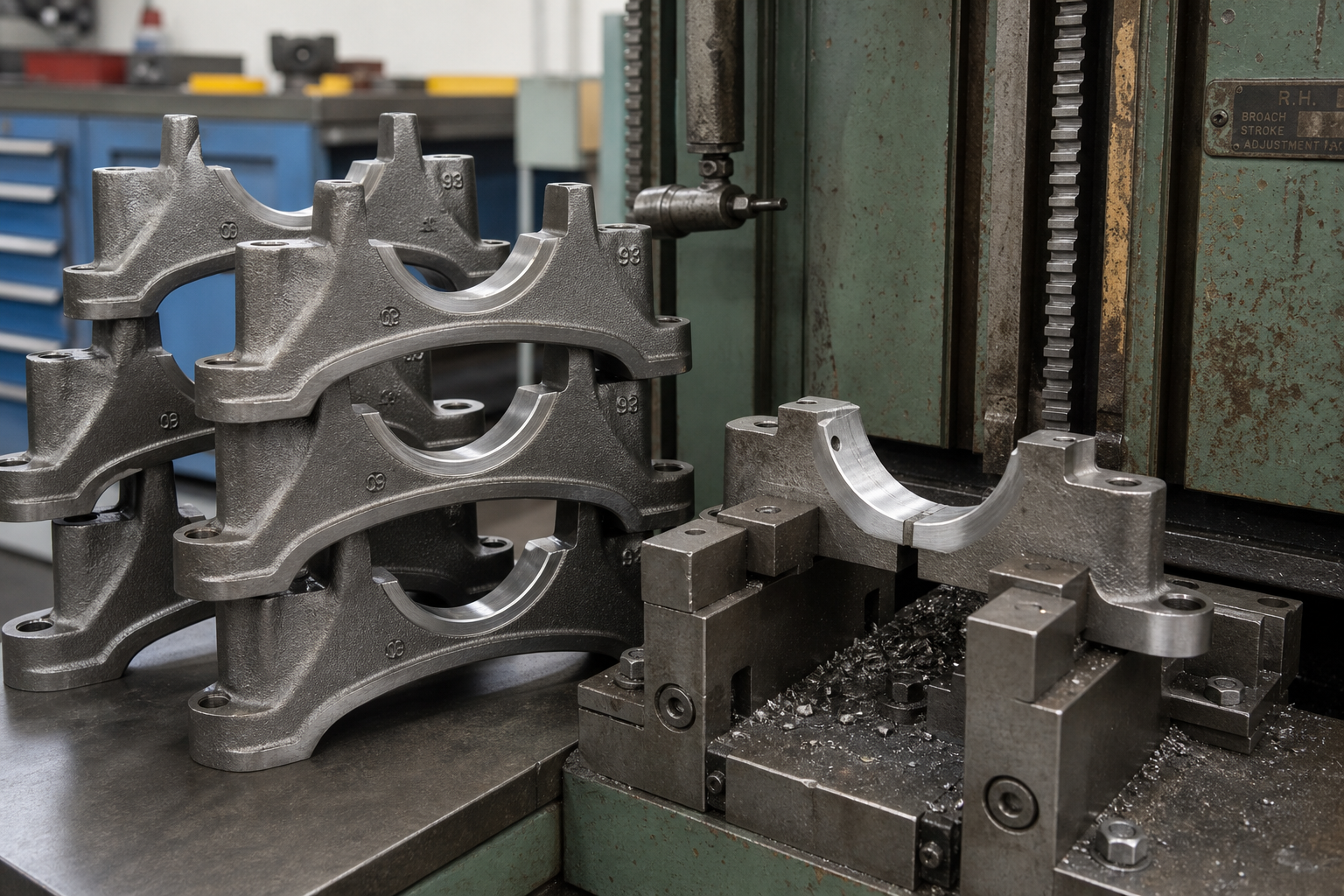
Boring and broaching are two internal machining processes whose names are close enough to trip people up, but they are not variations of the same idea. They use different tools, different motions, and different machines, and they answer different questions on a process plan. One finishes round holes that already exist; the other cuts shaped profiles through them.
If you remember only one sentence from this article, make it this one: boring uses a single-point tool that rotates and feeds to enlarge an existing hole and true up its roundness and concentricity, while broaching pulls or pushes a multi-tooth form tool in a straight line through the workpiece to cut a profile — a keyway, a spline, a hexagon, or a non-round hole. Everything else in this comparison follows from that difference.
Broaching vs. Boring at a Glance
Boring is a single-edge, continuously cutting process. A boring bar carrying one cutting edge (or a multi-insert boring head) enters a hole that has already been produced — by drilling, casting, forging, or flame cutting — and removes material as it rotates and feeds axially. The hole gets bigger, rounder, and straighter with each pass, and the final diameter is set by how far the cutting edge sits from the axis of rotation. Boring runs on lathes (where the workpiece rotates), and on boring mills and machining centers (where the tool rotates).
Broaching is a multi-tooth, progressive forming process. A broach is a long tool with dozens of cutting teeth arranged along its length, each tooth standing slightly taller or wider than the one before it. In one straight stroke — pushed or pulled through (or across) the part — the roughing teeth strip the bulk of the stock, the semi-finishing teeth bring the form close, and the finishing teeth stamp in the final profile. The geometry lives in the tool, not in the machine’s motion.
- You have a round hole that needs to be larger, rounder, or better aligned: that is boring.
- You need a keyway, spline, hexagon, square, or other profile inside a hole: that is broaching.
- One-off parts, small batches, frequent design changes: boring wins on flexibility.
- High volumes of one fixed design: broaching wins on consistency and cost per part.
- Hole position and concentricity are the problem: boring corrects it; broaching inherits it.
How Boring Works: One Cutting Edge, One Rotating Axis
The starting condition for boring is always an existing hole. A twist drill leaves a hole that is roughly right but rarely good enough for precision work — drills wander off line, produce a poor surface, and come in fixed sizes. Cast and forged bores are worse: tapered, oval, and off-center. Boring is the process that cleans all of this up. The boring bar extends into the cavity, and its single cutting edge takes a continuous, light cut along the bore wall as the tool and workpiece rotate relative to each other.
There are two basic machine configurations, and they matter for accuracy. On a lathe or vertical turning lathe, the workpiece rotates and the tool feeds: the bore is forced to conform to the workpiece’s axis of rotation, which is why bored holes on a lathe run so true to the turning axis. On a boring mill, jig borer, or machining center, the tool rotates while the part is clamped stationary on the table: the bore aligns to the spindle axis, and modern CNC control lets the programmer interpolate the toolpath and fine-tune the diameter on the machine.
The defining feature of boring is that the diameter is adjustable. Because size comes from the distance between the cutting edge and the axis of rotation — not from a fixed-diameter tool — a single boring bar with an adjustable or indexable head covers a wide range of hole sizes. Fine boring heads allow the edge to be nudged outward in small increments to dial in the final dimension. The trade-off is structural: a boring bar is a cantilever, and as the ratio of overhang to bar diameter grows, rigidity falls and chatter sets in, which is what limits boring in deep, small-diameter bores.
How Broaching Works: Many Teeth, One Straight Pass
Think of a broach as an entire roughing and finishing routine compressed into one tool. The front portion — the roughing teeth — removes the bulk of the material, with each tooth taking a slightly deeper bite than its predecessor; the height difference between consecutive teeth is the rise per tooth, the key variable that balances cutting load, tool life, and surface finish. The semi-finishing section brings the form close to final size, and the last few finishing teeth carry the exact geometry of the completed keyway, spline, or polygon and set the final dimensions in the same stroke. Our overview of what broaching is and how it works covers tool anatomy and machine types in detail.
On an internal broaching job, the tool starts with a smooth pilot section that enters the pre-machined hole and guides the broach concentric with it; the cutting teeth then follow, widening or profiling the hole as the machine pulls (or pushes) the tool through in a single stroke. The stroke is short in time — typically seconds — and there are no intermediate setups, no tool changes mid-cycle, and no dependence on machine kinematics for the form. What the machine must supply instead is force: broaching loads are high, which is why broaching machines are rated in tons of pull capacity.
Capability Boundary: Round Holes vs. Any Profile
Here the two processes diverge sharply. Boring can only produce rotationally symmetric surfaces — in practice, round holes. Within that restriction, its reach is enormous: on horizontal boring mills and heavy vertical lathes, bored diameters scale up into sizes that no fixed-size tool could ever touch, and the adjustable boring head means the same bar that finishes one bore can be reset for another. Boring can also correct a hole that was drilled off-position, because the cutter realigns the bore to the axis of rotation rather than following the existing hole.
Broaching cuts profiles that no rotating single-point tool can produce economically. Internal keyways, involute and straight-sided splines, hexagons and squares, irregular internal forms, and — on surface and pot-type machines — external profiles such as splined shafts and gear teeth are all classic broached features. The boundary on the broaching side is different in kind: each broach is built for one profile at one size. Change the spline’s minor diameter, the keyway width, or the number of teeth, and you need a different broach. And the work must physically allow a straight-through tool passage — a through-hole, or a cavity with room for the stroke — which is why deep blind holes are poor broaching candidates.
The two processes do overlap on one shape: the plain round hole. Round hole broaching is a standard, high-volume way to take a pre-drilled hole to a close tolerance in a single stroke, and our round broaching guide covers it in depth. As a rule of thumb, when the part mix changes often or volumes are low, boring a round hole on general-purpose equipment is the economical answer; when thousands of identical holes are on order, broaching them is faster and more consistent.
Accuracy: Position Correction vs. Profile Repeatability
Each process owns a different half of the accuracy story. Boring’s signature strength is correcting location and alignment. A drill that wanders, a cored hole that drifted in casting — boring fixes these, because the process re-establishes the bore around a true axis of rotation and can remove uneven amounts of stock from opposite walls to pull the hole back on center. Bored holes are also the standard route to concentricity between features machined in the same setup: bore, face, and turn in one clamping, and every surface shares one axis. Roundness and straightness of a bored hole are governed by the spindle, the workholding, and the boring bar’s rigidity — with a sound setup, boring delivers hole-quality grades suitable for bearing seats and other precision fits.
Broaching’s signature strength is profile consistency. The form is built into the finishing teeth, so the ten-thousandth spline is the same as the first, and a worn broach can be re-sharpened while preserving its geometry through many regrind cycles. What broaching cannot do is fix a hole that is in the wrong place: the broach follows the pilot and the pre-machined hole, so any positional error from upstream operations carries straight through to the finished part. The teeth shape the wall they find, wherever it is.
Put compactly: boring corrects what earlier operations got wrong; broaching repeats what the tool got right. That single line explains why precision shops use both, in that order.
Bore First, Broach Second: The Processes as a Team
The most common mistake in the “broaching vs. boring” framing is treating them as competitors for the same operation. On real process routings they usually appear in sequence, as upstream and downstream operations. For a large precision round hole, the chain runs: spot and drill undersize, then bore — first roughing the hole round and on-position, then finishing to size. The drill creates access; the boring bar creates accuracy.
For a hole that carries a keyway or spline, the chain extends one step: drill, then bore the hole to the exact pre-broaching dimension, then broach the keyway or spline through it. The bored hole serves two purposes — it establishes the finished minor diameter with the position and roundness the part requires, and it provides the true, predictable pilot surface that guides the broach. Broach manufacturers design the tool’s pilot and tooth spacing around the assumption that the pre-hole was machined correctly, which is why we treat hole preparation as half of a successful broaching job; see our guide to internal broaching part preparation for the stock allowance and pre-hole rules of thumb.
Seen this way, the choice between boring and broaching is rarely “either/or.” It is “which operation does this feature belong to, and what must the previous operation deliver to it?” Boring prepares and trues; broaching forms.
Machines, Tooling, and Cost: General-Purpose vs. Dedicated
Boring needs no dedicated machine. It runs on equipment most shops already own — engine lathes, vertical turning lathes, horizontal boring mills, jig borers, and CNC machining centers all bore holes every day. The tooling is equally general-purpose: boring bars and indexable or adjustable heads are catalog items at moderate cost, standard insert grades cover most workpiece materials, and one bar can serve many hole sizes. For job shops, prototypes, and low-to-medium volumes of changing part numbers, this flexibility is the whole economic argument.
Broaching usually means a broaching machine — vertical or horizontal, rated by tonnage and stroke length — because the process needs a long, powerful, precise linear pull that general-purpose machines cannot deliver. There are in-machine exceptions: rotary (wobble) broaching forms small hexagons and squares on lathes and mills, and some CNC machines accept broaching cycles for light work, but for serious depth and volume a dedicated machine remains the answer. Our internal broaching machine guide compares the machine styles, and because cutting loads drive everything, sizing the machine correctly starts with the force estimate — see how to calculate broaching machine tonnage before committing to a purchase.
The tooling economics run in opposite directions. Boring tooling is cheap, generic, and adjustable; the per-part cost is dominated by machine time, and multi-pass cycles are slower than a broach stroke. A broach is the mirror image: a custom-engineered, higher-cost tool dedicated to one feature on one part family — but it finishes that feature in a single seconds-long stroke, holds the profile across tens of thousands of parts between regrinds, and amortizes its cost to a fraction of a cent at volume. Small batches punish the broach; large batches reward it.
Broaching vs. Boring: Side-by-Side Comparison
| Dimension | Boring | Broaching |
|---|---|---|
| Workpiece feature | Enlarges and trues an existing round hole | Cuts a full profile through a prepared hole or across a surface |
| Profile capability | Round (rotationally symmetric) bores only | Keyways, splines, hexagons, squares, and nearly any internal or external form |
| Size flexibility | Adjustable edge position — one bar covers a diameter range; virtually no upper size limit on large machines | Fixed per tool — one broach, one profile at one size; a change means a new broach |
| Accuracy strength | Corrects hole position, concentricity, roundness, and alignment errors | Repeats the tool’s exact profile with outstanding part-to-part consistency |
| Cycle time and volume fit | Multi-pass cycles; strongest at prototypes, job-shop work, and low-to-medium volumes | Single seconds-long stroke; built for high-volume production of stable designs |
| Equipment | General-purpose: lathes, boring mills, jig borers, machining centers | Dedicated broaching machine (or rotary broaching for small forms on CNC machines) |
| Tooling cost | Low to moderate; catalog boring bars and inserts, shared across many jobs | High per tool; custom-engineered broaches amortized over production volume |
Two rows carry the most weight in practice. Profile capability is the hard boundary: no amount of process refinement lets a single-point rotating tool cut an internal spline, and no broach setup enjoys the diameter freedom of an adjustable boring head. And accuracy strength determines the sequence — because broaching cannot relocate a hole, precision parts are bored into position first and broached into profile second.
Stripped to a one-minute decision path: if the finished feature is a round hole, bore it when volumes are modest, the part mix varies, the hole is large, or its position needs correcting — and broach it (after drilling) when you are running high volumes of one design and want every hole identical. If the finished feature is anything other than round, the profile question is already settled, and your real decision is only how to prepare the hole: bored to the final minor diameter for precision work, or merely drilled for lower-tolerance parts. If the hole is both large and precision-located, plan on boring regardless, because nothing downstream will fix a hole machined in the wrong place.
The Bigger Map: Drilling, Boring, Reaming, and Broaching
Boring and broaching sit inside a four-process family that covers most internal machining, and the family portrait clarifies where each one belongs:
- Drilling creates the hole — fast stock removal to an approximate size and position.
- Boring enlarges and trues an existing hole, with adjustable size and the power to correct position.
- Reaming finishes a small-to-medium hole to a fixed size with a multi-edge tool — accurate and economical, but it cannot move a hole either.
- Broaching forms the non-round profile — keyway, spline, polygon — through a hole that earlier operations have prepared.
Notice the split inside the family: boring is the adjustable-size process with error-correcting authority, while reaming and broaching are fixed-size tooling processes whose accuracy flows from the tool itself. Reaming and broaching therefore make natural siblings to compare — same fixed-size logic, different jobs — and we cover that pairing in detail in broaching vs. reaming for internal holes. In a typical precision routing, all four appear in order: drill the hole, bore it true, ream or bore it to final diameter if it stays round, and broach the keyway or spline last.
Frequently Asked Questions
What are the disadvantages of broaching?
The main drawbacks: tooling is custom and costly, so any design change to the profile means ordering a new broach; cutting forces are high, demanding rigid workholding and a machine with sufficient tonnage; internal broaching generally requires a through-hole or enough clearance for the full stroke, which rules out many blind features; the process follows the pre-machined hole and cannot correct positional or alignment errors; and at low volumes the tooling investment is hard to amortize, making broaching a poor fit for one-off work.
What does broaching mean?
In machining, broaching is a metal-cutting process that uses a long, multi-toothed tool — the broach — with each successive tooth slightly larger than the one before it. The broach is pushed or pulled through or across the workpiece in a single straight pass, so the teeth progressively remove material and the final teeth deliver the finished profile in one stroke. The word also names the tool itself, and it appears in related forms such as rotary broaching, in which a tilted, rotating broach wobbles small polygonal forms into the work on a lathe or mill.
What does “boring” mean in machining?
In machining, boring is the process of enlarging and finishing a hole that already exists, using a single-point cutting tool on a boring bar that rotates and feeds axially. Its purpose is to bring the bore to an accurate size while improving roundness, straightness, and — critically — concentricity with the axis of rotation or other machined features. It is distinct from drilling, which creates the hole in the first place, and it has nothing to do with the tunneling sense of the word used in excavation and construction.
Broaching vs. boring, in one sentence: boring makes an existing round hole bigger, rounder, and correctly placed; broaching turns a prepared hole into a keyway, spline, or profile — and the most precise parts get both, in that order.
We design and build broaching machines and engineer the broaches that run in them, sized to your parts, materials, and annual volumes. If your routing includes internal splines, keyways, or non-round profiles at production quantities, send us the part drawings — we will recommend the machine tonnage, tooling configuration, and hole-preparation specification that makes the broaching step work the first time.