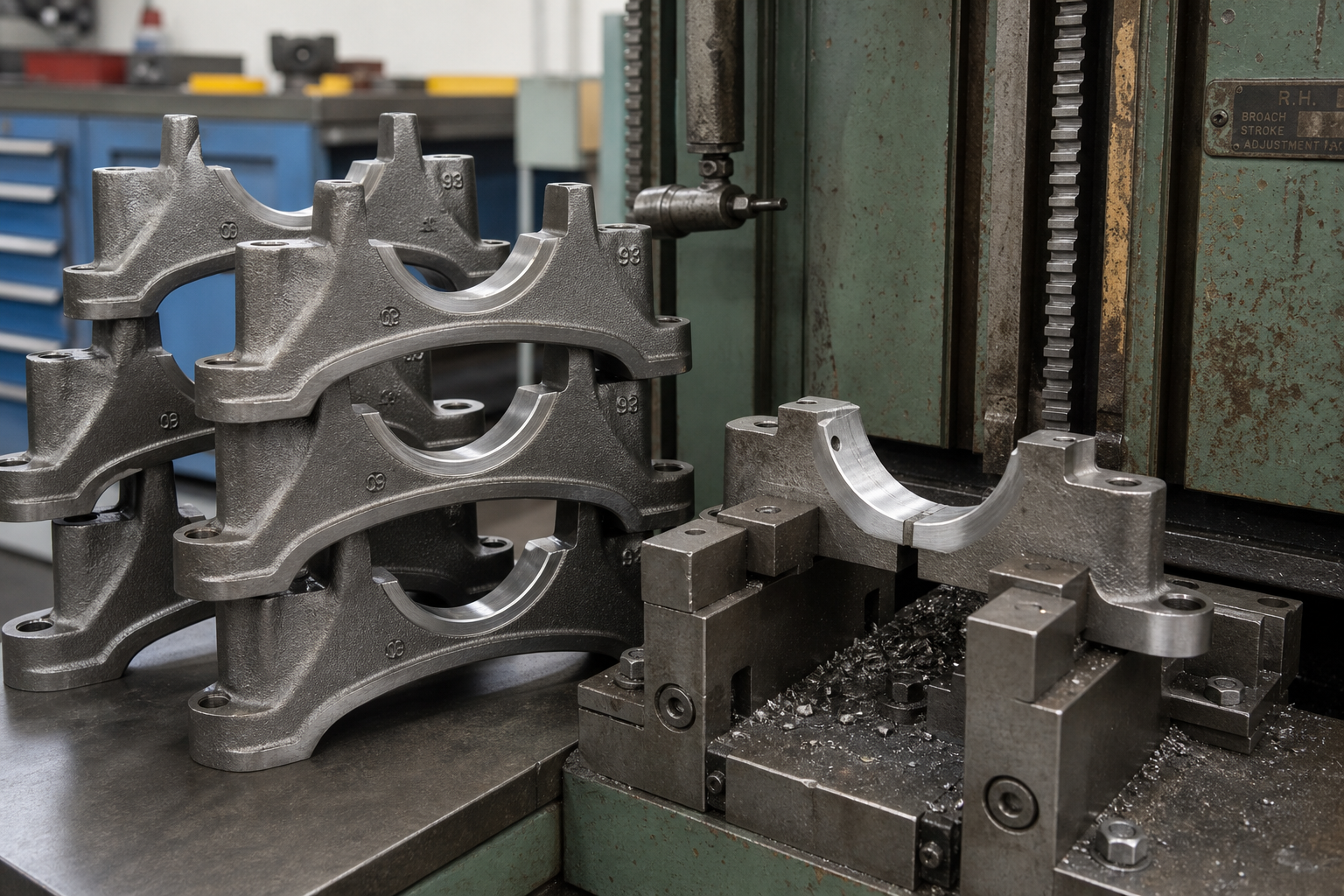
Engineering concept only. It is not a production drawing, cycle-time comparison, capability statement or claim that BroachingMach provides power-skiving equipment or service.
Choosing between broaching and power skiving for an internal gear or internal spline starts with the actual part definition, not with a general claim that one process is faster, cheaper or more accurate. Both process families can appear in internal-gear manufacturing discussions, but they require different tool, machine, workholding, programming and validation routes.
This guide is a drawing-led selection framework. It helps an engineering or sourcing team prepare the right questions for qualified process suppliers. It does not prescribe a universal process, publish gear grades, cycle times, cost ratios, tool life or acceptance limits. A BroachingMach review can address the broaching portion of a controlled drawing; power-skiving feasibility must be reviewed with a qualified alternative-process provider.
For broaching fundamentals, see Spline Broaching: The Complete Guide. For an internal transmission-gear route, see Transmission Gear Internal Spline Broaching.
The Short Answer
Broaching is commonly evaluated where a stable internal form, defined access, a suitable progressive tool route and repeat production justify a dedicated tool-and-machine system. Power skiving is commonly evaluated where synchronized cutting, cutter access and the alternative machine/control route are appropriate for the defined part family. Neither label alone decides the process.
Before comparing proposals, freeze the feature, blank stage, access, part-family variation, datum strategy, inspection plan and production pattern. If those inputs are incomplete, any comparison of cost or output is only an assumption.
1. Define the Exact Internal Feature
An “internal gear” can mean different features: an internal involute form, a spline-like connection, a ring feature, a shallow form or a geometry with restricted entry and exit. Similar names do not guarantee the same tool path or inspection task.
Record the controlled drawing/model revision and identify:
- the complete feature profile and usable axial length;
- entry, exit, shoulder and relief conditions;
- blank bore, stock condition and protected surfaces;
- material and heat-treatment position;
- required functional datums and mating relationship;
- quantity pattern, lot size and forecast stability;
- acceptance characteristics and the authority that interprets them.
Do not convert a generic internal-gear description into a promise that either process will reach the feature. The drawing and a qualified process review determine the feasible route.
2. Compare Process Systems, Not Marketing Labels

The motion map is non-dimensional. It illustrates different process-system questions, not cutting parameters, tooling geometry or a capability comparison.
A broaching route
For an internal progressive-broaching route, the review normally connects a prepared starting condition, a guided tool entry, a progressive tooth sequence, a machine stroke or pull arrangement, workholding, chip path and release inspection. The tool is dedicated to the defined feature family, so the drawing and expected change pattern matter before tooling is committed.
The most useful question is not “can a broach cut it?” It is whether the complete tool-machine-fixture-inspection route can be controlled for the specified access, material stage and production plan. Review the broach interface, guide/pilot assumptions, tool handling, chip clearance, lubrication, fixture reaction and inspection reference together.
A power-skiving route
Power skiving is a synchronized cutting process that requires its own machine, cutter, programming, workholding and process-development review. It should be evaluated as a separate qualified route, not described as a feature available from every gear machine or every supplier.
When considering it, ask the alternative-process supplier to evaluate the exact internal feature, accessibility, tool approach, blank state, machine kinematics, workholding and inspection plan. Do not use a broaching calculation or a competitor’s published example as a substitute for that review.
3. Access and Blank Condition Are Early Gates
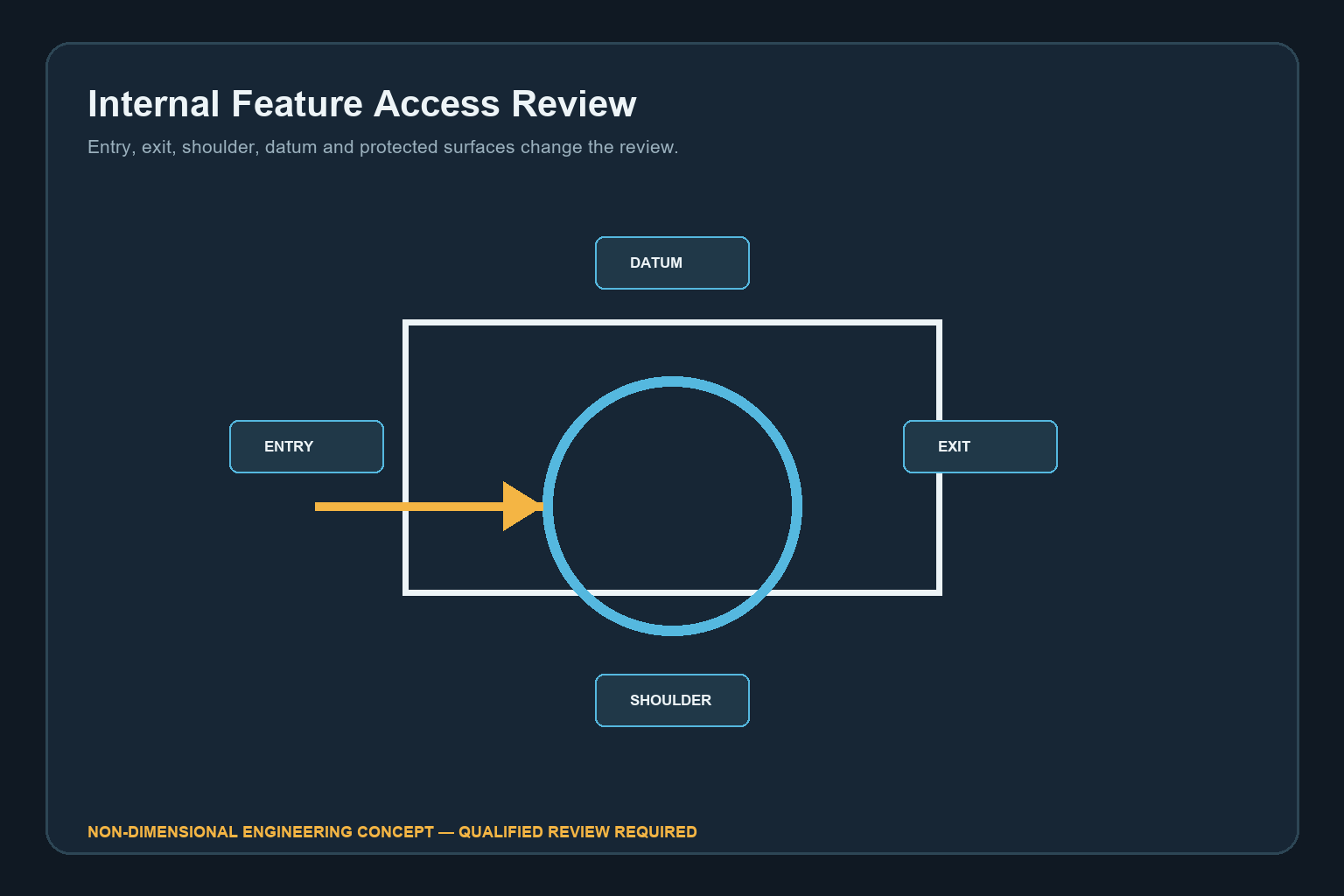
Conceptual access map. The controlled drawing defines the actual geometry, datum relationships and feature restrictions.
Access controls more than whether a cutting edge can enter a bore. A shoulder, interrupted surface, limited exit, thin wall, local relief, adjacent feature or protected face can change the candidate tool path and fixture design. Treat these as engineering gates before comparing commercial proposals.
The blank stage also matters. A review should state whether the feature is considered before or after heat treatment, finishing or another upstream operation. Hard vs Soft Broaching provides context for the material-stage discussion; it does not determine the correct process for an unreviewed gear.
Ask both process routes to identify what must be true before cutting begins: bore condition, runout/face relationship, stock distribution, hardness state, chip path and allowable deformation. If the proposed route changes the datum or part state, document how final acceptance will relate back to the drawing.
4. Volume and Variation Change the Business Case
The production pattern is as important as the nominal annual quantity. A high total volume spread over many unrelated profiles is different from a stable repeat family. A short program with frequent drawing changes is different from a long-lived feature with controlled revisions.
Build a planning record with:
- committed versus forecast demand;
- lot size, peaks and required recovery capacity;
- number of unique profiles and likely engineering changes;
- required launch, sample and approval timing;
- existing machine availability and opportunity cost;
- tooling lead-time, service and spare-tool plan;
- inspection capacity and escalation ownership.
Do not publish or rely on a universal break-even number. Cost depends on the particular tool, machine, fixture, setup, material, scrap, inspection, utilization and commercial terms. A robust decision compares comparable proposals under low, expected and high demand cases.
Include launch and recovery in the production pattern
The commercial decision also changes when a program is launching, moving between revisions or recovering from an interruption. Ask whether the route needs special spare tooling, a validated restart procedure, a backup supplier, extra first-article checks or a planned qualification window. These are not reasons to reject either process; they are part of the realistic capacity and continuity model.
Document the assumption rather than hiding it inside an annual-volume estimate. A route that looks attractive in steady-state may require a different support plan during launch or after a material, drawing or fixture change.
5. Tooling, Workholding and Datum Form One System
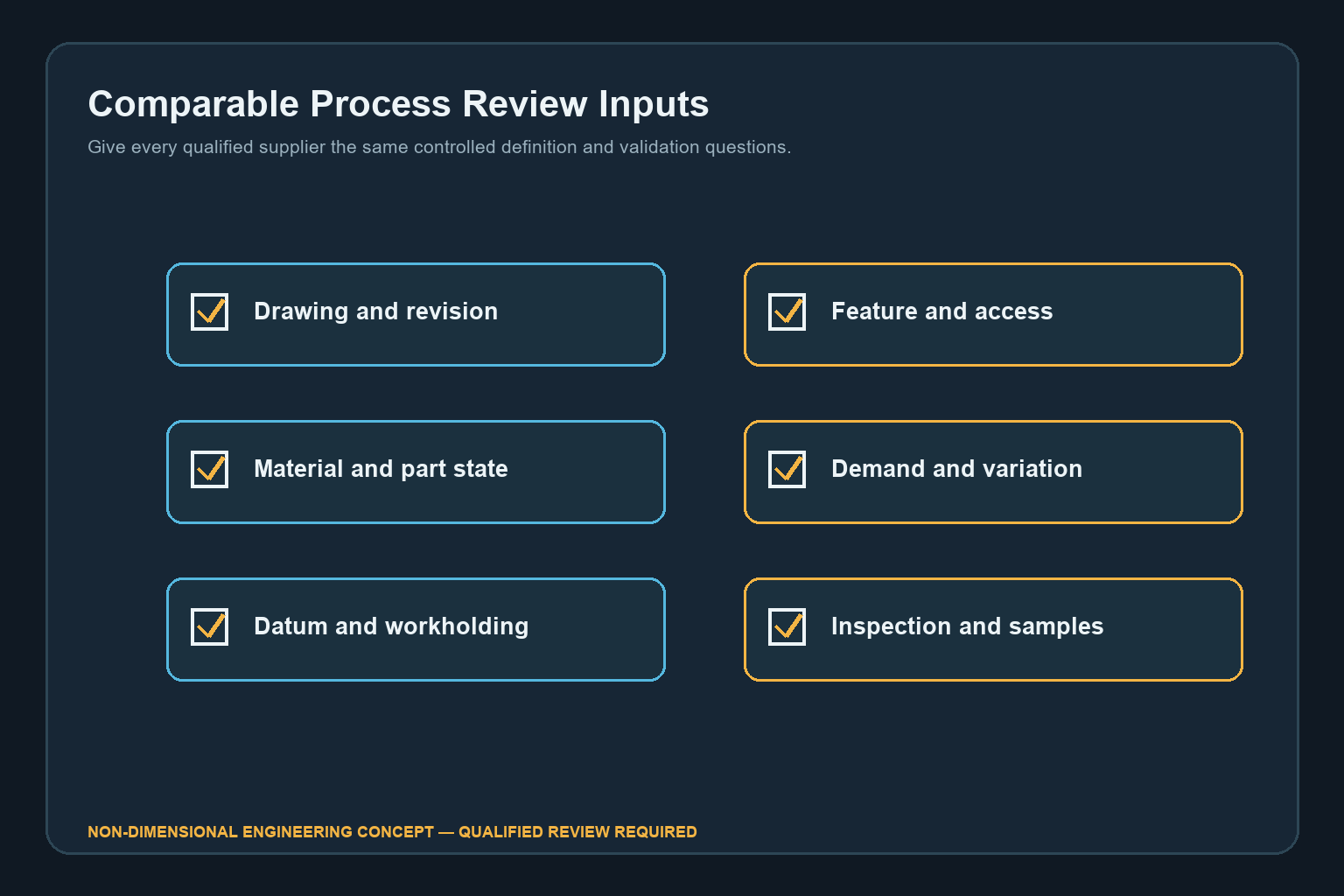
Conceptual checklist. It identifies review inputs and does not specify a broach, skiving cutter, machine, fixture or acceptance result.
For a broaching proposal, provide the complete drawing, material/stage, pre-machined condition, accessible entry/exit, required production pattern and inspection requirement. The review must connect the candidate broach and its interface to the machine stroke, fixture support, anti-rotation/load path, coolant/chip management and safe tool handling.
For an alternative skiving proposal, provide the same controlled definition and ask the qualified supplier to state its specific cutter, programming, machine and workholding assumptions. A generic process comparison cannot certify either setup.
The key question is whether both routes reference the same functional datums. A fixture may be adequate for cutting yet not establish the datum used for final inspection. Make this relationship explicit before a first article is interpreted.
6. Make Inspection Part of the Selection, Not a Final Step
Inspection must follow the released feature definition. Define which characteristics need functional acceptance, which need diagnostic evidence, what part state is required and how the relevant datum is established.
The Spline Broaching guide introduces the inspection role for a broached spline. For a selection decision, extend that discussion with a controlled agreement about what is accepted functionally, what must be measured diagnostically, and who owns the governing method. The drawing owner and qualified inspection authority decide the controlling method.
A useful first-article plan can include drawing review, controlled setup, agreed part state, defined functional check where applicable, diagnostic measurement where required and a reaction path for disagreement. It should not be replaced by a supplier’s generic accuracy statement.
Separate acceptance evidence from process evidence
Cutting-system evidence and part-acceptance evidence serve different purposes. Tool condition, setup confirmation, fixture cleanliness, coolant condition and controlled machine signals can support a stable process review. They do not independently prove that the final internal feature meets the released functional requirement. Conversely, an inspection result can show that the feature needs investigation without identifying a cutter, fixture, material or machine as the cause.
Keep these records connected but distinct. This makes a supplier comparison more useful: each route should explain how it establishes the part reference, what it records during the process and how it responds when the acceptance result and process signal do not agree.
7. Plan a Controlled Trial Rather Than a Headline Comparison
Where the feature is important enough to justify a process change, request a trial plan before approving a production route. The trial should not be reduced to showing that a single form can be cut once. It should identify the controlled blank condition, tooling and workholding assumptions, inspection method, normal operating sequence and the evidence needed for release.
A practical review should define:
- which drawing revision and material state the trial represents;
- which part features, datums and protected surfaces must be maintained;
- how the selected route will load, locate and react the cutting force;
- what first-off, in-process and final checks will be used;
- what tool, fixture, machine or material change requires re-evaluation;
- how an abnormal result is contained and investigated;
- what samples and records are retained for comparison.
This keeps a process-selection project from becoming a comparison of isolated demonstration results. It also protects against an apparently favorable route that later cannot be inspected, restarted or controlled at the intended production stage.
8. Request Comparable Reviews
To obtain a meaningful comparison, send each qualified supplier the same package:
- controlled drawing/model and revision;
- exact internal feature, entry/exit and protected zones;
- material, heat treatment and upstream process state;
- production forecast, lot pattern and profile variation;
- functional datums, mating information and inspection requirements;
- sample, first-article and change-control expectations;
- constraints for machine access, loading, utilities or automation.
Ask each supplier to identify its assumptions, unresolved risks, recommended trial scope and evidence required before release. Avoid requesting a single “best process” answer without the drawing-led inputs.
9. When Broaching Is the Route Being Reviewed
BroachingMach can review the broaching portion of a controlled internal-gear or internal-spline drawing. The review needs the actual feature definition, material/stage, access, expected production pattern, datum/fixture constraints and acceptance plan. It should result in a bounded engineering discussion—not an assumption that a competing skiving route, cost or output has been verified.
For broader machine-selection inputs, see How to Choose the Right Broaching Machine. For tooling inputs, see Broach Tooling Design.
Frequently Asked Questions
Is power skiving always more flexible than broaching?
No universal conclusion is safe. Flexibility depends on the defined feature family, equipment, cutter/tooling route, workholding, programming, capacity and change-control requirements.
Is broaching always better for high volume?
No. Stable repeat production may make a dedicated broaching route worth evaluating, but the decision still requires the real drawing, tooling, machine, fixture, inspection and commercial model.
Can this article select a process for my part?
No. It prepares the input package for qualified suppliers. Final selection requires a drawing-led feasibility review and a controlled validation plan.
Should a comparison include gear grinding, hobbing or shaping too?
Only when the actual feature makes those alternatives relevant. A broad method table can hide an access, blank-stage or feature-definition difference. Start with the two routes that are genuinely being considered for the same released internal feature, then add another process only when a qualified review confirms it is comparable.
What happens when the drawing changes after tooling has been reviewed?
Treat the revision as a new engineering input. Recheck the changed geometry, access, material state, datum, acceptance requirement and expected production pattern. Do not assume a prior proposal or trial remains valid merely because the part name has not changed.
Does BroachingMach provide power skiving?
This article does not make that claim. Contact BroachingMach for a review of the broaching portion of your drawing; evaluate power-skiving capability directly with a qualified alternative-process provider.
Start With the Controlled Drawing
The useful comparison is not “broaching versus power skiving” in the abstract. It is a controlled internal feature, at a defined material stage, with known access, demand, datums, fixture constraints and inspection requirements. Send that package through the contact page to begin a BroachingMach review for the broaching portion of the route.