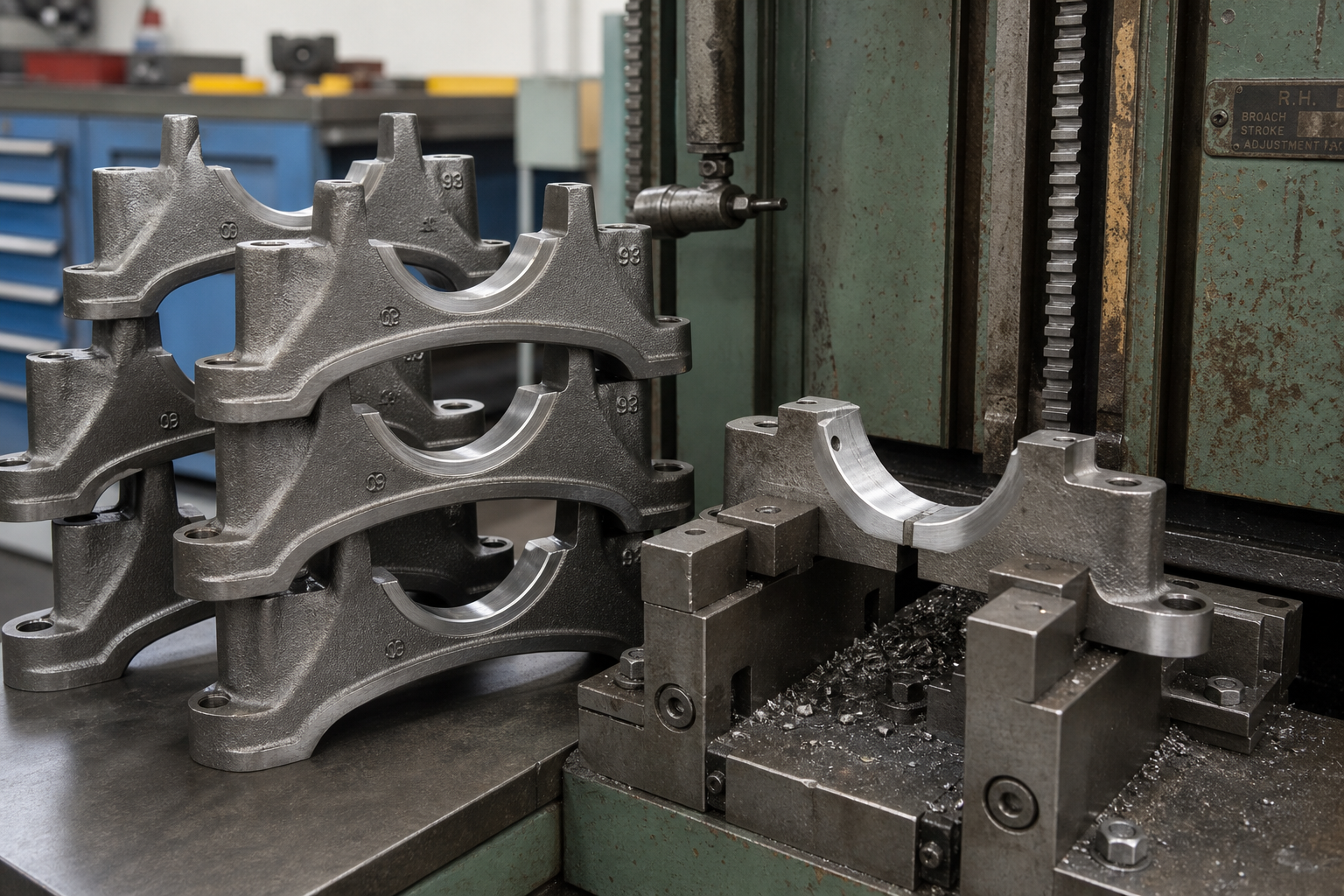
Original non-dimensional engineering concept. It is not a customer part, tooling specification or claim that BroachingMach supplies every method shown.
An internal keyway is not one machining problem. A through keyway in a guided bore, a blind keyway at the bottom of a bore, and a feature beside a shoulder can each need a different route review. Start with what the released drawing identifies: access, material stage, functional datum, fixture support and inspection method. Do not begin with a generic claim that one process is always faster, cheaper or more accurate.
This guide is a selection map for progressive broaching, keyseating, slotting, milling and EDM. It helps define a real route review, then directs the reader to the provider responsible for the selected method. It does not claim that BroachingMach offers every alternative.
The Short Answer
For a stable through keyway, a progressive-broaching route may be one candidate for review when the drawing and responsible provider confirm a workable path. A blind end, restricted exit, changing part family or special access condition may require a different route review. This page does not select keyseating, slotting, milling or EDM from a generic feature label.
Mark the exact keyway, related bore/face datum, through or blind condition, material and process stage, pre-machined opening, protected surfaces and acceptance method. A generic keyway label cannot supply those facts.
For broaching fundamentals, start with Keyway Broaching: The Complete Guide. A dedicated progressive-broaching versus keyseating comparison is maintained as a separate editorial route; it is not repeated in this method map.
Start with Access: Through, Blind or Interrupted

The access map screens geometry only. It does not determine a process, tolerance, cycle time, machine size or commercial capability.
Through features
A through condition may present an entry and far-face exit that a conventional progressive-broaching route can review. The drawing and responsible provider still need to confirm guidance, tool connection, chip route, fixture support and handling. Through access does not mean that a particular tool or machine is automatically suitable.
Milling, slotting or keyseating may also be considered for through access. Their review must define cutter or tool reach, workholding, clearance, chip evacuation and the functional datum. Compare the full controlled route, not only the cutting motion.
Blind features
A blind keyway is not a short through keyway. Its end condition changes the tool path, relief, retraction, chip control and inspection review. Start with Blind Keyway Broaching rather than assuming a standard through-broach sequence applies.
Alternative methods can be candidates in some blind conditions, but each has its own approach, tool path, holding and acceptance questions. The drawing must show the end condition and protected surfaces before a method is selected.
Interrupted or obstructed features
Cross holes, shoulders, thin walls, nearby splines and finished faces can change what is physically possible. Record every obstruction. A route must reach the feature, control the part and preserve the specified datum relationship without damaging protected areas.
Screen Each Method Family

Screening matrix only. It does not state universal cost, quantity, finish, tolerance or method capability.
Progressive broaching
Progressive broaching is reviewed as a purpose-designed tool, workpiece, machine, fixture and inspection system. For a conventional candidate route, the drawing review should ask whether entry, guidance, travel/exit and chip handling can be addressed. This is a screening question, not a universal capability statement.
The nominal keyway size is not enough. Material state, bore condition, related datum, tool interface, support and acceptance method can change the decision. Broaching-versus-milling is a separate, detailed route review; this page intentionally retains only the initial selection screen.
Keyseating and slotting
Keyseating and slotting are alternative reciprocating or programmed route families. They should be reviewed with their own tooling and machine providers, particularly where a conventional progressive path is constrained by access, end condition, revision flexibility or setup context. This article does not claim that BroachingMach supplies a keyseater, slotter or shaping service.
The review should record cut direction, approach, clearance, workholding reference, protected surfaces and inspection relationship. “Blind” must be explicit, rather than treated as a minor variation.
Milling
For a milling candidate, the responsible provider must review cutter access, part holding, overhang, chip handling and datum preservation against the released drawing. Its suitability cannot be selected from a generic quantity threshold. Use the linked broaching-versus-milling guide for the detailed two-route decision rather than repeating it here.
EDM
If EDM remains a candidate, the EDM provider must confirm material, access, workholding and the route-specific inspection requirements against the released drawing. This page does not define EDM eligibility or process details, and does not claim EDM equipment, programming, electrodes or service from BroachingMach.
Broaching-versus-EDM is a separate route review. Validate any EDM route with the provider responsible for that process rather than treating this method map as EDM process instruction.
Select from the Functional Datum
The keyway is normally related to a bore, face or other functional feature. A visually plausible slot is not automatically acceptable. Define how the fixture locates and supports the part from the functional reference scheme, then define how the completed keyway will be assessed from that same scheme.
This matters for every method. It prevents a route from being chosen before anyone has defined what correct location, form and functional relationship mean for the part. The inspection plan should be selected from the drawing, not from a process label.
Tooling Commitment and Part-Family Change
A progressive broach is designed around the specified feature. Changes in width, depth, corners, material stage, bore condition or datum can require a new tool/process review. Alternative methods also have commitments: cutter or tool access, program, holder, workholding and inspection need to be stable enough for the actual feature.
Record expected revisions and variants before selecting a route. Do not substitute an assumed high-volume/low-volume threshold for geometry, change-control and validation planning.
Build a Route Review That Can Be Repeated
The first review should create a small, traceable record. Identify the drawing revision, the named keyway, the bore/face or other functional datum, the blank condition, material stage and any protected surfaces. Record the possible route families separately rather than writing “machining method TBD.” That makes it clear which questions still need answers before a decision is treated as reliable.
For a potential broaching route, record the intended entry, guide or bushing concept, tool travel, chip path, exit and workpiece support. For any alternative route, record the provider's required approach, clearance, holding and acceptance inputs separately. These are screening inputs, not process settings.
Keep feature access separate from commercial assumptions
Quantity, delivery timing and tooling budget can matter to a route decision, but they should not hide an access problem. A process may look attractive commercially while remaining impossible because the tool cannot enter, the end condition cannot be made, the part cannot be supported or the inspection reference cannot be preserved. Resolve geometry and acceptance first, then make a commercial review with the responsible supplier.
The reverse problem also occurs. A route may be physically plausible but require a tool, fixture, program, electrode or inspection plan that is not validated for the actual family of parts. Treat feasibility as the start of the review, not as release approval.
Preserve the part condition used for the review
An internal keyway can be assessed at different points in a manufacturing route: before heat treatment, after a bore operation, after a related feature is created or after another finishing stage. Those states are not interchangeable. Preserve the material and blank condition used to screen a method. If a later drawing revision changes the bore, datum, wall thickness, material stage or protected surface, return to the feature-access review rather than carrying forward an old assumption.
Coordinate Broaching with the Rest of the Process Plan
Broaching is one operation within a larger part route. The process planner should identify operations that create the opening, locating references or protected surfaces before the cut, and operations that could change the functional relationship after it. This does not mean every operation must be described in a marketing article; it means that the keyway review should name the interfaces that affect method selection.
Before the keyway cut
Confirm whether the bore or opening is complete, whether the locating face exists, whether burrs or temporary supports could affect guidance, and whether material condition matches the proposed route. A practical review should also identify how the workpiece is presented to the fixture and where chips can leave the feature. These questions help distinguish a controlled route from a generic example.
After the keyway cut
Confirm which surfaces must be protected in handling and which inspection evidence is required before another operation changes the part condition. If a later heat-treatment or finishing operation changes the feature relationship, the inspection plan must state when the keyway is measured and from what reference. A well-defined sequence avoids evaluating the right slot at the wrong stage.
Use the Method Map Without Making Unsupported Claims
This article makes no promise about price, cycle time, tolerance, finish, machine architecture or availability. Such outcomes depend on the real part and the provider’s actual process. The method map is useful precisely because it identifies the facts needed before such claims can be evaluated.
When a non-broaching route remains a candidate, retain the relevant drawing data and review it with that method’s provider. For a potential BroachingMach broaching route, provide the controlled drawing and application inputs for review of the broaching-specific feature path, tool, machine, fixture and inspection questions. Keeping those responsibilities explicit prevents a neutral educational guide from being mistaken for a claim to supply every process.
Inspection Comes Before Release

The checklist prepares an engineering review. It is not a quotation, machine recommendation, quality certificate or production-release approval.
Choose acceptance from the drawing and feature. Depending on the requirement, it may use a functional method, dimensional check, profile assessment or another controlled procedure. This guide does not imply that BroachingMach supplies gauges, calibration or coordinate-measurement services.
Use this route-review sequence:
- Mark the exact keyway and functional bore/face datum.
- State through, blind or interrupted access and all protected zones.
- Record material, process stage and blank/opening condition; if EDM is considered, request its provider-defined input list.
- Screen the physical path with the provider responsible for each candidate route.
- Define fixture location, support and anti-rotation from the functional reference scheme.
- Record expected revisions and which method commitments would change.
- Choose the drawing-led inspection method before treating a route as released.
- Validate the selected route with the provider that actually supplies that process.
Common Mistakes
Selecting from a method name alone
Broaching, keyseating, slotting, milling and EDM are not interchangeable names for cutting a slot. Each has a distinct access, tool-path, fixture and inspection discussion.
Treating a blind feature as through access
A blind end condition changes the route. Show it on the drawing and use a dedicated review rather than forcing a standard sequence onto it.
Treating one material or access input as a complete EDM decision
One material or access input does not resolve the EDM route. The responsible provider must review the complete drawing, holding, route and acceptance questions.
Ignoring the datum
Slot width or visual appearance does not prove the functional relation required for assembly. Tie fixture location and inspection to the drawing datum.
When to Request a Broaching Review
For a BroachingMach review of a potential broaching route, provide the controlled drawing, material and stage, pre-machined opening, access/exit condition, functional datums, fixture constraints, expected changes and inspection method. Review any alternative route separately with the provider responsible for it.
FAQ
Which internal keyway machining method is best?
There is no universal best method. Start with feature access, end condition, material, datum, fixture and inspection requirements.
Can a blind internal keyway be broached?
It requires a dedicated blind-feature review. End condition, relief, retraction, chip route, tooling and inspection must be defined for the actual part.
Does this mean BroachingMach offers EDM, milling, slotting or keyseating?
No. This is an educational selection map. It supports only a potential BroachingMach discussion of a broaching route.
Editorial Scope Note
Current search results and public competitor pages establish that engineers compare internal-keyway method families. They do not establish BroachingMach capability, cost, tolerance, cycle time, machine availability or results for the alternative methods. This page is a drawing-led screening guide; final method selection belongs to the engineering review of the actual part and the responsible process provider.