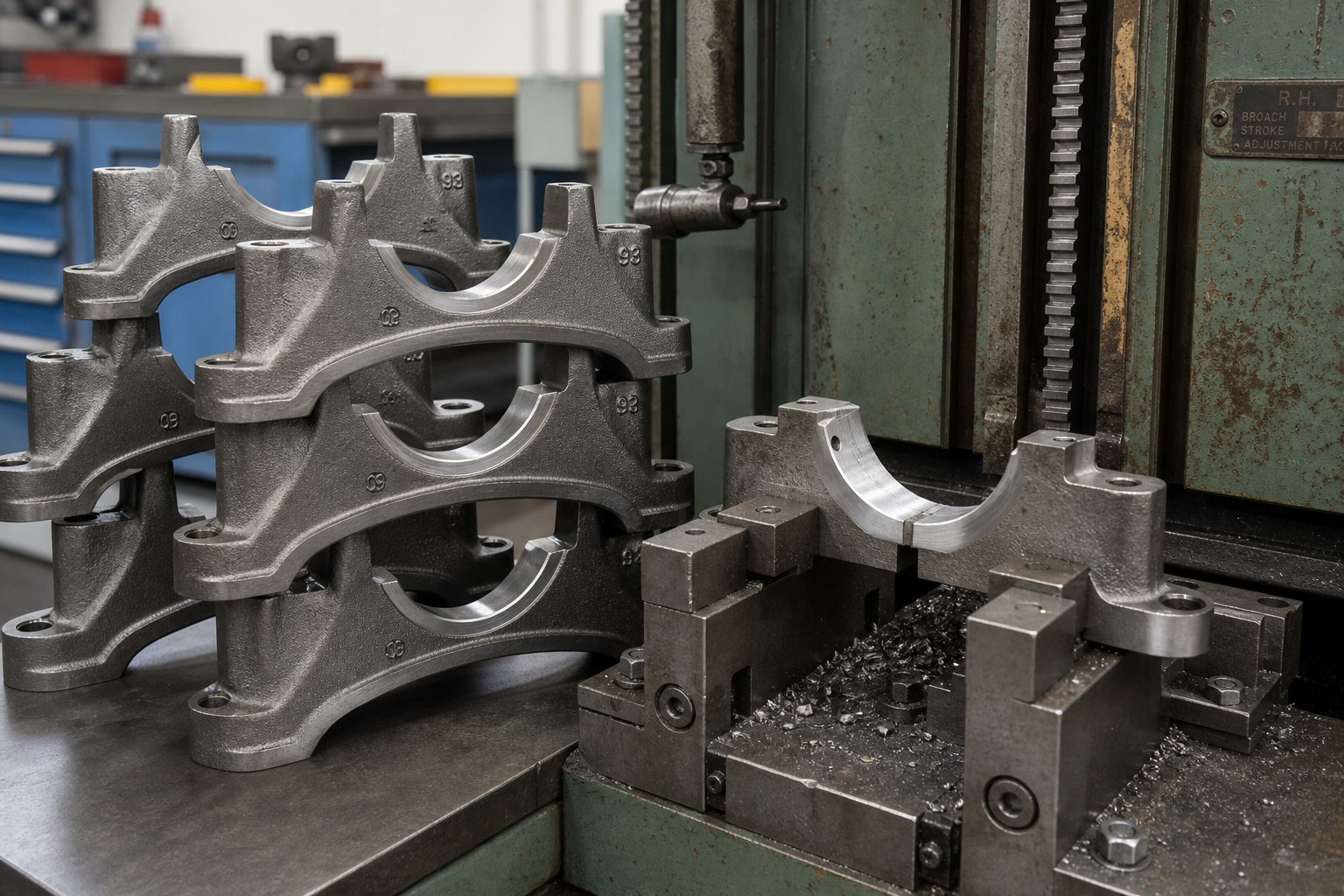
The main advantage of broaching over the shaping process is output without giving up accuracy: a broach is a multi-tooth cutting tool that roughs, semi-finishes and finishes a surface in a single stroke, while a shaper removes metal one stroke at a time with a single-point tool and returns idle after every cut. This guide compares the two processes — how each one cuts, where broaching gains its edge, where shaping still wins, and how to choose between them for a given part and volume.
목차
- What Is the Broaching Process?
- What Is the Shaping Process?
- Broaching vs Shaping: The Main Advantage
- Where Broaching Gains the Edge
- Where Shaping Still Wins
- Typical Applications of Each Process
- How to Choose Between Broaching and Shaping
- 자주 묻는 질문
- Talk to Us About Your Broaching Work
- References
What Is the Broaching Process?
Broaching removes material with a long, multi-toothed cutter — the broach — that is pulled or pushed through, or past, the workpiece in one pass. In Cutting Tool Applications, George Schneider defines the process in terms a shaper hand already knows: "The broaching process, similar to shaping with multiple teeth, is used to machine internal and external surfaces such as holes of circular, square, or irregular shapes, keyways and teeth of internal gears." The tool itself is the second half of the definition: "A broach is a long multi-tooth cutting tool with successively deeper cuts. Each tooth removes a predetermined amount of material in a predetermined location."
The teeth are the whole idea. Along the length of the tool they are divided into three groups — roughing, semi-finishing and finishing — so one tool covers the whole operation: "rough, semi-finish and finish cutting teeth combined in one tool or string of tools," and "a broach tool frequently can finish machine a rough surface in a single stroke." The finishing teeth are all the same size, so the last teeth that set the final dimension all cut to one setting.
Internal broaching needs a starting hole — "Internal broaching requires a starting hole or opening in the workpiece so the broaching tool can be inserted" — and the form must be open in the cutting direction: "almost any irregular cross-section can be broached as long as all surfaces of the section remain parallel to the direction of broach travel." External, or surface, broaching passes the tool over the outside of the part instead. If the process is new to you, start with our overview of what broaching is; if you specify tooling, see our guide to broach design.
What Is the Shaping Process?
Shaping cuts with a single-point tool that reciprocates across the work — planing on a machine small enough to move the tool instead of the table. Franklin D. Jones, in Operation of Machine Tools (Machinery's Reference Series No. 93), describes the machine's scope: "The shaper, like the planer, is used principally for producing flat surfaces, but it is intended for smaller work than is ordinarily done on a planer." The kinematics are the reverse of the planer's: "the tool moves back and forth across the work … which remains stationary, except for a slight feeding movement for each stroke." The ram is driven by a crank mechanism inside the column, and both the stroke length and the stroke position are adjustable while the machine runs.
Every cutting stroke is followed by a return stroke that cuts nothing. Writing about the planer — the same reciprocating principle, with the table moving instead of the tool — Jones records that on the return "the planing tool glides back over the work to the starting point for a new cut," and that the table "is returned quickly after the cutting stroke in order to reduce the idle time that elapses between the end of one cut and the beginning of the next." A surface is generated stroke by stroke: cut, return, feed over a little, cut again — and depth is taken in successive passes until the surface is finished.
The tooling is simple and cheap. Shaper tools "are similar in form to planer tools, though smaller," one blank grinds into many shapes, the vise swivels to any angular position, and the tool head sets to any angle for angular surfaces. One machine, one cheap tool, an assortment of flat and angled faces.
Broaching vs Shaping: The Main Advantage
Put the two definitions side by side and the advantage names itself. A shaper's single-point tool takes one depth of cut, one narrow pass at a time, with an idle return stroke after every cut. A broach stacks the whole sequence of passes into one tool: each successive tooth takes a slightly deeper, predetermined cut, and the finishing teeth bring the surface to size at the end of the same stroke. Schneider's comparison is direct: "Broaching competes favorably with other processes, such as boring, milling, shaping and reaming. Although broaches tend to be expensive, the cost is justified because of their use for high-production runs."
The boundary between the two processes was drawn a century ago, and it is still exact. The 1918 engineering book Broaches and Broaching (Ethan Viall) classifies by tool and pass count, not by machine: a hole or recess worked out "in a number of cuts, by means of a single-point tool" — even on a shaper — "is slotting," while work "finished to certain sizes or shapes by the use of tools having a number of teeth of increasing size is broaching, no matter whether the tools are pushed or pulled through." Schneider says the same thing from the tool side: a broach is "like a single point tool with many 'points,' each of which cuts like a flat-ended shaper tool."
So the main advantage of broaching over the shaping process is this: the total cutting work for a feature — roughing, semi-finishing and finishing — is compressed into one stroke of one tool. Output, consistency and workholding advantages all follow from that single-stroke compression.
Key takeaways
- Broaching finishes a surface in one stroke because roughing, semi-finishing and finishing teeth are combined in one tool; shaping removes metal stroke by stroke with a single-point tool and an idle return stroke between cuts.
- The single stroke is what drives broaching's advantages in output, consistency and workholding.
- Shaping keeps the edge on tooling cost and flexibility — one cheap tool and an adjustable stroke cover many different surfaces.
Where Broaching Gains the Edge
Output. Because the entire cut happens in one stroke, cycle time collapses. Viall's 1918 account of production practice records that "as a rule the keyway is finished in one operation" in about a minute, and that "sometimes three or four pieces can be done in one operation, thus increasing the usual output that many times." Those figures describe 1918 machines, but the mechanism — one stroke instead of dozens of passes — is unchanged. Modern machine capability widens the gap further. Schneider lists vertical internal pull-down machines with "speeds of up to 80 FPM," horizontal internal machines with "cutting speeds generally limited to less than 40 FPM," hydraulic horizontal surface machines with "normal cutting speeds of 100 FPM," and electromechanical horizontal surface machines with "cutting speeds, in some instances, of over 300 FPM."
Accuracy and consistency. "Broaching can produce parts with very good surface finish and dimensional accuracy," Schneider writes — and the mechanism is built into the tool rather than depending on the operator. Every finishing tooth is the same size, and tooth pitch is "calculated so that, preferably, two or more teeth cut simultaneously. This prevents the tool from drifting or chattering." On a shaper, finish and accuracy depend on the tool, the feed and the machine's rigidity; Jones observes that "broad tools and wide feeds cannot be used to the same extent as in planer work, because the shaper is less rigid and, consequently, there is a greater tendency for the tool to chatter."
Workholding. On many internal jobs the broach does its own clamping. Viall: "the action of the broach itself serves as a clamping medium and often nothing else is needed to hold the work in place," and "in a great many cases the operation of broaching may be finished in the time ordinarily taken to chuck the piece." For an ordinary keyway, "no clamps or setting devices are needed other than a guide bushing and in many instances this is dispensed with." A shaper setup, by contrast, clamps every part for every cut, and setup time is part of every job.
Scrap and repeatability. With a fixed tool and a fixed stroke there is little to vary from part to part. Viall reports one early automobile plant that "kept account of 10,000 pieces of all kinds, and found that less than 1 per cent, were spoiled in the process, a record not approached by any other method of machining" — a 1918 figure, cited here as history rather than as a modern guarantee. The source of the consistency, though, is structural: one tool, one stroke, one result.
Where Shaping Still Wins
The comparison is not one-sided, and for many jobs shaping is the more sensible buy.
Tooling cost and lead time. A broach is a precision, form-specific tool — each one ground for one feature size and shape — and Schneider's caveat is the mirror of his praise: broaches "tend to be expensive," justified only "because of their use for high-production runs." A shaper uses single-point tooling that any toolroom grinds from stock blanks at a fraction of the cost of a broach.
Flexibility. One shaper covers flat faces, angular faces (the tool head sets to any angle), vertical surfaces (the tool block swivels), and odd one-off castings held in a swiveling vise. Jones's worked examples — a small engine slide valve face, an odd-shaped casting bolted to the side of the table — are exactly the varied, low-volume work that a dedicated broaching tool could never justify.
Feature geometry. Internal broaching requires a starting hole and a form that is open in the cutting direction. Blind pockets, stepped internal forms and enclosed slots are outside broaching's envelope; Viall classifies single-point work on such features as slotting, and Jones assigns keyways in hubs and similar enclosed work to the vertical slotting machine, "for finishing slots or other enclosed parts" that horizontal machines cannot reach.
Machine investment. A pull-broaching machine is a dedicated asset. Viall describes the regular broaching machine as "built especially for the purpose and unsuited to any other use." A shaper or planer, even an old one, remains a general-purpose machine tool that earns its floor space across many different jobs.
Typical Applications of Each Process
Where broaching is standard practice. Keyways: "almost all keyways in machine tools and parts are cut by a keyway broach," Schneider writes — our keyway broaching guide covers the tooling and practice in detail. Internal forms: splines and internal gear teeth are the classic single-stroke features. Automotive surface work: "automobile cylinder blocks and heads are often faced flat by this method," and horizontal machines are used exclusively for roughing and finishing engine blocks on some lines. Turn-broaching: "an efficient method for machining steel and nodular cast iron crankshafts." Of the installed base, Schneider counts "about 60 percent" vertical machines and "about 40 percent" horizontal — a process concentrated where volume lives. For machine configurations see what is a broaching machine; for neighboring comparisons see broaching vs drilling 그리고 broaching vs hobbing.
Where shaping is standard practice. Flat and angular faces on parts too varied or too few to tool up for; repair and maintenance machining; machine-tool builder work on castings. Jones's shaper chapters are a catalog of this class of work — valve faces, bracket faces, one-off castings — the economical choice when the same surface will not be cut thousands of times.
How to Choose Between Broaching and Shaping
The decision usually resolves on four questions.
- Volume. High, recurring volume amortizes an expensive, dedicated broach; one-off and small-batch work does not. Schneider's cost logic points both ways at once — expensive tooling, justified by high-production runs — which is why the volume question comes first.
- Feature type. An internal form that runs through the part — keyway, spline, internal gear, polygon — is broaching's home ground. A blind or stepped internal form is not, and an open flat or angular face is shaping's.
- Tolerance and finish. When the print calls for a close, repeatable finish on a production feature, the single-stroke, all-finishing-teeth-equal structure of broaching holds it without depending on operator skill; shaping reaches good finish, but more slowly and with more attention to tool and feed.
- Tooling budget and existing equipment. A shop with a shaper and a toolroom grinds a cutter today; a shop with a recurring high-volume program orders a broach and a machine to pull it.
| Factor | 브로칭 | 셰이핑 |
|---|---|---|
| Stock removal | One stroke of a multi-tooth tool | Stroke by stroke, single-point tool |
| Idle time | Load, stroke, unload | Return stroke after every cut |
| Tooling | Expensive, form-specific broach | Cheap, regrindable single-point tools |
| Internal forms | Through forms with a starting hole | Limited (slotting machine for enclosed work) |
| Best volume | High volume, repeating features | Small batches, varied surfaces, repairs |
| Typical features | Keyways, splines, internal gears, block faces | Flat, angular and vertical faces, one-off castings |
자주 묻는 질문
Can broaching work be done on a shaper?
Yes, in a hybrid form, when no broaching machine is available. Viall devotes a section to exactly this practice: "shapers, planers, or other machines are sometimes fitted up for doing special broaching jobs where no regular machine is available." One shop he describes cut keyways in small steel gears with a broach-like blade about 4 ft long, drawn through the gear by the successive strokes of the ram — each tooth removing about 0.002 in. of metal, the stroke set to 12 in., and roughly eight strokes needed to pull a 4 ft cutter through on the short stroke. The tool is still a broach (multi-tooth, increasing size); the shaper just supplies the pull, far more slowly than a broaching machine would.
Is slotting the same as broaching?
No. Viall's boundary is the tool and the pass count: a hole or recess worked out "in a number of cuts, by means of a single-point tool" is slotting, while work done with tools "having a number of teeth of increasing size" in one pass is broaching. Jones describes the slotting machine as the vertical, vertically-reciprocating machine used for cutting keyways in the hubs of flywheels and pulleys and other enclosed work.
Talk to Us About Your Broaching Work
Choosing between broaching and shaping is, in the end, a volume-and-feature calculation — and when the volume is there, broaching's single-stroke advantage compounds into every part you make. We run production broaching for keyways, splines and internal forms, and we will tell you plainly whether a part belongs on a broaching machine at all. Contact our engineering team with your part drawing and annual volumes, and we will review the options with you.
References
- Cutting Tool Applications, Chapter 14: Broaches and Broaching — Schneider; broaching defined as shaping with multiple teeth, rough/semi-finish/finish teeth combined in one tool, single-stroke finishing, competition with boring, milling, shaping and reaming, broach expense justified by high-production runs, starting-hole and parallel-surface requirements, finishing teeth all the same size, the two-or-more-teeth pitch rule, keyway broaches, automotive surface broaching, turn-broaching, and machine cutting speeds in FPM.
- Broaches and Broaching (Ethan Viall, McGraw-Hill, 1918) — Viall; the broaching/slotting boundary by tool and pass count, the broach as its own clamping medium, keyways finished in one operation with three or four pieces stacked, the 10,000-piece scrap tally of an early automobile plant, dedicated broaching machines, and broaching work done on shapers.
- Operation of Machine Tools: The Planer, Shaper and Slotter (Machinery's Reference Series No. 93, 1912) — Jones; shaper versus planer scope, the tool reciprocating over stationary work fed per stroke, the idle return stroke and quick return, shaper tooling and its chatter limits, angular and vise flexibility, and the slotting machine for enclosed slots and hub keyways.