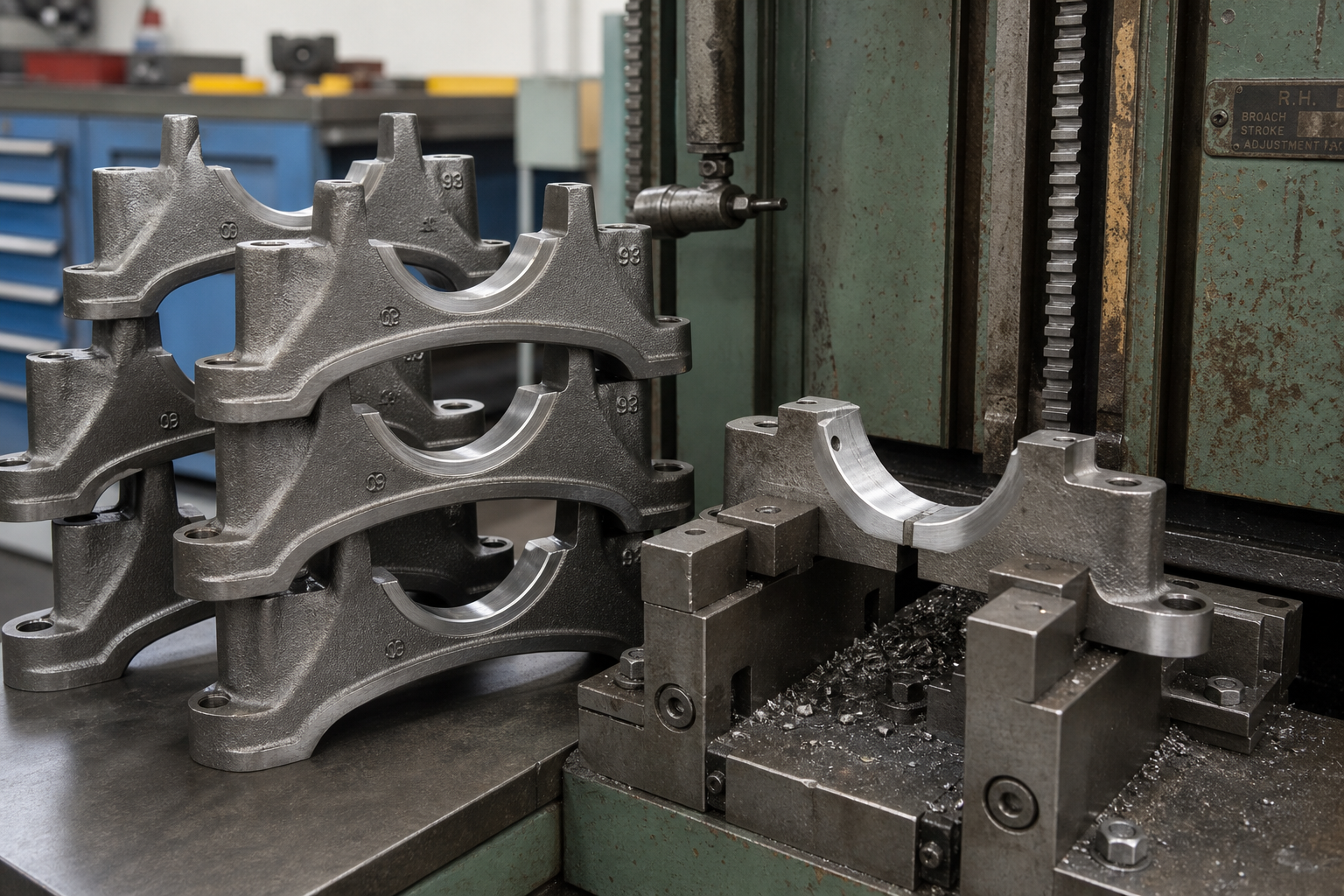
A broach is a multi-tooth cutting tool that finishes a surface in a single linear stroke. Along its length, the broach carries a progressive series of cutting teeth, each standing slightly taller or wider than the one before it, so tooth after tooth removes a thin, predictable chip from the workpiece. Because roughing, semi-finishing and finishing edges are all built into one tool, broaches hold tight tolerances and deliver a smooth surface finish at cycle times that drilling, milling or reaming cannot match. That is why broaches and broaching tools are everywhere in high-volume production: keyways in gears, splines in transmission shafts, round holes in hubs and hexagon sockets in fasteners.
This complete guide to broaches explains what a broach is and how it works, the terminology of pull-type and external broaching tools, every major broach type from the keyway broach and round broach to spline, surface and rotary broaches, the critical difference between a push broach and a pull broach, and how to care for broaching tools so a single tool delivers tens of thousands of cuts.

What Is a Broach?
A broach is a long, rod- or strip-shaped broaching tool with a sequence of separate cutting teeth spanning its whole length. The feed of the process is built into the tool itself: the rise from one tooth to the next determines how much material each cutting edge removes. The cumulative amount of material removed in a single pass is the combined action of all the teeth in the tool, and it is not required for every tooth to be in operation simultaneously. The cutting speed of the broach is set by the tool’s linear motion relative to the workpiece, which is why a broaching machine needs only one main motion, and no feed gearbox at all.
The contour of the cutting edges determines the shape of the machined surface. Because the final teeth are ground to the finished profile, the broach reproduces that profile exactly, part after part, with no dependence on operator skill. Broaches are most often constructed from high-speed steel (HSS). For highly abrasive workpiece materials or higher cutting speeds, the broach body may carry cemented carbide inserts, which are secured in place either by brazing or by mechanical clamping. The choice between HSS and carbide is a system decision that involves tooth geometry, machine condition and the sharpening route, covered later in this guide.
Terminology for a Pull-Type Broaching Tool
The specification of a broach describes its nomenclature in numerical terms. The following terms explain this terminology for a typical pull-type internal broach, the most common broaching tool on production broaching machines.


Pull End
The pull end is designed to connect the broach to the broaching machine through the puller head. Because a pull broach works in tension, this end carries the full cutting load of the stroke.
Front Pilot
The front pilot aligns the broach precisely in the pre-machined hole just before cutting begins. A worn or undersized front pilot is a common cause of misaligned broached features.
Roughing Teeth
These cutting edges are designed to remove the bulk of the material efficiently. A larger rise per tooth removes more material and speeds up the operation, but at the cost of a rougher surface and higher cutting forces.
Finishing Teeth
Also called polishing teeth, these cutting edges remove very small amounts of material. They are responsible for the precise size and final surface finish of the broached feature, which is why they are always the last teeth to contact the workpiece.
Rear Pilot and Follower Rest
The rear pilot supports the broach as it exits the workpiece, and the follower rest is an auxiliary device used with the broach to keep it aligned during and after the cut.
Land
The land is the flank face width of the broach tooth. It is typically ground with a slight inclination to provide a relief angle on the flank face, so only the cutting edge rubs the workpiece, not the whole surface behind it.
Pitch
Pitch is the distance between two corresponding points on consecutive teeth. The pitch of the finishing teeth is usually smaller than that of the roughing teeth. Pitch also controls how many teeth are in the cut at the same time, which in turn determines the total cutting force and the chip space available in each gullet.
Rise per Tooth
The height of the roughing and finishing teeth increases progressively from the front of the broach to the back. This increment is called the rise per tooth, or cut per tooth, and its value depends on the material being machined. Roughing teeth typically remove on the order of 0.05 to 0.2 mm per tooth depending on the workpiece material, while semi-finishing and finishing teeth take far less, sometimes as little as 0.01 mm, to bring the feature to final size and finish.
Terminology for an External Broaching Tool
External or surface broaching removes material from the outside of the workpiece. Just like pull-through and push-through broaches, the teeth of surface broaches grow progressively larger along the tool, so the same terminology of pitch, rise and gullet applies, with a few additional terms for the tooth geometry.

- Land: the area at the base of the tooth that serves as a foundation for the cutting edge.
- Rake: the angle at which the cutting face meets the workpiece. Chips produced during cutting travel along the rake face, so this angle governs chip flow, cutting force and edge life.
- Pitch: the distance between the cutting edges of two adjacent teeth.
- Clearance angle: the inclination of the land with respect to the direction of travel. It minimizes friction between the teeth and the workpiece by ensuring that only the leading edge of each tooth touches the cut surface.
- Depth: the vertical height of each tooth, which determines the size of the chip space behind it.
- Gullet radius: the radial gap between two adjacent teeth, which provides the pathway for chips to curl into and exit the cut.
- Chipbreaker: indentations ground into the tooth faces to break up chips and aid their removal. On roughing and semi-finishing teeth they are ground parallel to the tool axis and staggered from tooth to tooth. Chipbreakers are critical in round broaching tools because they prevent the formation of ring-shaped chips that would otherwise jam in the hole.
- Side relief: when broaching slots, the tool is surrounded by the slot and the tooth flanks rub against the sidewalls. A relief angle ground on the lateral surfaces of the teeth minimizes this abrasion while preserving a short land next to the cutting edge.
Types of Broaches
Broaching tools come in a wide variety of shapes and types, each designed for specific applications and cutting requirements, and custom broaches are widely used across the manufacturing industry. Below are the most common broach types, what each one cuts, and where it is used.

키웨이 브로치
A keyway broach is a flat bar with cutting teeth spaced along one surface, and nearly all keyways in machine parts are cut with one. These broaches can cut both internal and external keyways. Internal keyways usually require a slotted bushing, or horn, that fits the hole; the keyway broach is pushed or pulled through the horn and guided by its slot, with shims stacked behind the broach to control the keyway depth in multiple passes.
- Used to cut keyways, the slots that hold keys and other mating components.
- Available in a variety of sizes to accommodate different bore diameters and key standards.
For dimensions, standards and setup practice in depth, see our complete guide to keyway broaching.
Square Broaches
- Designed to cut square holes or forms, converting a round pre-drilled hole into a precise square bore in one pass.
- Often used in applications that demand a true square form, such as tool holders and adjustable-spanner jaws.
Hexagonal Broaches
- Used to cut hexagonal holes or forms.
- Bolts, nuts, collars and other hexagonal-shaped components are frequently machined with them, and the hex socket in a set screw or fitting is a classic hex broach application.
원형 브로치
A round broach is the simplest sort of broach: a circular, toothed bar that finishes a round hole, much like a drill or reamer would, but faster, cleaner and to tighter tolerances. The round broach enters a pre-drilled hole and, in a single pass, brings that hole to final diameter, roundness and surface finish. Staggered chipbreakers along the roughing teeth break the chip ring that would otherwise form in a round cut, while the finishing teeth size the hole accurately.
Round broaching is the preferred method whenever a large volume of parts needs a precise round bore: bearing bores in hubs and pulleys, pin holes in linkages, and fit holes in forgings and castings. Because one stroke replaces a drill, a boring bar and a reamer, round broaches are ideal for high-volume mass manufacturing, where the per-part cost of the tool is low and the consistency of the hole is absolute.
For the full process picture, including tolerances, chip control and machine selection, read our round broaching complete guide.
Splined Broaches
A spline broach cuts a series of teeth or notches around the perimeter of a previously cut hole. This design is extremely important in the automotive sector, where splines transmit torque in driveshafts, gearboxes, pump rotors and power-take-off components. The ridges along the spline’s perimeter provide an effective way of transmitting power, because the mating component that fits within has no wiggle room. Broaching guarantees that these precision components meet their accuracy requirements tooth after tooth.
- Used to cut splines, the longitudinal ridges or teeth inside a bore or on a shaft.
- Essential in the manufacture of gears and other components with spline connections.
For profile standards, measurement and process detail, see the spline broaching complete guide, and for the most common gear tooth form, the involute spline broaching guide.
Dovetail Broaches
- A cutting tool used to create dovetail-shaped grooves or slots.
- Commonly utilized in applications that need a sliding or locking mechanism, such as toolholders, jigs and sliding machine elements.
Internal Broaches
- Designed to cut interior details on a workpiece, working through a pre-existing hole.
- Depending on the requirement, the finished form may be square, hexagonal, round, splined or another profile.
External Broaches
- Used to cut the exterior surfaces of a workpiece.
- Can generate exterior forms such as flats, hexagons, racks and other geometries in a single stroke.
Surface Broaches
The slab broach is the most basic surface broach: a general-purpose tool that cuts flat surfaces. Surface broaches are used to achieve smooth, uniform finishes on faces, steps and slots, and they machine these features far faster than milling.
Rotary Broaches
A rotary broach, also called a wobble broach, is a small form cutter held at a slight angle in a special holder on a lathe, screw machine or Swiss-type machine. As it wobbles against the rotating workpiece, it shears a hexagon, square, torx or other axisymmetric form into the face of the part in about a second. Rotary broaching is the practical route to polygon forms on bar-fed parts without a dedicated broaching machine. See rotary broaching tools and holders for how these cutters and their holders work.
Involute Gear Broaches
- Specifically developed to cut involute gear teeth and involute splines.
- Gear manufacture requires accurate tooth profiles to guarantee smooth engagement, which the involute profile built into the finishing teeth delivers.
Serrated Broaches
- Used to cut serrations, a series of notches or teeth.
- Serrated surfaces are commonly used in applications that need a positive grip or mechanical locking, such as adjustable shaft collars and knurled joints.
Taper Broaches
- Designed to create tapered holes or forms.
- Useful wherever a progressive change in diameter is required, such as taper pins and muzzle-loader tools.
Oval Broaches
- Used to cut oval or elliptical forms.
- Applied where a non-circular aperture is required.
These are only a few examples, and the variety of broach forms reflects the wide range of applications and machining requirements across industries. The preferred broach type is determined by the desired feature, the workpiece material and the production constraints of the job.
Push Broach vs. Pull Broach
Every linear broaching tool is loaded in one of two ways: it is either pushed through the workpiece in compression or pulled through it in tension. That single difference in loading shapes the whole design of the tool and the machine around it.
A push broach is a short, stout broaching tool that is forced through the workpiece under compression, typically by an arbor press, a hydraulic press or the ram of a vertical broaching machine. Because a push broach acts like a column, its length is limited by column buckling: as a rough rule, the working length of a push broach should stay within about four times its diameter. Beyond that ratio, the axial force of the cut can bow the tool, wander the feature or snap teeth. Push broaches therefore have fewer teeth, remove less total stock and suit shorter cuts, such as keyways in small hubs, hex sockets and small round holes.
A pull broach is pulled through the workpiece in tension. Steel carries far more load in tension than a slender column can carry in compression without buckling, so a pull broach can be long, slender and densely toothed. It removes more stock per pass, holds closer alignment over long cuts, and is the standard tool on production vertical and horizontal broaching machines for splines, precision round bores and large internal forms.
- Loading: push broaches work in compression; pull broaches work in tension.
- Tool build: push broaches are short and thick (length-to-diameter about 4:1 or less); pull broaches can be long and slender.
- Machine: push broaching runs on arbor presses, hydraulic presses and short-stroke machines; pull broaching runs on dedicated broaching machines with a puller head.
- Typical work: push for keyways, small hex and round forms in low-to-medium volumes; pull for splines, precision round bores and high-volume production.
For a detailed side-by-side comparison of the two methods, see push broaching vs. pull broaching.
How Broaches Work
In use, the broach, often a slender rod, is pushed or pulled through the workpiece, causing the hole or surface to adopt the inverse of the tool’s profile. There are no sparks, no streams of coolant-chasing chips across the shop, and no long series of passes: a typical broaching stroke takes seconds, not minutes, and finishes the feature complete.
The efficiency of the procedure is determined by the design of the broach itself. Each tooth of the broach is successively larger than the previous one, removing a little more material as the broach advances. The leading teeth are engineered to take coarse cuts, removing the bulk of the stock. The middle teeth follow with semi-finishing cuts that bring the form close to size. The final teeth make the finest cuts, producing the exact profile, dimension and surface finish intended. The gullets carry the chips out of the hole with the tool, so the part comes out clean with minimal secondary work.
Broaches may carry a higher initial cost than other cutting tools of similar size. However, they can exhibit remarkably long service lives if properly maintained: a well-cared-for broach is routinely reconditioned and resharpened several times before it is retired. How the tool is made, from tooth grinding to final inspection, determines how well it will hold up, a process covered in the broach manufacturing process guide.
How to Care for Your Broaching Tools
When you obtain a new broach, it is probably good for at least 8,000 cuts. If the broach is well maintained and sharpened on a regular basis, that initial estimate can be extended to approximately 60,000 cuts or more.
Broaches are expensive items, with some costing $2,000 or more. Although the predicted 8,000 cuts may be sufficient for smaller operations, not every business can afford to replace these tools at that rate.
As a result, after roughly 3,000 components, it is usually worthwhile to send your broaches out to be sharpened and reconditioned in order to extend their useful life and lower total production cost. The clearest warning sign is an increase in the force required to cut your components; a dull broach pulls harder, heats more and finishes worse. To judge the right moment precisely, follow the schedule in when to resharpen a broach tool, and track the factors that govern durability in the 브로치 공구 수명 가이드.
Reconditioning, which combines sharpening with repair of nicks, regrinding of pilots and recoating, restores most worn broaches to service for a fraction of replacement cost. The full workflow is described in the broach reconditioning guide, and the acceptance measurements that qualify a reconditioned tool are listed in the broach tool inspection guide.
What Is Straddle Broaching?
Straddle broaching uses opposed or coordinated cutting elements to machine two accessible external surfaces in a controlled relationship. A typical objective is to produce parallel flats, slots or shoulders while controlling their spacing, symmetry or position from a shared datum. The name describes the way the cutters straddle the workpiece; it does not define one universal broach, machine orientation or stock allowance.
The process is a candidate only when both cutting zones are accessible along the tool travel and the workpiece can be supported through the load path. Application review should define:
- the two finished surfaces and the datum that controls their relationship;
- stock on each side, including casting, forging or prior-machining variation;
- whether the cutters remove stock simultaneously or in a staged sequence;
- fixture support against bending, rotation and side-to-side load imbalance;
- chip space, chip exit, cutting-fluid delivery and safe tool clearance;
- machine force over the full stroke, not only a nominal tonnage value;
- how spacing, parallelism, symmetry, finish and burrs will be inspected.
Unequal stock can make one side cut harder than the other, shifting the load and deflecting the part or tooling. A representative trial should therefore use production-intent blanks and measure both individual surfaces and their relationship. Surface broaching, milling, grinding or a revised preform may be better when access, support or volume does not justify a dedicated straddle tool. See the surface broaching machine guide for the broader process context.
How Should Broach Tool Material and Coating Be Selected?
Tool material and coating are part of one cutting system. They cannot be selected from workpiece hardness alone. The toolmaker must also review tooth geometry, section strength, broach length, cutting speed, rise per tooth, interruption, chip evacuation, cutting fluid, sharpening route and the machine’s alignment and load behavior.
Start with the failure mode that must be controlled. Edge chipping, abrasive flank wear, built-up edge, thermal damage, tooth breakage and body deflection do not have the same remedy. A harder or more wear-resistant coating does not correct inadequate chip space, misalignment, excessive stock, poor support or an unstable machine. Coating also changes the sharpening and recoating plan: confirm which surfaces are ground during resharpening, whether the coating must be stripped, and how the restored tool size will be qualified.
For a quotation or tool review, provide the workpiece drawing, material specification and condition, blank variation, target volume, existing machine data, fluid route, inspection plan and any failed-tool evidence. Ask the supplier to state the material and coating basis, expected maintenance route and trial acceptance criteria. Then validate the combination on representative parts instead of treating a catalog grade as a guaranteed tool-life result. The broach tooling design page 그리고 resharpening inspection guide explain the connected design and maintenance inputs.
Frequently Asked Questions About Broaches
What is a broach tool?
A broach is a multi-toothed cutting tool whose teeth rise progressively from front to back, so it roughs, semi-finishes and finishes a surface in a single pass. Broaches are made mainly from high-speed steel, sometimes with brazed or clamped carbide inserts, and are used on broaching machines, presses, lathes and screw machines to produce keyways, splines, round bores, hexagons, flats and other forms.
What are the types of broaches?
The main types are keyway, square, hexagonal, round, spline, dovetail, serrated, taper, oval and involute gear broaches, plus the broader classes of internal, external, surface and rotary broaches. Each type is ground with the finished form in its finishing teeth, and custom broaches are common when a standard form does not fit the drawing.
What is a push broach?
A push broach is a short, stout broaching tool driven through the workpiece in compression, usually by an arbor or hydraulic press. Because the tool works like a column, its length is limited by buckling to roughly four times its diameter, so push broaches suit short features such as keyways and small hex or round forms. Pull broaches, loaded in tension, can be much longer and are standard for production broaching.
What is the difference between a round broach and a spline broach?
A round broach finishes a plain circular hole to final diameter, roundness and finish. A spline broach cuts a series of ridges, or splines, around the inside of a previously cut hole so the bore can transmit torque to a mating shaft. The spline broach’s teeth carry the spline profile, which makes it more complex to manufacture and inspect than a round broach, but both finish their feature in a single pass.
Broach vs. reamer: which one should you use?
A reamer corrects the size and finish of an existing hole in a general-purpose machine, and is economical for small batches. A broach finishes the hole faster, to closer tolerances and with better repeatability, but requires a suitable machine and a higher tool investment. Above a certain production volume, broaching wins on cost per part; the trade-offs are compared in broaching vs. reaming internal holes.
결론
Broaches are among the most versatile and productive tools available to machine shops and manufacturers today: one tool, one stroke, finished feature. Choosing the right broaching tool starts with the form you need to cut, then the machine and stroke direction available, and finally a maintenance plan that keeps the tool cutting for tens of thousands of parts.
If you are looking for the right broach for your application, browse our selection of broaching tools 그리고 special broaches, or explore more articles in the broaching tools category. To discuss a custom form, 문의하기 with your drawing and we will recommend the right tool for the job.