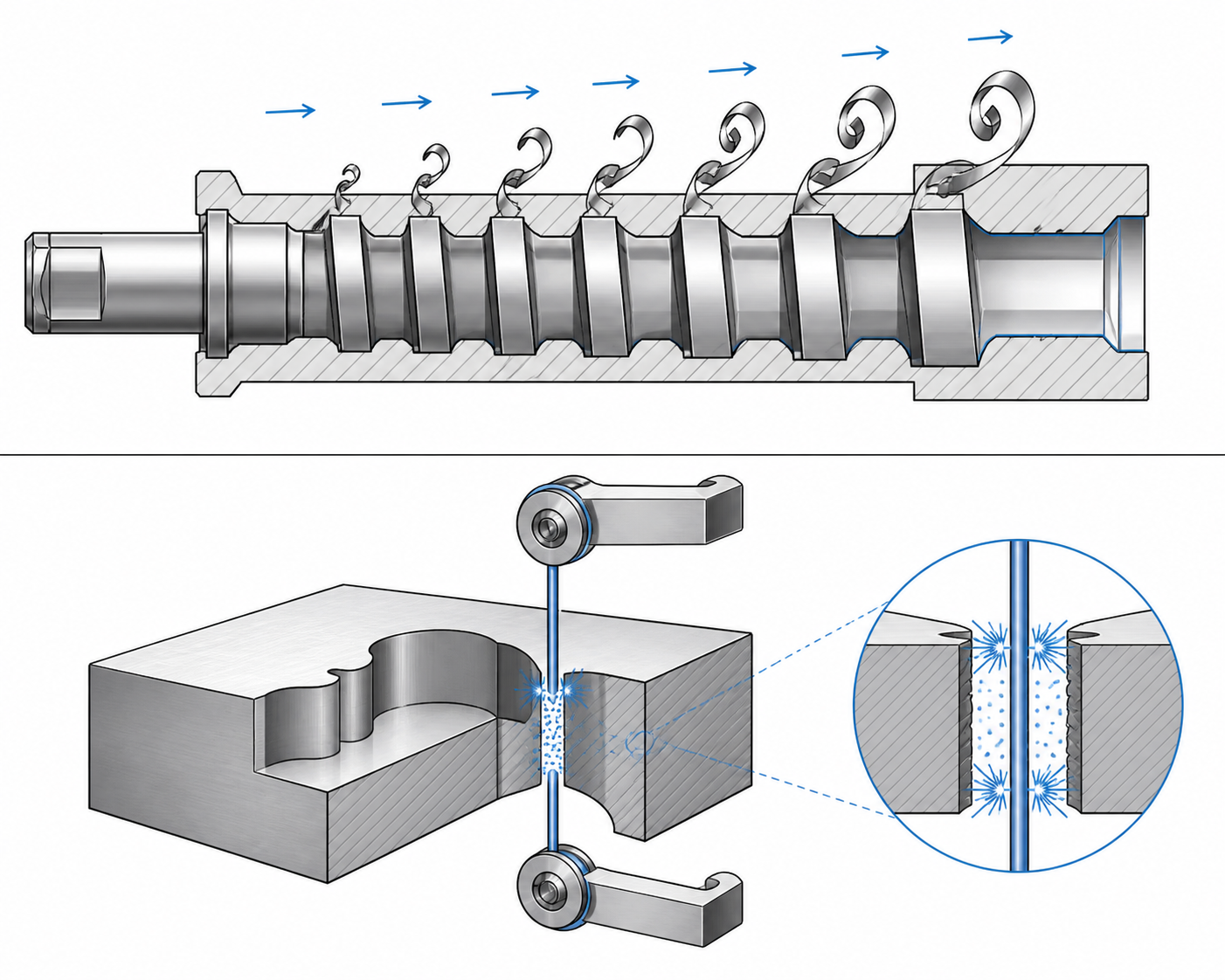
Give two machine shops the same internal form — a spline bore, a hexagon in a fitting, a fir-tree slot in a turbine disc — and one will reach for a broach while the other threads a wire. Broaching and wire EDM are the processes most often weighed against each other for internal profiles, and they sit at opposite ends of the manufacturing spectrum: one is pure mechanics, a hardened multi-tooth tool shearing metal in a single forceful stroke; the other is electricity at work, a traveling wire eroding material spark by spark with almost no force at all.
The shortest honest summary: broaching finishes an internal form in one stroke of seconds, but requires a custom-engineered broach and a machine to pull or push it. Wire EDM requires no dedicated tooling and cuts any conductive material regardless of hardness, but each part pays in cutting time measured in minutes to hours. That trade-off — tooling amortization versus machine hours — explains almost everything about how the two processes divide the work in real shops.
One clarification before we go further: “EDM” covers two distinct processes. This article is about wire EDM, in which a traveling wire cuts a two-dimensional contour through the work like an ultra-precise band saw. Sinker (die-sinking) EDM, which drives a shaped electrode into the work, is a different tool with different economics, treated separately in broaching vs. EDM for internal keyways. Here, the subject is the wire.
Broaching vs. Wire EDM at a Glance
- Metal removal: broaching shears chips with progressive teeth; wire EDM melts and vaporizes material through sparks between wire and workpiece.
- Cutting force: broaching generates substantial force the part must resist; wire EDM is essentially force-free — thin walls and finished parts deform almost nothing.
- Cycle time: broaching completes a form in one stroke of seconds; wire EDM often needs minutes to hours per contour, per part.
- Tooling: a broach is a custom, single-purpose asset with real cost and lead time; wire EDM needs only a program and a supply of wire.
- Material hardness: EDM cuts hardened steel and carbide as easily as annealed stock; conventional broaching needs a machinable state, with hard broaching as the engineered exception.
- Geometry limits: wire EDM needs a start hole and cannot reach a blind internal cavity; broaching excels at through-forms and has dedicated answers for blind keyways.
- Volume economics: one-offs and tiny batches favor wire EDM outright; at production volumes the per-part math swings decisively to broaching.
How Each Process Removes Metal: Shearing vs. Spark Erosion
Broaching: many teeth, one stroke
A broach is a long tool carrying rows of teeth along its length, each tooth standing slightly taller or wider than the one before it. When the machine pulls or pushes the broach through the pre-machined bore, every tooth takes one small, predetermined bite: leading teeth rough the form, middle teeth semi-finish, and the final teeth carry the exact finished profile. Roughing and finishing are compressed into a single pass — the geometry lives in the tool, and the machine’s only job is to deliver a long, straight, powerful stroke.
The catch is that all those teeth working at once generate real cutting force. Machine, fixture, and workpiece must be rigid enough to absorb it. This is why broaching engineers care about rise-per-tooth, pitch, and chip load — the force is manageable and predictable, but never zero.
Wire EDM: a spark, a million times over
Wire EDM works on an entirely different principle. A thin, continuously fed wire — brass and coated wires are the common choices — travels a programmed path through the workpiece while deionized water flushes the gap. Pulsed electrical discharges jump between wire and work; each spark generates enough localized heat to melt and vaporize a microscopic crater of material. There is no cutting edge, no chip, and no mechanical contact. “Cutting speed” is really an erosion rate, which is why machining time scales with the cross-sectional area to be removed and the thickness of the part.
Because the wire never touches the work, the process is often described as force-free — and the description is fair. Fixturing can be minimal, and thin walls, delicate features, and parts already finish-machined elsewhere can be cut without deflection or clamping distortion. For certain work, that absence of force is not a convenience; it is the enabling technology.
Cycle Time and the Economics of Volume
The per-part arithmetic
Here the two processes diverge most sharply, and the arithmetic is unforgiving on both sides. A broaching stroke is one of the fastest finishing operations in metalworking: load the part, stroke, unload — a complete internal form in seconds. The same form on a wire machine may take many minutes per part for a small profile, and hours per part for deep, large, or multi-pass contours. Wire EDM usually demands multiple passes — a roughing cut followed by skim cuts for accuracy and finish — which multiplies machine time further.
But cycle time is only half of the ledger. The broach itself is a capital asset: designed for one profile, ground tooth by tooth, priced accordingly, with lead times measured in weeks. Wire EDM has essentially no dedicated tooling cost per job — program the path, thread the wire, cut. The per-part cost of broaching therefore falls with every part produced (the tool amortizes across the batch), while the per-part cost of wire EDM stays nearly flat: the first part and the ten-thousandth pay roughly the same machine-hours bill.
Where the crossover happens
Sketch those two cost curves — one falling, one flat — and they cross somewhere. Below the crossover, wire EDM wins on total cost; above it, broaching does. Where the lines cross depends on three variables: the price of the broach, the wire cutting time per part, and the shop’s machine-hour rates. In general terms: for a one-off, the broaching trade-off is essentially nil — nobody procures a custom broach and a broaching machine for a single part, which is why job shops quote one-off internal forms to the wire machine. Small batches of a few pieces still usually favor wire EDM. As quantities climb into the hundreds and beyond, the falling per-part tooling cost of broaching meets an EDM bill that grows linearly with volume — and the economics tip heavily toward the broach. The larger and deeper the form, the sooner the crossover arrives, because wire time grows with material removed while a broaching stroke stays roughly constant.
There is also a lead-time dimension. On a brand-new part, the wire machine can start cutting as soon as the program exists; the broach must first be designed and built. In development and urgent repair work, that head start matters more than unit cost — one reason wire EDM has found a lasting role in the aero-engine world we discuss next.
The Fir-Tree Slot Question: What Wire EDM Changed — and What It Didn’t
No application frames this comparison better than the fir-tree slot — the tapered, multi-lobed dovetail that locks turbine blades into a jet-engine disc. Fir-tree slots are precise, deep, high-consequence internal forms, and for decades they have been a signature broaching application: purpose-built machines pull matched broaches through disc rims, producing rows of identical slots at rates no other process could touch.
Wire EDM has made genuine inroads here, and it deserves the credit. For prototype discs, for engine MRO shops replacing a handful of slots on an expensive component, and for small turbine programs that cannot justify dedicated tooling, wire EDM cuts an accurate fir-tree form with no broach procurement, no broaching capacity, and no cutting force on a thin rim. In that segment — prototypes and maintenance — the wire machine has genuinely displaced broaching, and there is no reason to expect it back.
But displacement at the margins is not replacement at scale. A production aero-engine program builds discs by the thousands, and at those volumes the economics above take over completely: multi-hour wire cuts per disc versus seconds-long broaching strokes, repeated across every slot and every disc in the fleet. High-volume turbine disc lines worldwide are still anchored by broaching, as the fir-tree slot broaching process we detail here shows. The realistic picture is a division of labor: wire EDM for development, repair, and low-rate production; broaching for the production line.
Material Hardness: Where EDM Holds the Edge
If volume economics favor broaching, hardness is the axis on which wire EDM wins without argument. Because spark erosion does not depend on shearing, EDM is indifferent to hardness: fully hardened die steel, heat-treated alloy steel, carbide, and superalloys all erode at broadly similar rates. A part already heat-treated to final hardness can go straight to the wire machine — no interim machining, no distortion risk. This is why wire EDM owns hard die-making work: punches, dies, and inserts are routinely hardened first and wire-cut after.
Conventional broaching must cut material in a machinable state. A standard broach in a hardened workpiece would wear rapidly and cut poorly, so the classic chain is: machine the form soft, broach, then heat-treat — accepting whatever distortion the treatment introduces. That sequencing constraint is real, and for parts that cannot tolerate it, wire EDM is often the right answer.
It is not, however, the whole story. Hard broaching — specially designed, coated broaches running on rigid machines to cut directly into hardened workpieces — exists precisely to close this gap, letting some parts be broached in their final hardness state and eliminating post-broach heat-treatment distortion. Our comparison of hard broaching vs. soft broaching covers where it applies and what it demands of tooling and machine. For a broader view of workpiece materials, see what materials can be broached.
Accuracy, Surface Finish, and Surface Integrity
Both processes rank among the more precise ways to make an internal form, but they are precise in different directions. Wire EDM’s signature strength is geometric: tight internal corner radii (a function of the fine wire diameter), accuracy held across tall parts, and genuinely complex two-dimensional contours that no series of broach teeth could carry. Modern wire machines hold close tolerances as a matter of routine, and skim passes refine both geometry and finish.
Broaching’s strength is consistency. Because the finished form is ground into the finishing teeth, every part that passes the broach receives the same form from the same edges — profile accuracy is reproduced part-to-part by construction, not re-achieved by a servo path. Spline tooth-to-tooth spacing, keyway width and symmetry, and surface finish all come out highly repeatable — exactly what a production line paying for a broach is buying. The surface left by the finishing teeth is a conventional cut texture, with no thermal alteration beneath it.
That last point is the surface-integrity issue unique to EDM. Spark erosion does not merely remove metal; each discharge heats the surface it erodes, leaving a thin recast layer (often called white layer) on a shallow heat-affected zone. For most industrial parts this skin is acceptable or easily handled, but fatigue-critical components — turbine hardware prominent among them — commonly require a follow-on operation such as polishing, honing, or peening to restore surface condition. Broaching, being a cold mechanical cut, adds no thermal layer. Whether that difference matters depends entirely on what the part does for a living.
Blind Cavities and Start Holes: The Geometric Limits
Wire EDM has one hard geometric requirement and one hard impossibility. The requirement is a start hole: the wire is continuous, so before any internal contour can be cut, a hole must be drilled through the workpiece for the wire to thread through. The impossibility is the blind internal cavity: because the wire must pass through the work and travel its full contour, it cannot generate an internal form that terminates inside a solid pocket. A blind internal form is the domain of sinker EDM (slower, with a shaped electrode to machine first) or of a mechanical process.
Broaching, conversely, is naturally a through-process — the broach enters one side and exits the other, which is why keyways, splines, and polygon bores through hubs and collars are its home turf. But it is not limited to through-forms: blind keyway broaching is an established practice with purpose-designed tooling, which we cover in blind keyway broaching. Where the slot must stop inside the part, the tooling is engineered for it rather than improvised — a design requirement that often decides the process before any cost analysis begins.
Broaching vs. Wire EDM: Side-by-Side Comparison
| Dimension | Broaching | Wire EDM |
|---|---|---|
| Removal principle | Mechanical shearing by progressive multi-tooth tool in one stroke | Spark erosion between workpiece and traveling wire electrode |
| Cutting force | Substantial; part, fixture, and machine must resist it | Essentially force-free; no mechanical contact |
| Cycle time | Complete form in a stroke of seconds | Minutes to hours per contour; multiple passes typical |
| Volume economics | Broach amortizes across the batch; per-part cost falls with volume | Nearly flat per-part cost — every part pays full machine time |
| Dedicated tooling | Custom broach per profile; real cost, weeks of lead time | None beyond a program and consumable wire |
| Material hardness | Cuts machinable-state material; hard broaching is the engineered exception | Indifferent to hardness — hardened steel and carbide cut directly |
| Blind internal forms | Through-forms natural; blind keyways handled with dedicated tooling | Cannot cut a blind internal cavity; sinker EDM required instead |
| Accuracy character | Form ground into finishing teeth; exceptional part-to-part consistency | Tight tolerances, fine internal corner radii, complex 2D contours |
| Surface integrity | Cold machined texture; no thermally altered layer | Recast (white) layer and heat-affected zone; fatigue-critical parts may need post-processing |
| Best-fit scenario | Medium-to-high volumes of stable internal form designs | One-offs, prototypes, hardened parts, complex 2D profiles, repair work |
How to Choose: The Four-Question Framework
1. What is the quantity?
This is the first question because it dominates the answer. One part or a handful: wire EDM, no contest — nobody builds broaching tooling for a one-off. Hundreds or thousands of identical parts: broaching, with equal certainty — the flat EDM bill cannot compete with a falling per-part cost at scale. The judgment zone lies in between, and there the answer turns on the next three questions.
2. What is the material state?
If the part is already hardened, or must be machined after heat treatment to avoid distortion, wire EDM starts with a structural advantage — though confirm whether hard broaching applies before conceding the job. If the part is machined soft anyway, the hardness question dissolves and broaching runs at its best.
3. What is the geometry?
A blind internal form rules out wire EDM immediately. A form with extreme contour complexity or very tight internal radii may exceed what broach teeth can carry, favoring the wire. A standard production form — keyway, spline, polygon bore, fir-tree — sits squarely in broaching’s territory, where the broach was purpose-built to excel.
4. When do you need the first part?
If the answer is “this week,” wire EDM cuts as soon as the program is posted. If the program has development time before production ramps, the broach’s lead time is absorbed once and repaid across the entire run. Timing questions that kill broaching for a rush job are irrelevant for a planned production launch.
Frequently Asked Questions
What are the disadvantages of wire EDM?
Wire EDM’s main drawbacks are speed and surface condition. It removes metal slowly, so each part consumes significant machine hours — a cost that scales linearly with volume and never amortizes. The cut leaves a thin recast layer and heat-affected zone that fatigue-critical parts may need a follow-on operation to address. The process requires a start hole for internal work and cannot produce blind internal cavities at all, and the machines themselves are a serious capital investment.
What are the disadvantages of broaching?
Broaching’s weaknesses concentrate in tooling and rigidity. A broach is a custom, single-geometry tool with meaningful cost and weeks of lead time — every design change means re-engineering the tool, and low volumes cannot amortize it. The process needs a pre-machined bore for internal work, generates substantial cutting force, and conventionally requires the workpiece in a machinable state. A shop running many one-off parts gains nothing from a process engineered for repetition.
When should you use wire EDM?
Use wire EDM for one-offs, prototypes, and small batches of internal or profiled forms; for parts already heat-treated to final hardness; for materials that resist conventional cutting; for complex two-dimensional contours and tight internal corner radii; for thin-walled work that cannot tolerate cutting force; and for repair and salvage where dedicated tooling can never be justified. In those roles it is not a substitute for broaching — it is the only sensible tool for the job.
Is EDM faster than broaching?
No — not in cycle time. A broaching stroke completes an internal form in seconds; a wire cut of the same form typically takes minutes to hours. Where EDM is “faster” is time-to-first-part: it needs no custom tooling, so it can begin cutting as soon as the program exists, while the broach is still being designed and ground. Speed of preparation favors EDM; speed of production favors broaching.
Broaching vs. wire EDM, in one sentence: wire EDM buys freedom from tooling with machine hours; broaching buys production speed with a dedicated tool — and the quantity on the order form decides which purchase makes sense.
If your parts call for internal forms — keyways, splines, polygon bores, or fir-tree slots — at production volumes, we build the broaching machines and engineer the broaches that pair with them. Send us your part drawings, material specifications, and annual quantities, and we will tell you plainly whether broaching is the right economics for your job — and what the machine, tooling, and process plan would look like.