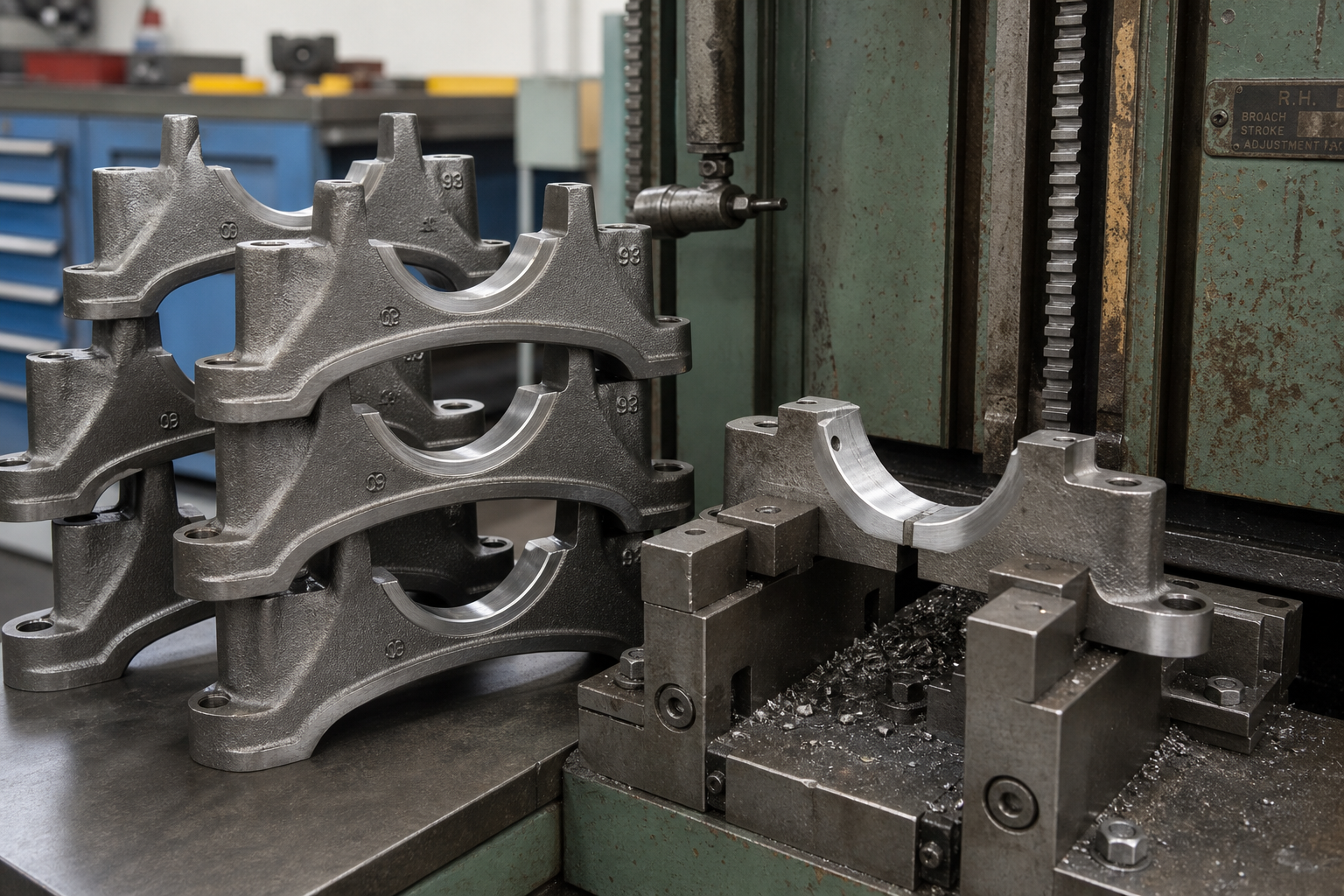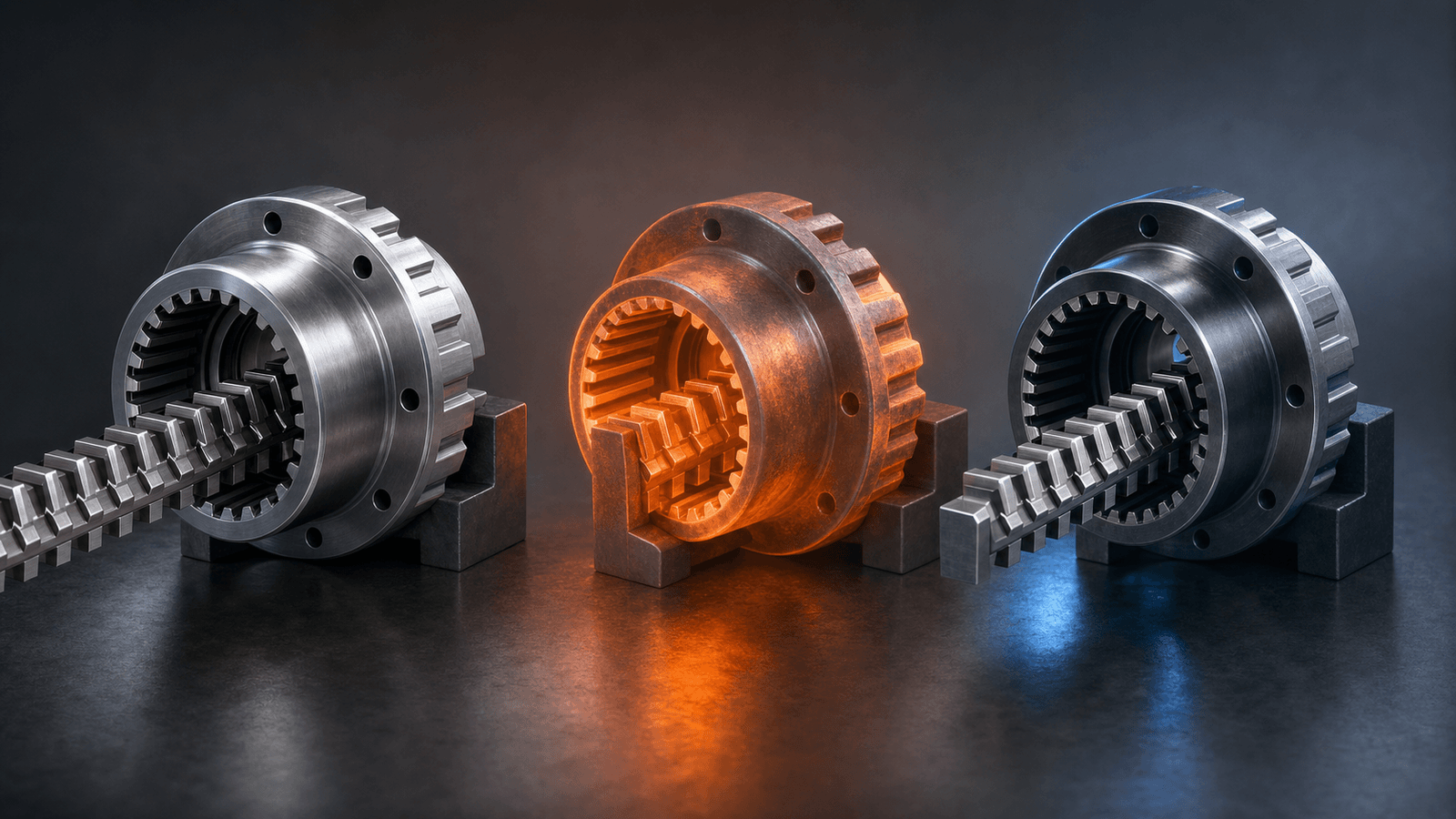
Conceptual illustration of soft broaching before heat treatment and precision hard broaching after heat treatment. The image is illustrative, not a process drawing.
Hard broaching and soft broaching are not simply two names for cutting “hard” and “soft” metals. The more useful distinction is where the broaching operation sits in the heat-treatment route.
Soft broaching normally creates most or all of the profile before heat treatment, while the workpiece is easier to cut. Hard broaching is commonly a controlled finishing or recalibration step after heat treatment, used when distortion has moved an internal spline, bore or other profile outside its final requirement.
The right choice depends on measured distortion, available finishing allowance, feature access, datum control, machine rigidity, tooling, coolant, inspection and total production cost. Material hardness alone is not enough.
Hard Broaching vs Soft Broaching at a Glance
| Decision factor | Soft broaching | Hard broaching |
|---|---|---|
| Typical process stage | Before final heat treatment | After heat treatment |
| Main purpose | Generate the required profile efficiently | Finish, recalibrate or correct a hardened profile |
| État du matériel | Softer or pre-hardened machining condition | Hardened final or near-final condition |
| Stock removal | Usually carries most of the profile-generating load | Normally a controlled finishing allowance |
| Heat-treatment distortion | Occurs after broaching and must be accepted or predicted | Measured first, then corrected where feasible |
| Tool demand | Lower cutting severity in many applications | Greater wear, edge and coating demands |
| Machine demand | Stable force, alignment and chip control | High rigidity, precise alignment, controlled motion and monitoring |
| Tool life | Generally more favorable | Usually more sensitive to hardness, allowance and process stability |
| Best economic case | Heat-treated parts remain consistently within tolerance | Post-heat-treatment correction prevents scrap or another finishing process |
This table describes the usual process roles, not universal limits. A final process must be validated against the actual alloy, hardness profile, geometry and acceptance method.
What Is Soft Broaching?
Soft broaching is broaching performed while the workpiece remains in a machinable condition, commonly before final hardening. A progressive multi-tooth broach removes material to create an internal spline, keyway, round form or another profile.
Because the workpiece is easier to cut at this stage, soft broaching can usually carry the main stock-removal task. Cutting forces, tool wear and cycle economics are generally more favorable than attempting the same removal after the part is fully hardened.
The central risk is downstream: heat treatment can change size, roundness, straightness, tooth alignment or the relationship between the broached feature and its datums. If this change remains inside the final tolerance window, soft broaching followed by final inspection may be the simplest route. If it does not, the process needs a post-heat-treatment correction strategy.
Soft broaching should still be treated as an engineered process. Material that is unusually soft or adhesive can produce built-up material, tearing or poor surface finish. Tooth geometry, cutting fluid and cutting conditions must match the actual workpiece—not just a nominal hardness range.
What Is Hard Broaching?
Hard broaching is a precision broaching operation performed after the workpiece has been heat treated. In many drivetrain and internal-spline applications, its job is to correct profile distortion and bring the hardened feature back into its required geometry.
It is usually best understood as a finishing or recalibration process, not as a substitute for removing the full profile from solid hardened material. The soft operation, heat-treatment route and hard-finishing allowance should be planned together.
A successful hard-broaching operation may correct controlled deviations in an accessible internal profile, but it cannot repair every heat-treatment problem. Excessive or inconsistent distortion, insufficient allowance, unstable datums, interrupted cutting, poor through-access or an unsuitable hardness layer can make another process more appropriate.
Where Each Process Fits Around Heat Treatment
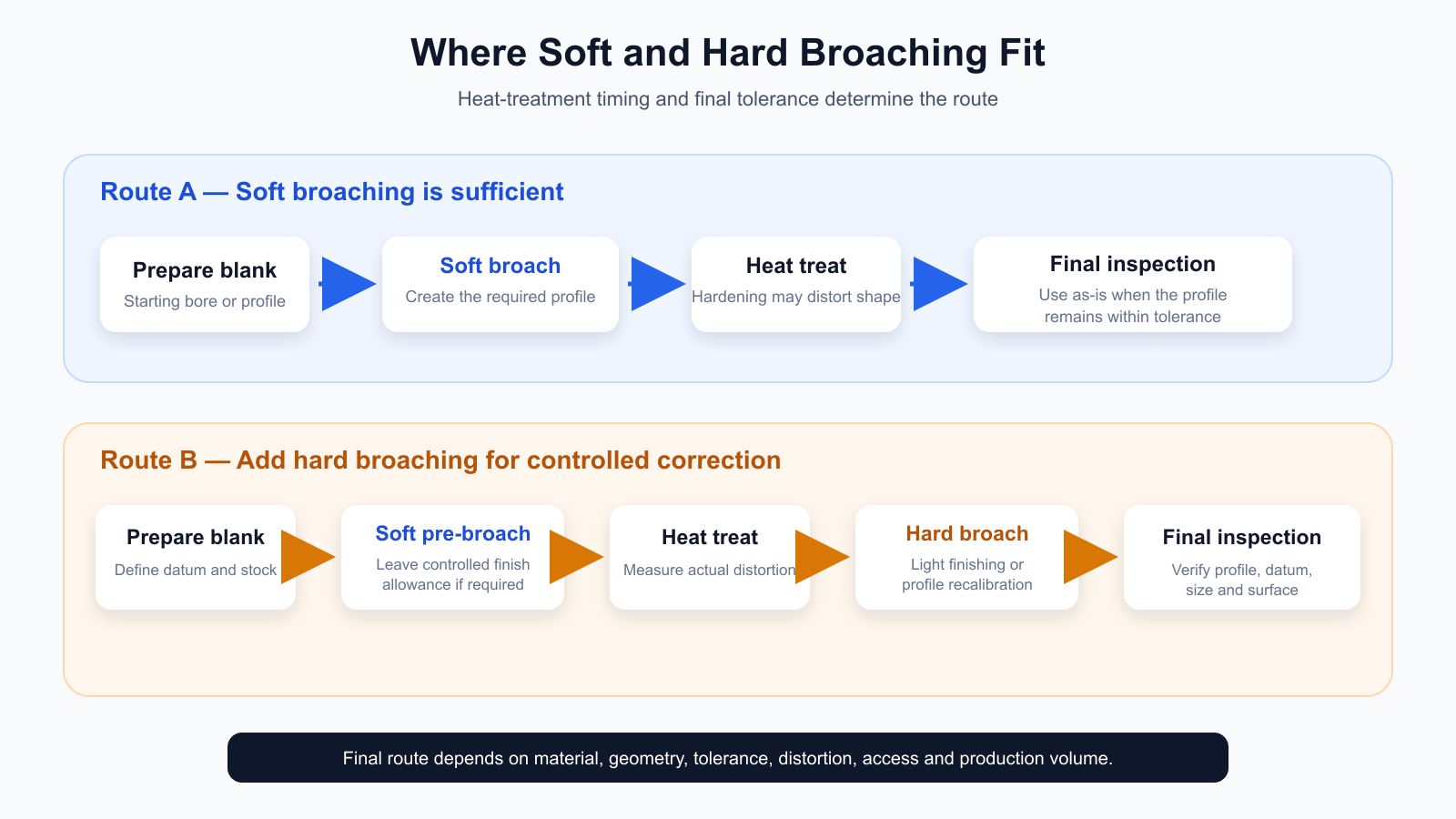
Soft broaching may be sufficient when the heat-treated profile remains within tolerance. Hard broaching adds a controlled finishing step when measured distortion is correctable.
Two common routes are:
- Soft broach → heat treat → final inspection. Use this route when process capability shows that the hardened profile remains within its final tolerance consistently.
- Soft pre-broach → heat treat → measure → hard broach → final inspection. Use this route when heat-treatment distortion is predictable enough to leave and remove a controlled finishing allowance.
The decision should be based on production evidence. Prototype measurements, heat-treatment studies and capability data are more reliable than applying one generic allowance to every part.
Why Heat-Treatment Distortion Changes the Decision
Heat treatment changes more than bulk hardness. Heating, quenching, phase transformation, residual stress and part geometry can alter the relationship between the internal profile and the rest of the component.
For an internal spline, relevant changes may include:
- Involute-form error.
- Major- or minor-diameter change.
- Tooth alignment or lead variation.
- Bore roundness and concentricity change.
- Datum movement relative to faces or journals.
- Part-to-part variation within the same heat-treatment batch.
Hard broaching is most valuable when the deviation is measurable, the cutting path is accessible and the correction can be achieved with a stable light cut. If the hardened profile already meets the functional requirement, adding a hard-broaching operation only increases cost and risk.
Before choosing the route, inspect representative parts after heat treatment. Record not only average deviation but also the range and direction of distortion. The tool must be designed for the worst credible condition without being overloaded by unexpected stock.
Tooling Differences
Stock Allowance and Tooth Progression
A soft broach normally generates most of the profile, so its roughing, semi-finishing and finishing sections are designed around the complete stock-removal task. A hard broach usually removes a smaller, controlled amount to restore geometry.
Too much hardened stock can overload cutting edges and shorten tool life. Too little or uneven allowance can leave parts only partially corrected. The pre-broaching geometry and heat-treatment result therefore determine the hard-broach tooth progression.
Tool Material and Coating
Tool substrate, heat treatment, edge preparation and coating must be selected as a system. Hard broaching places greater emphasis on wear resistance and coating performance, but excessive brittleness can be equally damaging when alignment or stock varies.
No coating can compensate for an unstable process. Verify workpiece hardness, allowance, cutting speed, lubrication, machine alignment and regrinding strategy before treating coating selection as the main solution.
For custom tooling, start with the finished part, process route and machine interface. See BroachingMach's broach tool categories and broach tooling design pages for the information required in an engineering review.
Chip Formation and Lubrication
Chip space remains critical even in a finishing operation. A hard-broaching tool must carry chips through the feature without packing, recutting or damaging the finished surface.
Coolant or cutting oil supports lubrication, heat control and chip evacuation. Wet, dry and minimum-lubrication strategies are application-specific. Review the alloy, coating, machine enclosure, filtration, fire risk and environmental requirements before selecting the fluid system. Our Guide sur les fluides de coupe pour le brochage explains the main selection factors.
Machine and Process-Control Requirements
Hard broaching demands more than higher machine force. The complete system needs:
- High structural rigidity.
- Accurate alignment between the tool, workpiece and machine axis.
- Controlled cutting speed and motion profile.
- Stable workholding and repeatable datums.
- Protection against collision and abnormal load.
- Effective lubrication, filtration and chip management.
- A defined inspection and tool-wear response.
Soft broaching also needs correct force and alignment, but it generally operates in a more forgiving material condition. The machine can often be selected around productive stock removal, stroke, tool length, loading and cycle time.
When estimating equipment, do not size from part hardness alone. Broach length, number of simultaneously cutting teeth, rise per tooth, profile perimeter, material condition and friction all affect the load. Review our guide to calculating broaching-machine tonnage and the main broaching machine categories.

BroachingMach CNC high-speed hard broaching machine for post-heat-treatment internal-profile applications. Final suitability and specifications require an application review.
BroachingMach offers a Machine de brochage à grande vitesse à commande numérique (CNC) intended for post-heat-treatment internal holes, splines and internal teeth. The workpiece, tool, finishing allowance and inspection plan should be reviewed together before machine selection.
Accuracy and Surface Finish
Soft broaching can produce accurate profiles and good surfaces before heat treatment. The question is whether those characteristics survive the remaining manufacturing route.
Hard broaching moves the final cutting operation closer to final inspection. This can improve the finished profile when heat-treatment distortion is the main source of error. However, the result still depends on:
- A consistent starting condition.
- Sufficient but not excessive allowance.
- Stable location from functional datums.
- Tool condition and resharpening quality.
- Machine alignment and rigidity.
- Clean cutting edges, coolant and chip evacuation.
Define the inspection method before tool design. Profile accuracy, size, lead, location, runout and surface finish may require different gauges or measurement systems. “The part fits” is not a complete acceptance definition for a production process.
Tool Life and Total Process Cost
Soft broaching usually offers a lower cutting cost because the material is easier to machine and the tool can carry a productive stock-removal load. If the heat-treated part remains capable, this is often the preferred route.
Hard broaching adds tooling, machine time, inspection and process-control cost. Its economic value comes from what it prevents:
- Scrap caused by post-heat-treatment distortion.
- Rework or manual sorting.
- A slower finishing process.
- Assembly interference or functional variation.
- Lost capacity caused by an unstable final profile.
Compare total process cost, not tool price alone. Include broach life, regrinding, coating, coolant, inspection time, machine utilization, changeover, scrap and the cost of alternative finishing processes.
Tool-life monitoring should use evidence such as cutting-force trend, surface change, dimensional drift, edge wear or chipping—not an arbitrary part count. If the process shows rising load or degraded finish, use the checks in our guide to avoiding broach breakage.
How to Choose Between Hard and Soft Broaching
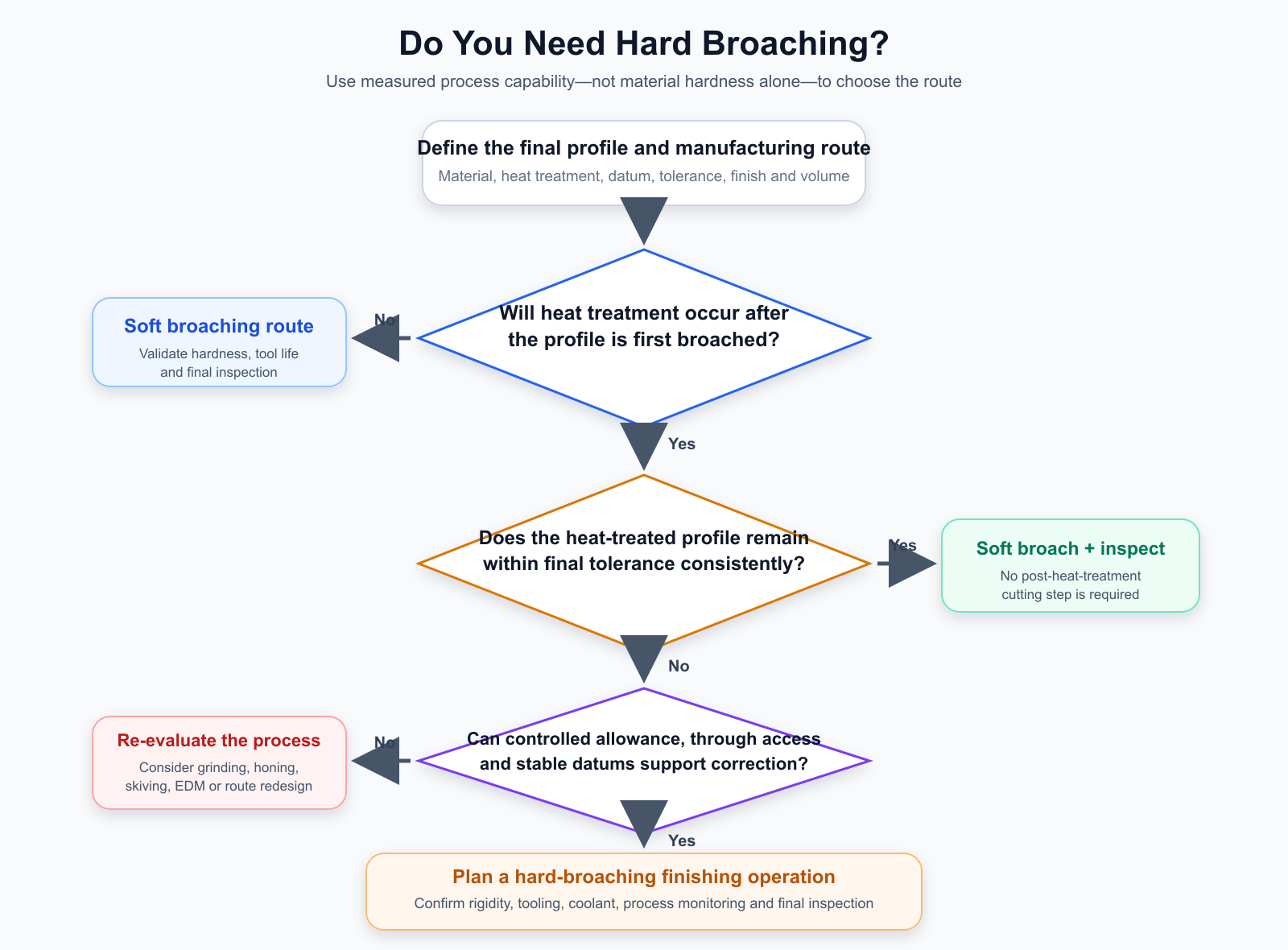
Choose the route from heat-treatment timing, measured capability, controlled allowance, access and datum stability.
Use this sequence:
- Define the finished profile, functional datums and inspection method.
- Confirm the material condition before and after heat treatment.
- Soft-broach representative parts using the planned production route.
- Measure the profile and datum relationship after heat treatment.
- If the result remains capable, retain the soft-broach-plus-inspection route.
- If it is outside tolerance, determine whether the error is consistent and accessible.
- Confirm that a controlled finishing allowance can be left without compromising the part.
- Validate hard-broaching tooling, machine rigidity, coolant and inspection on representative hardened parts.
- If access or stock control is unsuitable, compare grinding, honing, power skiving, EDM, keyseating or a redesigned manufacturing sequence.
Typical Applications
Soft broaching is common for internal splines, keyways, round forms and surface profiles when the main geometry can be generated before heat treatment.
Hard broaching is most often considered for hardened internal profiles where heat-treatment distortion affects final fit or function. Examples include internal splines in gears, hubs, couplings and transmission components. It may also be considered for other accessible internal forms when the finishing allowance and hardness condition are controlled.
Hard broaching is less attractive when:
- The operation requires heavy stock removal in the hardened state.
- The feature is blind and does not provide the required tool or chip exit.
- Distortion is too variable for one tool strategy.
- The datum system cannot locate the hardened feature consistently.
- Production volume does not justify dedicated tooling.
- A grinding, honing, skiving or EDM process provides a lower-risk route.
Information Required for an Engineering Review
Send the following data before choosing a hard- or soft-broaching system:
- Finished part drawing and pre-broaching drawing.
- Material grade and hardness before broaching.
- Heat-treatment method and required final hardness.
- Measurements of size, profile and datum shift after heat treatment.
- Required profile class, tolerance and surface finish.
- Through or blind feature and effective cutting length.
- Available finishing allowance and its variation.
- Existing broach, machine, pull head or shank connection.
- Cutting fluid, filtration and chip-handling system.
- Batch size, annual volume and target cycle time.
- Current scrap, tool-life or quality problem.
This information allows the tool, machine, workholding and inspection method to be reviewed as one process.
Foire aux questions
Can hardened steel be broached?
Yes, in suitable applications. The feasible hardness depends on the alloy, profile, stock allowance, tool system, coating, machine rigidity, cutting conditions and required tool life. A hard-broaching trial should use representative heat-treated parts rather than a universal hardness limit.
Do hard broaching and soft broaching use the same tool?
Usually not. They perform different process roles and face different material conditions. Tooth progression, cutting-edge design, substrate, coating, chip space and finishing allowance may all differ.
Does every heat-treated spline need hard broaching?
No. If the soft-broached profile remains within the final requirement after heat treatment, final inspection may be enough. Hard broaching is justified when controlled post-heat-treatment correction adds measurable quality or economic value.
Can one machine perform both soft and hard broaching?
Some machine platforms can be configured for both, but suitability depends on speed range, rigidity, drive, control, tool handling, coolant and safety requirements. Confirm the actual part and tool rather than relying on a general machine label.
Is hard broaching always more accurate?
No. It places a finishing operation after heat treatment, which can improve final geometry, but accuracy still depends on starting condition, datums, allowance, tool quality, machine alignment and inspection.
What is the biggest hard-broaching mistake?
Treating it as a correction for uncontrolled upstream variation. If heat-treatment distortion, allowance or location is inconsistent, the hard broach may see unstable loads and produce variable results. Measure and stabilize the starting condition first.
Recommandation finale
Choose soft broaching when it can create the required profile efficiently and the complete heat-treatment route remains capable. Add hard broaching when measured post-heat-treatment distortion must be corrected, the feature is accessible and the finishing allowance can be controlled.
The strongest process is designed backward from the final functional requirement. BroachingMach can review the part, heat-treatment condition, tool, machine, coolant and inspection method as one system. Send your drawing and production requirements to begin an application review.