Tenons and mortises are usually associated with woodworking, but the joint itself is older and broader than any one material. In metal manufacturing, a tenon is any male feature — a tongue, rail, lug or projecting key — that enters a matching female feature, the mortise, to locate one part relative to another and carry load across the interface. Cut the pair accurately and the parts self-locate on assembly, transmit shear and torque through metal-to-metal bearing, and hold their relationship while fasteners, pins or welds lock the joint for good. Cut them inconsistently and every downstream operation pays for it: fitting becomes filing, assembly becomes sorting, and interchangeability disappears.
This article is about how these features are produced in metal by broaching — specifically by side broaching, in which the tool enters the workpiece horizontally rather than passing through a bore. We cover the joint family and where it appears in industry, tenon cutting as an external-form problem, mortise and groove cutting as a side-cutting problem, the CNC horizontal and vertical machines built for this work, the tolerance and fit questions that decide whether an assembled joint functions, and how the process compares with milling.
What Tenons and Mortises Mean in Metal
In a metal context, the terms describe complementary geometry rather than a specific joint style. The tenon is the external half: a projecting tongue, a dovetail or T-rail, a flat lug with sized flanks, an ear on a casting, a raised key strip along a bar. The mortise is the internal half: the slot, groove, channel or recess that receives it. Unlike the woodworking joint, which relies on a pressed interference fit and adhesive, metal tenon-and-mortise joints are usually designed with a clearance or transition fit so parts can be assembled, aligned and serviced — bolts, rivets, taper pins or shafts carry the final locking, while the machined pair handles positioning and bearing. That is why fit class, not just size, is a production specification.
Where the Joint Appears in Industry
In power transmission components, tenon-type features are everywhere once you look. Cutting-tool interfaces and modular tooling systems carry drive keys, transmission tenons and clamping flats that must mate with spindle-side counterparts to a few hundredths of a millimeter. Clutch and brake assemblies locate friction plates on hub grooves. Couplings, pulleys and sprockets ride on keys and splines — close cousins of the mortise, differing mainly in feature count around a circle. In each case the joint transmits torque through flank contact, so flank accuracy is functional accuracy.
Structural applications are just as common. Aluminum extrusion framing systems join through slot-and-corner-fitting geometry — long mortise grooves in the profiles, tenon-like inserts in the corners. Machine tool saddles, slides and carriages ride on keyed ways and gib strips. Agricultural and construction equipment links arms, booms and implements through clevis and pin joints whose eyes and slot bosses are mortise-family features. Connecting rods machined with tongue-and-groove split faces — a case covered in depth elsewhere on this site — are the same idea applied to a fractured-and-machined joint. The common thread across all of them: a repeating male-female pair, cut at volume, whose fit must hold part after part.
Tenon Broaching: External Forms in One Stroke
A tenon is an external feature, which places it squarely in the surface-broaching family — the tool passes across the outside of the workpiece and generates the form as it goes. The fundamentals are those of our surface broaching machine guide: a multi-tooth tool whose teeth rise progressively, each removing a fixed chip load, so that one stroke takes the surface from raw blank to finished profile. Applied to a tenon, the broach is ground with the complete cross-section of the feature — flanks, shoulder heights, root radii and the top land — in a single form. The roughing teeth open the tongue, semi-finishing teeth bring it near size, and finishing teeth generate the final flanks and widths.
The engineering value of doing this in one pass is geometric. Symmetry of the tenon about its datum — flank-to-flank and shoulder-to-shoulder — is built into the tool’s grind and the fixture’s orientation, not accumulated from a sequence of separate cuts. The fillet radii at the root, which matter for fatigue in loaded joints, come out consistent because they are ground into every finishing tooth identically. And when a part carries a tenon together with adjacent flats or steps, a surface broach can often generate several of those faces in the same stroke, so feature-to-feature position comes from one setup and one tool. Where an external tenon must also match a bore axis — a tongue centered on a hub, for example — the fixture references the machined bore so the cut form stays concentric to it.
Mortise and Groove Broaching: The Side-Broaching Principle
Mortises, grooves and slots in metal are side features: the cutting happens on a face or wall of the workpiece rather than through a pre-machined bore. Internal keyway broaching, which pushes or pulls a shank-type broach through a hole, belongs to a different machine family covered in our keyway broaching machine guide. When the groove does not live inside a bore — when it runs along an outside face, through an open channel, or must be cut into a wall from the side — the natural method is side broaching: the broach travels horizontally and enters the workpiece laterally, shearing the groove or recess in one pass.
How the Cut Is Generated
Mechanically, side broaching is conventional broaching mechanics with a lateral tool path. The workpiece is clamped beside the guideway; the broach — a slab-type or form cutter held in a robust carrier — strokes past it at a programmed speed, its rising teeth taking the groove from entry depth to full depth in a single travel. Open slots are cut directly from the solid. Partial-depth channels, recesses and stepped mortises are formed by tools ground to the required contour. Because the tool is supported along its full length in the carrier, the cut is rigid and chatter-resistant, and because every part sees the same finishing teeth, groove width, flank angle and depth repeat without depending on operator skill or in-process measurement.
Machine Forms: Horizontal and Vertical
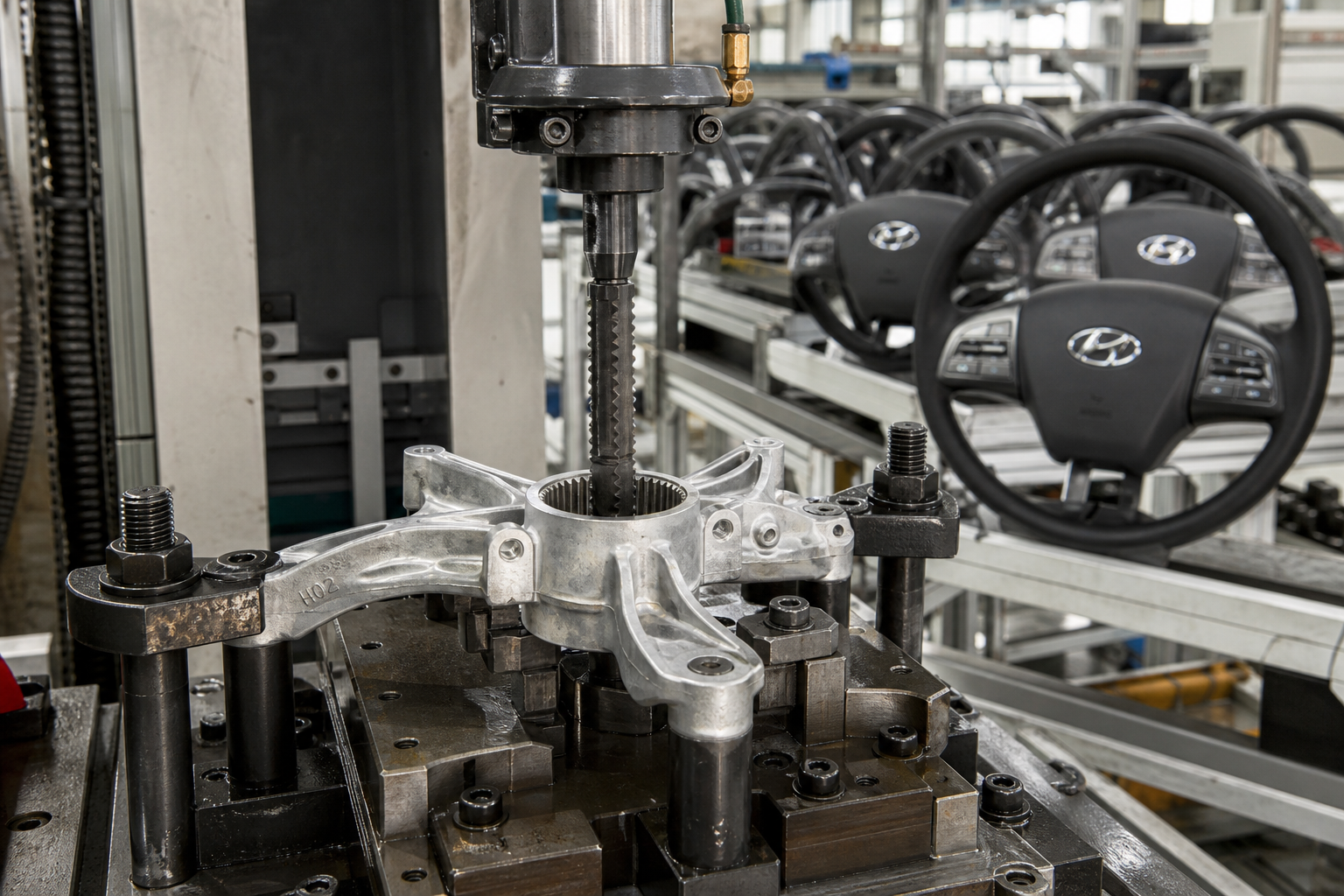
Two machine architectures dominate this work. The horizontal configuration strokes the broach along a level guideway, with the workpiece presented at the side — well suited to long grooves, multi-station tables and parts that flow along a line, since gravity does not fight chip evacuation from the cut. Our CNC horizontal side-broaching machine for tenon and groove work is the representative example: a horizontal bed, CNC-controlled positioning and stroke, and tooling configured for external tenon forms and lateral grooves on the same platform.
The vertical configuration stands the cutting axis upright: the part sits on or beside a vertical slide, and the broach strokes downward or the workpiece is fed past it. Vertical machines shine where floor space is tight, where the part is better presented flat, or where mortise-type features open downward for clean chip flow. The CNC vertical side-broaching machine with mortise and groove capability pairs that architecture with CNC control for combined tenon, mortise and groove features. The choice between them is a plant-layout and part-geometry decision rather than a capability hierarchy — both cut the same forms to the same discipline.
Why CNC Changes Tenon and Mortise Production
On a dedicated mechanical broaching machine, one fixture, one tool and one stroke make one feature, and changeover means physical retooling. A CNC side-broaching machine reorganizes that economics. Numerical control governs the stroke — position, speed and dwell — and, just as importantly, the auxiliary motion: table indexing between stations, workpiece shuttling, tool-carrier exchange and clamping sequences. In practice this yields three advantages that matter for joint work specifically.
First, multi-feature parts in one setup. A part needing a tenon on one face and a mortise groove on another can be machined across programmed stations without re-fixturing, which protects the datum relationship between the male and female features — exactly the relationship the assembled joint depends on. Second, multi-station and palletized production: while one part cuts, the next loads, so the aggressive per-stroke productivity of broaching is not diluted by load time. Third, changeover flexibility: for the mixed, medium-volume production that structural and equipment components typically see, a new part can mean a stored program and a tooling change rather than a rebuilt line.
One clarification keeps expectations honest: the CNC does not generate the broached profile by interpolation, the way a mill traces a contour. The finished form still lives in the ground broach — that is where broaching gets its speed and repeatability. What the control adds is everything around the cut: where it happens, in what order, at what stroke conditions, and how quickly the machine switches between them. The combination — deterministic tool-defined geometry plus programmable process — is what makes CNC side broaching the standard answer for tenon and mortise work at production scale.
Fit and Tolerance: Controlling Slot Width and Flank Position
A tenon-and-mortise joint is specified by more than dimensions — it is specified by fit. Clearance fits let the tenon slide or pivot in the mortise; transition fits locate with minimal play for pinned or bolted assemblies; interference fits lock the pair until disassembly forces or heat release them. The controlling dimension in nearly every case is slot width (and its complement, tenon width), together with the symmetry of the pair about their datums. A slot-width deviation of five hundredths of a millimeter changes the joint from snug to sloppy, and asymmetry that would pass a dimensional check can still bind an assembly.
Broaching earns its place here through distribution control. Because groove width is set by the tool’s finishing teeth rather than by a machine axis responding to a servo loop, tool wear is the dominant source of drift — and it is gradual, monitorable and correctable by presetting. Across a production run, slot widths come out in a tight distribution centered on the grind, which is precisely what fit-class control requires. Flank squareness and groove parallelism to the part datum are governed by the guideway and fixture, both stable references. The practical discipline is to control tenon and mortise on separate tools, each calibrated to its side of the fit band, with a common datum scheme transferring between them — then the pairs assemble interchangeably without matching or sorting.
Broaching vs. Milling Tenons and Mortises
The traditional alternative is milling: a slotting or end mill generating the groove, and a profile or end mill forming the tenon, typically in multiple passes with the contour built up from straight cuts or interpolated arcs. Milling wins on flexibility — one machine, one tool library, any prototype geometry today and a different one tomorrow, with no special tooling lead time. For one-off fixtures, repair work and short-run parts, milling is usually the right call.
As volumes rise, the trade inverts, for reasons we lay out in detail in our comparison of broaching versus milling for keyways and profiles. A broach finishes the form in one stroke measured in seconds; a milled groove needs multiple passes, tool changes and path segments, so cycle time — and per-part cost — multiplies. A broached form repeats identically because every part passes the same finishing teeth; a milled form inherits variation from tool wear, deflection and program execution on every part. And forms that milling must approximate with flats and arcs — dovetail flanks, crowned tenon tops, compound groove sections — a broach cuts exactly, because the grind defines them. For a joint whose function is fit, that consistency is the argument.
Fixturing and Tooling Essentials
Tenon and mortise work is unforgiving of fixture shortcuts, because the cut is short and the forces are high. The principles are those in our broaching fixture design guide, and a few carry particular weight for joint features. Datum discipline comes first: the fixture must locate the part from the same datums the joint’s symmetry is dimensioned from — a bore, a machined face, a previously cut groove — so form accuracy is not spent recovering location. Clamping must close its force loop through stiff material into the cut zone without deflecting the wall being broached; slender sections, long extrusions and thin-walled castings need support backers or full-envelope nests to keep the groove straight under load.
Chip management is the second constant: lateral grooves trap chips against the fixture, so flushing and clearance paths are designed in, not improvised. Tooling strategy completes the picture — slab broaches for open grooves, form broaches for compound mortise sections, separate roughing and finishing tools where volumes justify the split, and preset tooling with documented grind offsets so a tool change does not become a re-qualification exercise. On a CNC machine, fixture and tool data live with the part program, which is what makes fast, repeatable changeovers realistic rather than aspirational.
Choosing a Configuration and Related Guides
Selecting a machine for joint work follows the feature map. Parts whose tenons dominate — external tongues, rails and steps on accessible faces — point toward surface-broaching platforms and horizontal side-broaching configurations. Parts whose mortises dominate, or which combine open-face grooves with recessed channels, point toward the vertical side-broaching form factor or a horizontal machine with multi-station tooling. Mixed parts with both male and female features in one datum scheme are the natural territory of CNC side-broaching machines, horizontal or vertical, where both feature families run in one setup. The overview of available broaching machines lays out the platforms side by side, and the companion guides referenced above — surface broaching for external forms, keyway broaching for in-bore work — complete the map by feature location.
Frequently Asked Questions
Do tenons and mortises exist in metal parts, or only in woodworking?
They are widespread in metal manufacturing. Any male feature that enters a female feature to locate and carry load qualifies: drive keys and clamping flats on cutting-tool interfaces, hub grooves in clutches, keyed ways on machine slides, slot-and-insert joints in aluminum structural framing, and pin-boss clevis joints on agricultural and construction equipment. Unlike woodworking joints, metal pairs are usually cut to a clearance or transition fit and locked mechanically — the machined geometry provides location and bearing, not adhesion.
What is side broaching?
Side broaching is broaching in which the tool travels horizontally and cuts into the workpiece laterally — from the side, rather than through a hole. A form-ground broach strokes past the clamped part and generates a groove, slot, recess or external tenon profile in one pass. It is the standard method for mortise-type features that live on an outside face or wall, and it is practiced on two machine architectures: horizontal side-broaching machines and vertical side-broaching machines, both available in CNC configurations.
Tenon and mortise broaching vs. milling — when is each the right choice?
Milling is right for prototypes, one-offs and short runs, where its flexibility and lack of special tooling lead time dominate. Broaching is right at production volumes: one stroke finishes the form in seconds, the ground tool reproduces the identical profile on every part, and compound forms — dovetails, crowned sections, exact flank angles — come out as ground rather than approximated. Since joint function depends on fit consistency, the repeatability of a finishing tooth is usually the deciding factor once annual quantities justify a broach.
What machines cut metal tenons and mortises?
External tenons are cut on surface-broaching platforms and side-broaching machines; mortises and grooves on outside faces are cut on side-broaching machines in horizontal or vertical configuration; grooves inside bores go to keyway broaching machines. For parts combining male and female features, CNC side-broaching machines run both in one setup with programmed positioning, indexing and stroke control — the horizontal form favoring long grooves and line layouts, the vertical form favoring compact footprints and downward chip flow.
If your parts carry tenons, mortises or matching groove pairs that must assemble interchangeably at volume, that is the work these machines are built around. Send the part drawings, material specification and annual quantities, and our engineering team will return a machine, broach and fixture configuration with stroke and cycle time worked out against your workpiece. Start on the CNC horizontal side-broaching machine or vertical side-broaching machine pages, or contact us directly with your workpiece details.