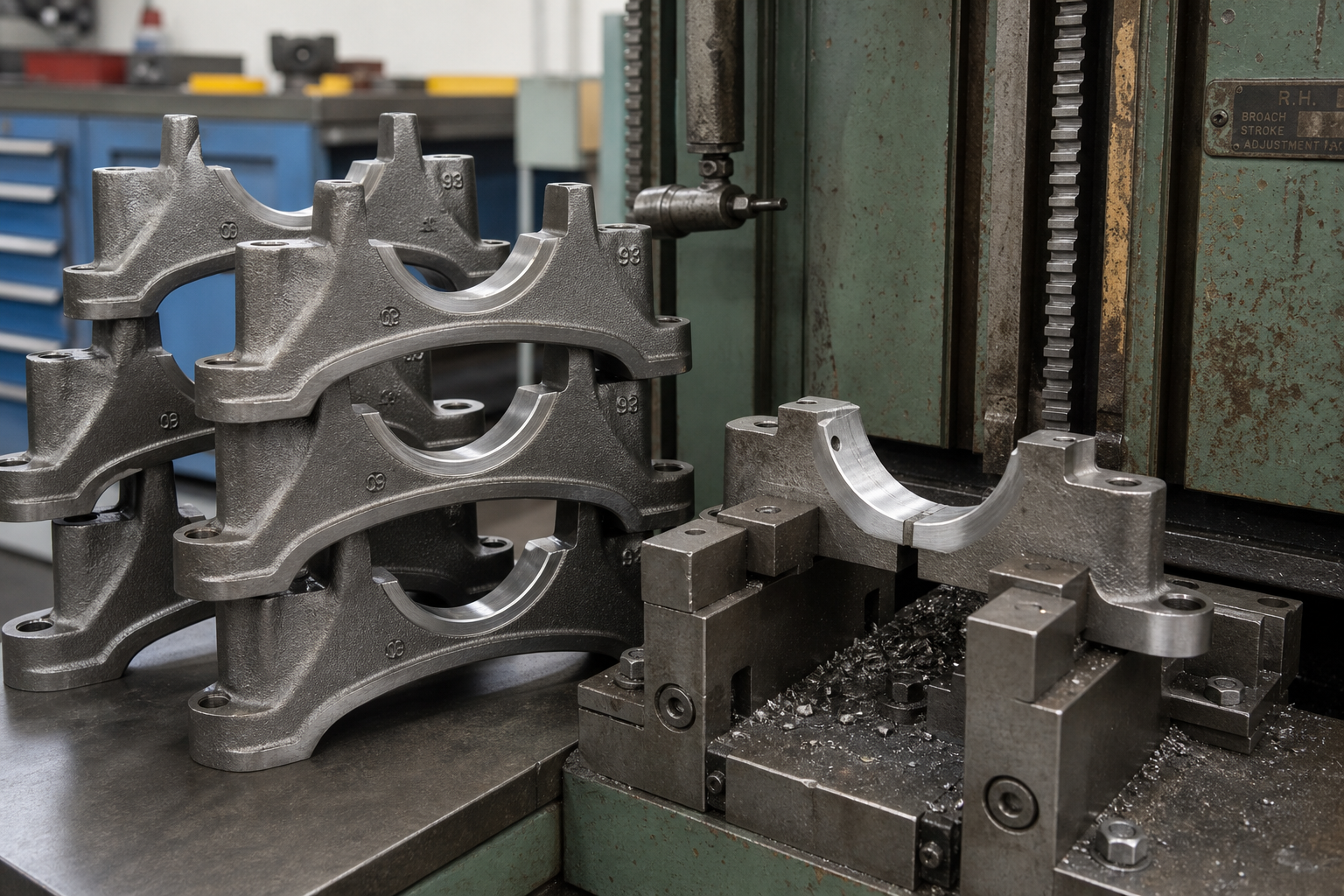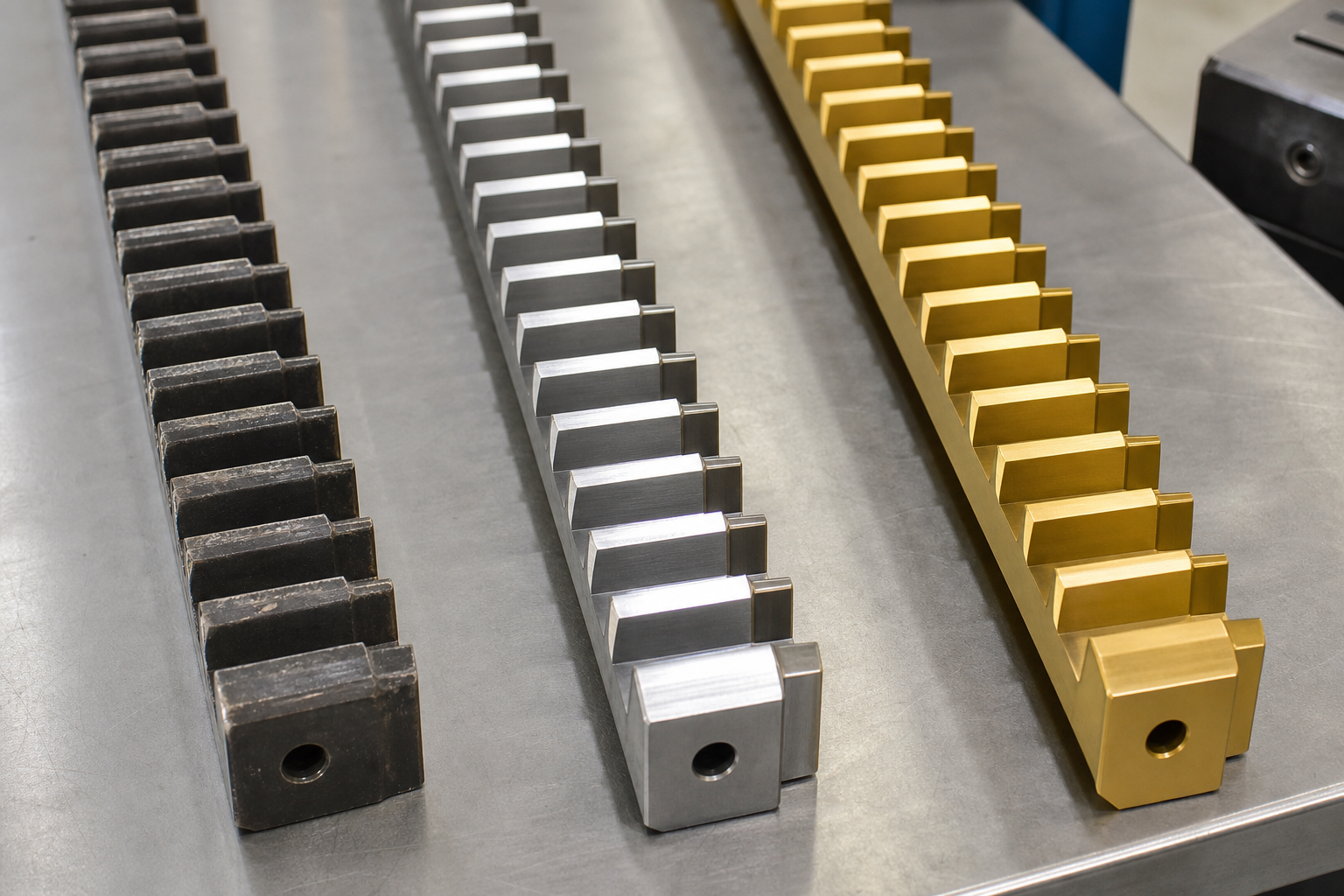
A production broach is, pound for pound, some of the most expensive steel in your tool crib. A worn one is not scrap — it is an asset with remaining life locked inside it, and broach reconditioning is the discipline of releasing that life economically. Done well, it keeps a broach cutting at specification for many cycles between factory-fresh and retirement; done carelessly, it shortens tool life, drifts part dimensions out of tolerance, and can turn a regrindable tool into scrap in a single pass across a badly dressed wheel.
This guide is the reconditioning side of the story: the process, what it can and cannot restore, the economics, and how to evaluate who does the work. We have already covered the warning signs that a tool is due — chattering, rising cutting force, deteriorating finish — in when to resharpen a broach tool, and how long a broach lasts in broach tool life. Those two are the “when” and the “why”; this article is the “how,” the “how far,” and the “how much.” One idea carries the whole subject: every broach is designed with a finite reconditioning reserve, every intervention draws that reserve down, and nothing puts it back.
The Broach Reconditioning Spectrum: Three Levels of Intervention
“Broach reconditioning” gets used loosely for everything from a touch-up regrind to a full rebuild, which is why shops get wildly different quotes for what they thought was the same job. In practice there are three distinct tiers, and knowing which one your tool needs is the first economic decision you make. If broach anatomy — tooth rise, cutting sections, sizing teeth — is new to you, our Der umfassende Leitfaden zu Broschen covers it first.
| Tier | What it includes | What it fixes | Typical trigger |
|---|---|---|---|
| Field regrind (sharpening) | Cleaning, inspection, rake-face grinding on every cutting tooth, edge honing | Dull edges; rising cutting forces; poor finish | Normal edge wear, dimensions still inside tolerance |
| Full reconditioning / remanufacture | Regrind plus tooth-form repair, chipped-tooth rework, straightening, recoating | Wear plus minor chipping, slight bow, degraded coating | Several problems stacked, or dimensions nearing the tolerance limit |
| Replacement | A new broach | Nothing — it retires the tool | Reserve exhausted, excessive tooth damage, or a part change |
The tiers are not interchangeable. A regrind on a broach that needs tooth-form repair burns grinding reserve without fixing the problem; a full remanufacture on a tool that only needed sharpening pays for life it cannot add. Correct tier selection starts with an honest incoming inspection — which is why every reputable provider, including our own broach reconditioning service, begins there, not at the grinder.
What Reconditioning Restores — and What It Cannot
This is where most of the money hides. A regrind is a powerful restoration process with exactly one hard limit, and the limit is physical, not commercial.
What a regrind fully restores: cutting-edge geometry
Grinding the rake face re-creates everything that made the tool cut well when new: the rake angle, the keenness of the edge, the micro-geometry of the tooth face, the surface texture the chip slides across. Cutting forces drop back toward their original values, chip formation cleans up, workpiece finish recovers, and the risk of built-up edge and chipping retreats. In cutting performance, a properly reground broach is a sharp broach again.
What no regrind can restore: tool length and the dimensional chain
Here is the hard limit. When the rake face is ground, the new edge sits slightly further back along the tooth than the old one, and every tooth’s effective dimension shifts with it. On an internal broach, the finishing and sizing teeth lose a little diameter with each regrind cycle, so the hole the broach produces trends in one direction; on a keyway or surface broach the same happens in tooth height, and the working section grows marginally shorter. This is not a defect of the process — it is the direct geometric consequence of removing material from the face; no skill can grind it back.
Broach designers plan for this. A new broach is built with deliberate room — the reconditioning reserve — so it can absorb a limited number of regrinds before the produced dimension walks out of part tolerance; some designs extend that reserve with extra sizing teeth that can be re-purposed as cutting teeth as the tool ages. The consequence: every broach has a finite, design-set number of sharpenings in it, and managing the tool is largely the job of not wasting them. Every regrind should remove the minimum consistent with a clean, sound edge — aggressive grinding not only risks burning the edge, it spends reserve you cannot replace.
What can be reapplied: coatings
PVD coatings worn or stripped in service can be reapplied after regrinding. TiN remains the general-purpose workhorse for broaching steels; TiCN offers higher hardness for abrasive workpieces; TiAlN holds its properties at higher temperatures for demanding applications. A regrind naturally strips coating from the edge region, and recoating usually requires stripping residual old coating first so the new layer bonds to clean substrate. Recoating is optional and not always justified: on short-run work a sharp uncoated edge may be adequate, while on high-volume abrasive parts a coating meaningfully stretches the interval between regrinds — a per-application call, one more reason inspection should precede pricing.
The Reconditioning Process, Step by Step
Whether the work happens in your shop or ours, sound reconditioning follows the same sequence — use it as a process map and an audit checklist for any provider, including your own in-house setup.
1. Clean and inspect incoming
The broach is cleaned of chips, swarf and coolant residue, then examined tooth by tooth under magnification: edge wear, chip locations and severity, cracking, bow, and where the produced dimension currently sits. This inspection decides everything downstream — which tier applies, whether recoating is worth it, whether the tool is a candidate at all. The measurement methodology is covered in our broach tool inspection guide.
2. Index and establish reference
The broach is mounted between centers or on its functional locating features — the shank and pilots are the datum, as in the machine — and each tooth is presented to the wheel in sequence with accurate indexing. Indexing error is one of the two classic ways a regrind goes wrong: teeth that receive uneven removal make tooth rise uneven along the tool, loading some teeth beyond their design share, with size and finish problems that follow the tool back into production.
3. Grind the rake faces
The heart of the operation: each tooth’s rake face is ground with a formed wheel, removing the worn layer and re-establishing the designed rake angle and face geometry. Two failure modes dominate. The first is grinding burn — excessive feed or a glazed wheel overheats the edge, tempering the steel behind it, so the regrind looks perfect while the edge breaks down in a fraction of its expected life. The second is over-grinding, spending dimensional reserve unnecessarily.
4. Hone and deburr the edges
A freshly ground edge carries microscopic burrs and serrations; used as-is, it chips microscopically at the start of the next run. Edge honing — deliberately radiusing the edge by a small, controlled amount — removes those weak points and stabilizes early tool life. It is standard practice on quality reconditioning, and effectively mandatory before recoating, since coatings adhere poorly to razor-sharp unstable edges.
5. Recoat (optional)
Where the application justifies it, residual coating is stripped and a new PVD layer applied as discussed above. Reputable shops either coat in-house or work with a named coating partner, and can say which coating they apply and why.
6. Final dimensional and runout verification
The finished tool is re-measured: tooth form against the design profile, the produced dimension against part tolerance, and runout relative to the mounting datums. A provider who cannot show these numbers is asking you to discover their errors on your production floor. Ask for the inspection record with every returned broach — over time it becomes the wear history that says how much reserve each tool has left.
The Economics: Regrind, Retire, or Replace
Three numbers govern every reconditioning decision: the cost of the intervention, the price of a replacement broach, and how many serviceable cycles remain in the tool afterward. The third is the number shops forget — and the only one that changes over a broach’s life. On the headline economics, a regrind costs only a small fraction of the price of a new broach — the longer and more complex the tool, the more dramatic the ratio — so every early-cycle regrind is emphatically worth making. Full reconditioning costs more than a simple regrind but still lands well below replacement.
The subtlety arrives late in the tool’s life. Each regrind consumes dimensional reserve, so the number of remaining cycles shrinks every time while the cost of the next regrind stays roughly constant — and at some point, paying even a fraction-price for one short final cycle approaches the per-cycle cost of buying new. Seasoned tool cribs therefore track a wear history per broach: cycle count, regrind count, and where the produced dimension sits inside the tolerance band. That record — the same record a good provider hands you with every job — turns the end-of-life decision from a guess into arithmetic.
Finally, price in downtime. If the broach is a single point of failure and you hold no duplicate, the true cost includes every hour the line waits for the tool — which can exceed the regrind invoice itself. The standard remedies are a standby broach and scheduling reconditioning around production breaks instead of running tools to failure; the tool life guide covers the planning side.
When a Broach Is Beyond Reconditioning
Some tools should be retired, and knowing it early saves a wasted regrind and the scrap parts a marginal tool produces. Four conditions end a broach’s service life:
- The dimensional reserve is exhausted. The produced dimension has drifted to the tolerance boundary and the sizing section has no grind stock left. Every further sharpening produces out-of-tolerance parts — this is the design end of life, and the correct one.
- Tooth damage exceeds repairable limits. An isolated chipped tooth can often be reworked with its stock redistributed across neighbors. But damage spanning multiple adjacent teeth, reaching the sizing section, or removing a large share of a tooth cannot be blended out without destroying the tooth-rise progression.
- The bow exceeds straightening limits. Slender broaches can be press-straightened during full reconditioning, but only within limits — a bend too severe, one that recurs after straightening, or cracking along the bend means structural integrity is gone. Straightening is rehabilitation, not resurrection.
- The part changed. A new workpiece with a different profile, material or tolerance may need a tooth rise, pitch or length the existing tool can never deliver. Reconditioning restores a broach to its own design; it cannot redesign the broach.
When one of these lines is crossed, replacement is not the expensive option — continuing to recondition is. Specifying the replacement is a fresh design decision, and a manufacturer who can both build the new tool and recondition it for its whole life, as our Räumnadeln line is set up to do, keeps both decisions in one feedback loop.
Regrind In-House or Outsource?
For shops running enough broaches, the in-house question comes up yearly. It can make sense — but the entry ticket is higher than most expect, because the machine is the cheap part.
Competent in-house broach regrinding requires a tool grinder configured for the job: workholding between centers with accurate indexing for the tooth pitch, formed wheels matched to your rake geometry, dressing equipment and flood coolant. It requires measurement capability — a projector or comparable tooth-form check, plus runout and produced-dimension verification. And it requires a person with genuine broach-grinding experience, because indexing error and burn are invisible on the finished tool and surface only as mystery tool life lost weeks later. Shops grinding a few broaches a month on a general-purpose setup often pay their “savings” back several times over in shortened tool life.
The honest case for in-house is volume plus speed: a shop with dozens of active broaches justifies the capability and gains same-day turnaround. The honest case for outsourcing is everything else — expertise concentrated in people who grind broaches all day, access to recoating, straightening and tooth-form repair you will never justify in-house, and an independent inspection record with every job. Its weakness is lead time: external work typically takes days to a couple of weeks depending on scope and coating, which is why the standby-broach strategy matters. Whichever path you choose, hold the work to the same acceptance checks: an incoming inspection report, a statement of what was ground and why, and final dimensional and runout numbers.
How to Evaluate a Broach Reconditioning Provider
Whether you outsource entirely or send out only the hard jobs, use the same checklist — it maps directly onto the process steps above:
- Grinding equipment: tool grinders with proper indexing and workholding for broaches of your length and type — not a universal cutter grinder making do.
- Inspection capability: magnified tooth-by-tooth incoming inspection, tooth-form verification, and runout measurement, documented and shared.
- Full-scope services: straightening, chipped-tooth rework, and recoating — so tier selection is driven by the tool’s condition, not the provider’s limitations.
- Process transparency: minimum-stock grinding policy, edge honing as standard, and a willingness to explain what they found and did.
- Lead time and communication: committed turnaround you can plan production around, and honest escalation when inspection changes the scope.
- Wear history: per-tool records across visits, so “how much reserve is left in this broach?” gets answered with data.
We hold our own broach reconditioning service to exactly this framework — inspection before commitment, minimum-stock grinding, documented results, recoating support — and we encourage you to apply the checklist to any provider you evaluate, including us.
Preventive Practices That Stretch the Regrind Interval
The cheapest reconditioning is the one you postpone: every practice that reduces wear per part pushes the next regrind further out and makes each of the tool’s finite sharpenings buy more parts. That is why prevention belongs inside the reconditioning budget, not beside it. Four practices carry most of the weight.
- Alignment and guiding: a broach cutting true to its axis wears evenly; one cutting crooked wears unevenly and burns dimensional reserve faster. Keep guideways, guides and fixture alignment within spec.
- Coolant cleanliness and coverage: filtered coolant delivered to the cutting zone carries heat and chips away; dirty coolant recirculates abrasive fines straight into the cut.
- Stored like a precision gage: broaches stored vertically or fully supported, teeth protected from nicking, surfaces protected from corrosion. A dropped broach can chip in one second what years of careful use would not wear.
- Condition monitoring: tracking cutting force and surface finish so the tool comes off for sharpening when due, not after it degrades into chipping.
The machine side — alignment checks, hydraulic condition, guidance wear — is laid out in our broaching machine preventive maintenance checklist. Together with the resharpening signals article and the tool life guide, it completes the loop: maintain to wear slowly, detect to sharpen on time, recondition to restore, replace only when the reserve is truly spent.
Häufig gestellte Fragen
How many times can a broach be sharpened?
A limited number of times, set by the reconditioning reserve designed into the tool, and it varies by type: simple round or keyway broaches generally carry more reserve than long, complex spline or form broaches, and aggressive or burned regrinds consume reserve faster than skilled minimum-stock grinding. There is no universal count. What matters is tracking the produced dimension against tolerance; a provider who measures your tool can give you a realistic remaining-cycle estimate.
How much does broach reconditioning cost?
Relative to the alternative, it is inexpensive: a regrind typically runs to a small fraction of the price of a new broach, and full reconditioning — regrind plus tooth repair, straightening and recoating — still lands well below replacement. Within that, price scales with broach length and complexity, the damage found, and whether recoating is applied. Reputable providers quote against an actual incoming inspection rather than a price list — so send the tool, don’t shop for a number.
Can a broken broach be repaired?
It depends what “broken” means. An isolated chipped tooth is routinely repaired during full reconditioning, and a bowed broach within straightening limits is straightened. But a broach snapped across its section, or with cracking in the body, is finished: it is a single structural member carrying the full pulling load, and a repaired joint cannot be trusted to carry it. That tool is a replacement — and the useful question is what drove it: overload, misalignment, or a dull tool pulled too hard.
How do I know if my broach needs regrinding?
Rising cutting force or motor load, deteriorating surface finish, dimensional drift toward a tolerance limit, a visible wear land under magnification, and chatter during the cut. Any one justifies pulling the tool; two together mean it is overdue. We cover each signal in detail in the when to resharpen a broach tool guide.
Get Your Broaches Assessed
The cheapest next step in broach management is an inspection. Send us your worn or suspected broaches and we will examine them tooth by tooth, tell you honestly which tier each needs — regrind, full reconditioning, or retirement — and quote against what we actually find. If a tool is beyond saving, we will say so and spec its replacement from our Räumnadeln manufacturing line, keeping the new tool and its future reconditioning in one loop. Start at the broach reconditioning service page to request an assessment.