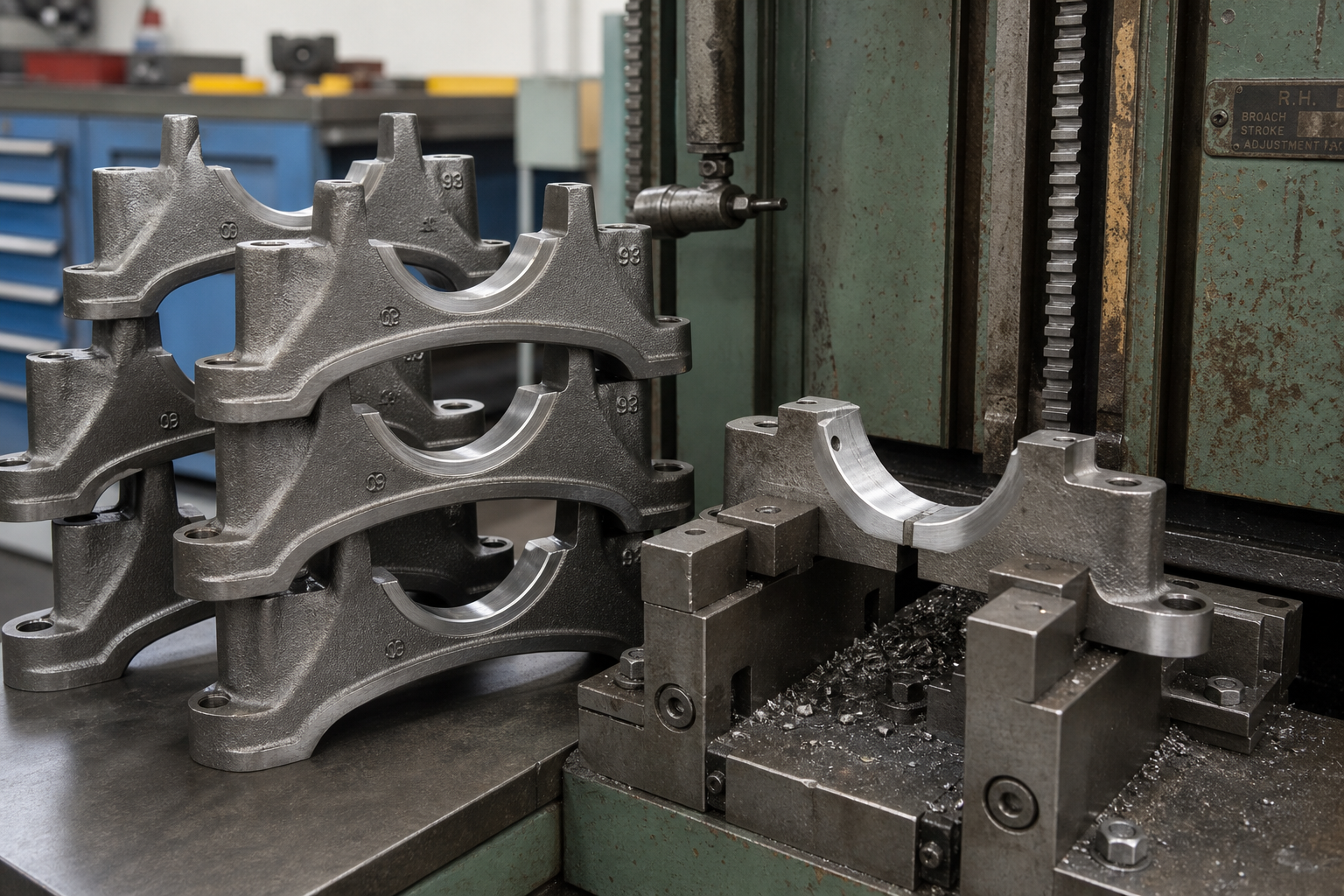
Shopping for a broaching machine for sale usually starts the same way: a browser tab full of dealer listings, marketplace pages, and auction catalogs. What none of those listings tell you is whether a used broaching machine or a new one is the right buy for your shop. That decision depends on the machine’s production role, your maintenance capability, and your tolerance for downtime — not on which listing looks cheapest.
This guide walks through the used market and where its machines come from, the real price ranges, the risks hidden under a repainted machine, a hands-on inspection checklist, the remanufactured middle path, and a five-year total-cost-of-ownership framework for comparing every option against a new build.
Full disclosure up front: we manufacture new broaching machines, and we are still going to tell you that in several common scenarios, used is the smarter buy. You will see exactly which scenarios below — B2B buyers deserve the whole picture, and the whole picture is more useful to us than a one-sided pitch.
Where Used Broaching Machines Come From
Knowing why a machine is for sale tells you more than its spec sheet does. Used broaching machines reach the market through three main channels:
- Plant closures and liquidations. Machines from shops that shut down often ran until the final weeks, with maintenance deferred as cash tightened. These units surface at auction, typically sold as-is, where-is, with little or no inspection window.
- Upgrade displacement. A shop buys a faster or more automated line and sells the old machine to a dealer. These units tend to have better histories — always ask for maintenance records.
- Lease returns. Equipment returned at the end of a lease term, usually with moderate hours and sometimes refurbished before resale.
In the US market you will encounter four types of sellers:
- Dealer inventory — machines inspected and often mechanically refreshed, priced accordingly, occasionally with a short warranty or return window.
- Listing platforms and live auctions — the lowest prices and the highest risk, sold as-is with no recourse after the hammer falls.
- International marketplaces — broader inventory, largely European stock. Factor in ocean freight, import duty, and the supply mismatch: a machine built for a 400 V, 50 Hz supply needs a transformer and sometimes motor work to run on an American shop floor.
- Remanufacturing shops — turnkey rebuilt machines with modern controls, covered separately below.
What a Used Broaching Machine Actually Costs
On the open market, used horizontal broaching machines from established brands such as Ekin commonly list between $10,000 and $30,000, while high-end vertical machines list meaningfully higher. Marketplace-listed prices vary widely with tonnage, age, condition, and whether tooling is included, so treat these figures as orientation, not quotation.
A useful mental model: a horizontal broacher that represented a mid-six-figure capital line item when new can surface years later in the low five figures. That discount is real — and it is also where the risk budget lives, because the gap between “runs” and “runs to spec” is exactly what listing photos cannot show you.
New machines price by capability: compact vertical machines occupy the lower end of the range, while long-stroke horizontal and CNC machines with automated part handling sit at the top — separated by an order of magnitude. If you are early in the process, defining your tonnage and stroke requirements first will narrow the price question faster than browsing listings ever will.
When Buying Used Is the Right Call
There are four situations where a used broaching machine is genuinely the better business decision:
- Hard capital constraints. When the capex ceiling is fixed and the real choice is a used machine now versus no machine at all, used wins by default. Capacity that ships this quarter beats perfect capacity that never gets approved.
- Short contract life. If the machine serves a contract with a defined end date and the workload will not outlive it, minimizing capital at risk matters more than maximizing service life.
- Backup and redundancy. A standby machine that carries load only when the primary is down does not need primary-machine reliability. Older iron is well suited to low-duty roles.
- Legacy broach inventories. Cutting tools are among the most expensive assets in a broaching operation. If you hold a rack of broaches ground for a specific legacy model, a good-condition unit of that same model keeps that tooling productive — replacing the tooling and the machine together is a far larger project.
The common thread: used machines fit where the machine itself is not the constraint on your business.
The Hidden Risks in a Used Broaching Machine
This is the section listing pages never print. Five failure modes consistently separate a bargain from a money pit, and none of them are visible in photographs.
Guide wear and cylinder wear you cannot see
The nameplate tonnage is not today’s tonnage. Rated force depends on the condition of the hydraulic cylinder bore, the piston seals, and the guide ways. A scored cylinder wall or hardened seals leak pressure internally, and the machine delivers less force than its data plate claims — often discovered only when a broach stalls mid-cut on a tough part. Worn guide ways show up differently: ram play translates into keyway symmetry errors, taper, and surface-finish drift that quietly raise scrap rates. Cosmetic repainting, unfortunately, is most often applied to exactly these machines.
Obsolete controls and the spare-parts cliff
Many serviceable used broachers run on relay logic or early PLC platforms whose modules are long out of production. When one of those boards fails, the machine sits for weeks while you hunt salvage parts. Safety circuits present a parallel problem: machines built before current expectations often lack light curtains, two-hand controls, and guarded interlocks, and bringing them up to modern practice is an electrical project of its own. Budget the control system as its own line item, not a footnote.
Hydraulic internal leakage
Aging seals and worn cylinders produce a recognizable symptom set: the pump cannot reach rated pressure, pressure decays during a hold test, the ram creeps or moves in stick-slip fashion, and cutting speed drifts as oil temperature rises. Seal kits are affordable; a scored cylinder bore that needs re-honing or re-boring is not. We cover the failure signatures and their causes in detail in our guide to common hydraulic broaching machine failures.
No documentation, no warranty, no support
As-is machines frequently arrive without hydraulic schematics, electrical drawings, or tool-interface dimensions. Every future repair starts with reverse-engineering. Simple jobs — identifying a seal kit, tracing a faulty limit switch — turn into day-long diagnostics. And if the original manufacturer is out of business, there is no one to call at any price.
The refurbishment bill that eats the discount
Tally a realistic re-commissioning: full seal replacement, hydraulic oil and filters, electrical safety upgrades, freight, rigging, alignment, and a test-cut validation. On machines bought at deep discounts, this package routinely exceeds the discount itself. The honest comparison is used-plus-refurbishment versus new — never used versus new.
The Used-Machine Inspection Checklist
If you buy used, inspect in person or send a qualified inspector. Work through this list as written:
- Tonnage verification by test cut. The gold standard: ship a known part and your broach to the seller and run it on the machine under power. Short of that, witness the seller pull a demonstration part and measure finish and profile yourself.
- Stroke and tool interface. Measure stroke length, puller style, and tool-seat dimensions, then compare them against the broaches you intend to run. A stroke a few inches too short makes the machine worthless for your parts.
- Guide-way clearance. With a dial indicator, check ram side play at the top, middle, and bottom of travel in both axes. Readings that grow toward one end indicate wear concentration.
- Hydraulic pressure-hold test. Bring the system to rated pressure and isolate it. A gauge that bleeds down noticeably within minutes confirms internal leakage.
- Pump character and oil condition. Listen for cavitation whine or bearing growl. Pull an oil sample: dark, burnt-smelling, or water-hazed fluid tells you how the machine lived.
- Electrical cabinet review. Relay logic or PLC? If PLC, is the platform still supported? Inspect contactors for pitting, wiring for embrittlement, and the enclosure for contamination.
- Parts and manufacturer viability. Is the OEM still in business? Can you source seal kits, wear plates, and control components today? A cheap machine from a defunct builder can be a dead end.
- Records and hours. Maintenance logs and usage history materially change the risk assessment. Absent records, price the machine at your worst-case assumption.
Before the inspection, run your part numbers through our broaching machine tonnage calculation guide so you know the minimum machine you should even be considering.
Remanufactured Machines: The Middle Path
Between as-is used and new build sits remanufacturing: the machine is fully disassembled, the ways are re-scraped or ground, the hydraulic cylinder is re-bored or replaced with new sealing, and the control system is upgraded to a modern PLC with current safety practice. Unlike a repainted used machine, a true remanufactured build carries a warranty — typically measured in months — along with complete documentation.
Economically, remanufactured machines occupy the middle ground: a meaningful discount to a comparable new machine, with lead time usually shorter than a new build because the base castings already exist. The fit is specific — shops that want the heavy structure and geometry of a proven legacy model with contemporary controls and warranty coverage, without paying full new-machine price.
What a New Broaching Machine Gets You
Stated plainly, a new machine is priced around the failure modes above. Here is what the premium buys:
- Warranty and support. Defined coverage, spare-parts availability, and a manufacturer obligated to help when something goes wrong.
- Specification to your parts. Tonnage, stroke, fixture interfaces, part handling, and control system are built around your part family instead of adapted to it. If you are early in product selection, start with our guide to choosing the right broaching machine.
- Modern control and safety. Current PLC platforms, energy-efficient drives, and guarding built to contemporary ANSI and CE practice. If you are weighing drive technology, our servo versus hydraulic broaching machine comparison covers the trade-offs.
- Production integration. Clean interfaces to automation, conveyors, and plant data systems — practical for unattended or lightly attended cells.
- Financing. Leasing and staged-payment structures that spread the capital hit.
- Tooling alignment. The machine is designed around your existing broach inventory or your new-tooling procurement plan, so interface dimensions are correct on day one.
None of that makes used wrong. It makes new the rational premium when the machine sits on a critical path.
Buying a New Broaching Machine from China
Chinese manufacturers have become a major presence in the new broaching machine market, and buyers evaluating this route should assess it like any supply decision — on evidence, not assumptions.
The structural advantages are real: a mature domestic supply chain for castings, hydraulic components, and machine-tool elements supports competitive pricing, and engineering teams are accustomed to custom specification — tonnage, stroke, fixtures, CNC or servo control — built around customer part drawings rather than a fixed catalog. Lead times for comparable scope are typically shorter than Western custom builds.
The credibility of any individual manufacturer rests on process, and four practices separate serious exporters from the rest:
- Process engineering before quotation. A manufacturer that asks for your part drawings and returns a tonnage and stroke proposal is doing engineering; one that quotes from a price list alone is doing sales.
- Pre-shipment test cuts with your parts. Send sample workpieces and witness — in person or by video — the machine pull your actual geometry before it ships. A written test report should accompany the machine.
- Third-party inspection. SGS, Bureau Veritas, or TÜV inspection before shipment is a standard, reasonable request — and a good sign when a supplier volunteers it.
- Commercial terms understood in writing. FOB means you take responsibility and cost for freight and insurance from the port of loading; CIF covers freight to your destination port but typically not duties, inland transport, or installation. Whether commissioning and training are included belongs in the contract, not in a verbal assurance.
Ask also about spare-parts policy, response commitments, and reference installations in your industry. These questions apply equally to any manufacturer, anywhere.
The Five-Year Total-Cost View
Purchase price is the least informative number in the comparison. Over a five-year horizon, the picture looks like this:
| Cost element | Used (as-is) | Remanufactured | New |
|---|---|---|---|
| Acquisition price | Lowest | Middle | Highest |
| Re-commissioning and refurbishment | High — often consumes the discount | Included in price | Installation and setup only |
| Downtime exposure over 5 years | Highest — unproven systems | Moderate | Lowest — warranty aligned to break-in period |
| Annual maintenance | Unpredictable; rises with age | Known; documented | Planned; follows a preventive schedule |
| Tooling compatibility | Must match legacy interfaces | Re-specified at rebuild | Designed around your broaches |
| Documentation and diagnostics | Rarely complete | Complete | Complete |
| Residual value | Already depreciated; stable | Moderate | Highest through early life |
How to read it: when the machine is auxiliary capacity, the left column can win outright — the acquisition savings are real and the downtime exposure is cheap. When the machine is on your main line, invert the logic: at a four-figure hourly cost of a stopped line, reliability is not an upgrade — it is the product. A structured program — our broaching machine preventive maintenance checklist is a working example — is what keeps the right-hand columns honest.
Decision Framework: Used, Remanufactured, or New
Condensed to two lists:
Buy used when:
- The machine is backup or auxiliary capacity
- A hard budget ceiling makes new unfinanceable
- The workload has a defined end date
- You hold legacy broaches matched to the model
- You have in-house maintenance capability and schedule slack
Buy new when:
- The machine sits on your primary production line
- You are introducing a new part or process
- Your requirements — tonnage, stroke, automation, control — exceed what the used market currently lists
- The cell must run integrated or unattended
- You cannot afford the diagnostic overhead of legacy controls
Between the two — when you want legacy structure with modern control and a warranty — remanufactured is the designed answer.
Frequently Asked Questions
How much does a broaching machine cost?
New machines scale by type and capability over a wide range: compact vertical machines for short-stroke work occupy the lower end, while long-stroke horizontal machines and CNC models with automated handling sit at the top — separated by an order of magnitude. On the used market, horizontal broachers from established brands such as Ekin commonly list around $10,000 to $30,000, with high-end vertical machines higher; marketplace-listed prices vary with age, condition, and included tooling. The productive way to price the decision is by requirement: define tonnage and stroke first, then collect quotes against that specification.
What should I check when buying a used broaching machine?
The five checks that most often catch problems: witness a test cut under power; verify stroke length and tool-interface dimensions against your broaches; measure guide-way clearance with a dial indicator; run a pressure-hold test to expose internal leakage; and confirm that the control platform and critical spares are still obtainable. The full checklist is above — use it as written, not from memory.
Is a Chinese broaching machine reliable?
Reliability tracks the manufacturer, not the country. Assess any builder on specifics: willingness to run pre-shipment test cuts with your sample parts, acceptance of third-party inspection, documented export history in your industry, spare-parts and support commitments, and engineering depth evidenced by a real tonnage proposal against your drawings. Manufacturers who practice these routinely — in China or elsewhere — deliver dependable machines, and the verification steps above are exactly how you tell them apart.
Whichever direction the decision points, the first step is identical: convert your part drawings into tonnage, stroke, and interface requirements. We offer a free tonnage calculation and machine-selection review — send us your workpiece details and we will return the numbers, whether you end up buying from us, from a dealer’s used list, or at auction. Start with the tonnage calculation guide, or browse our broaching machine line to see what a purpose-built configuration looks like.