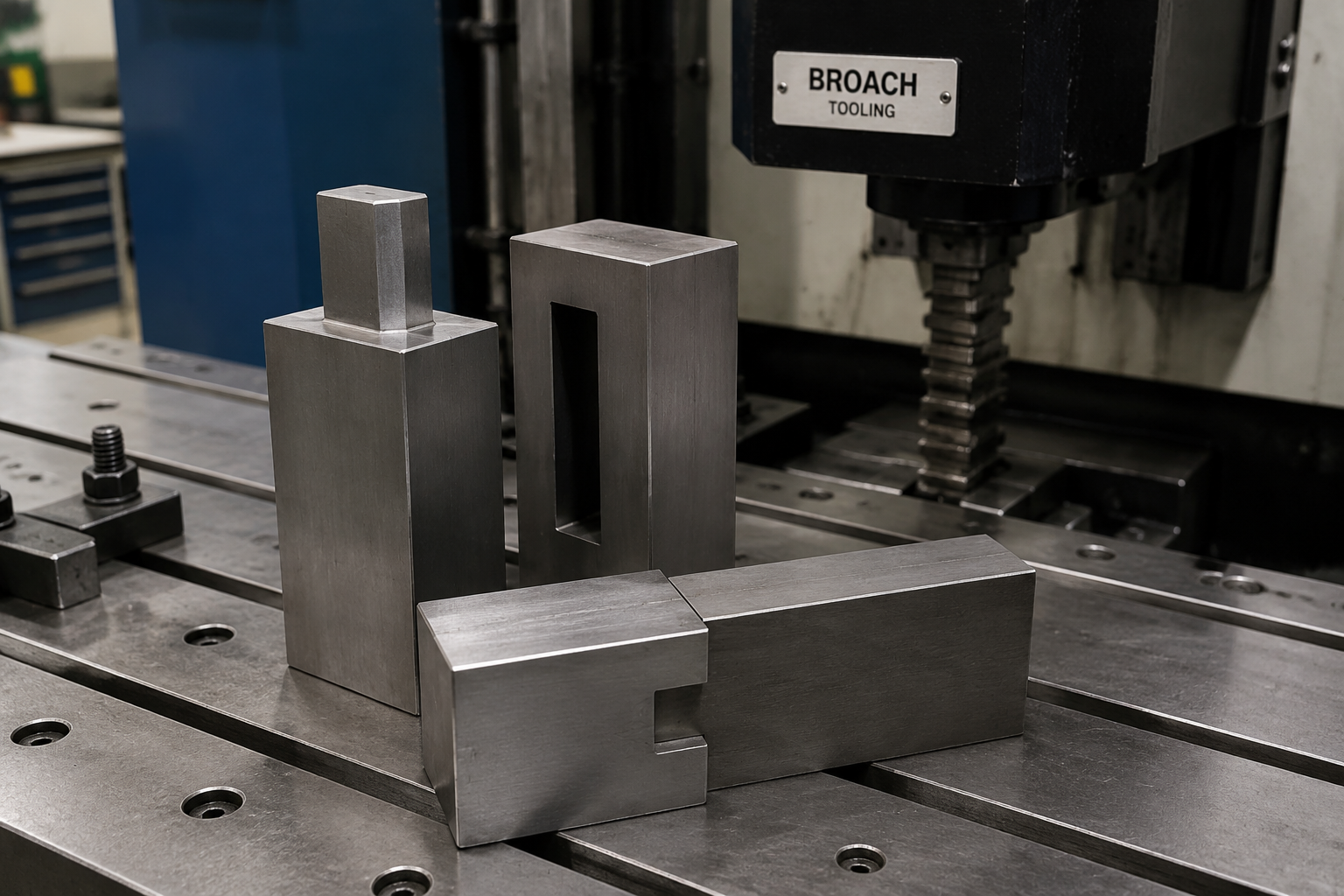
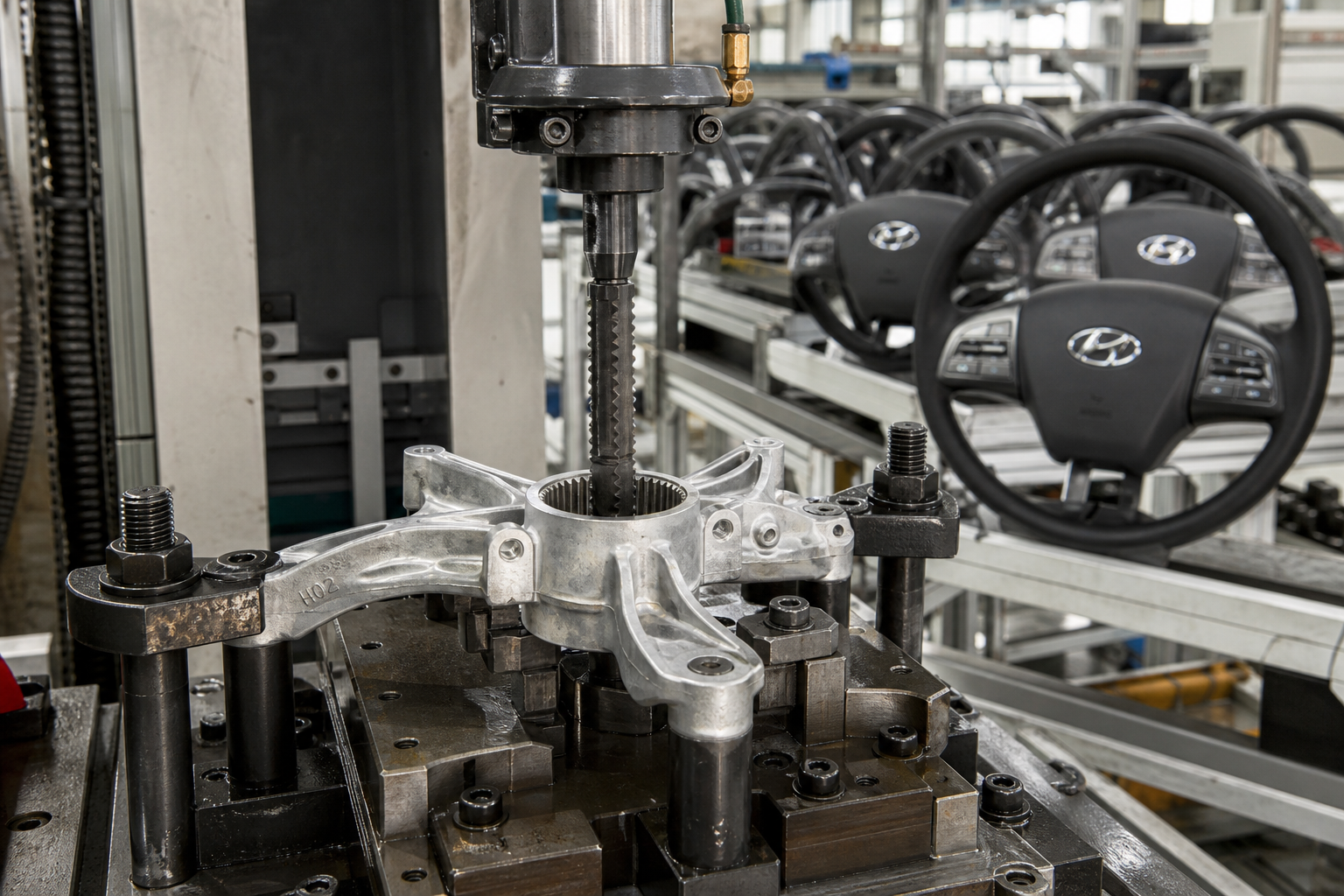
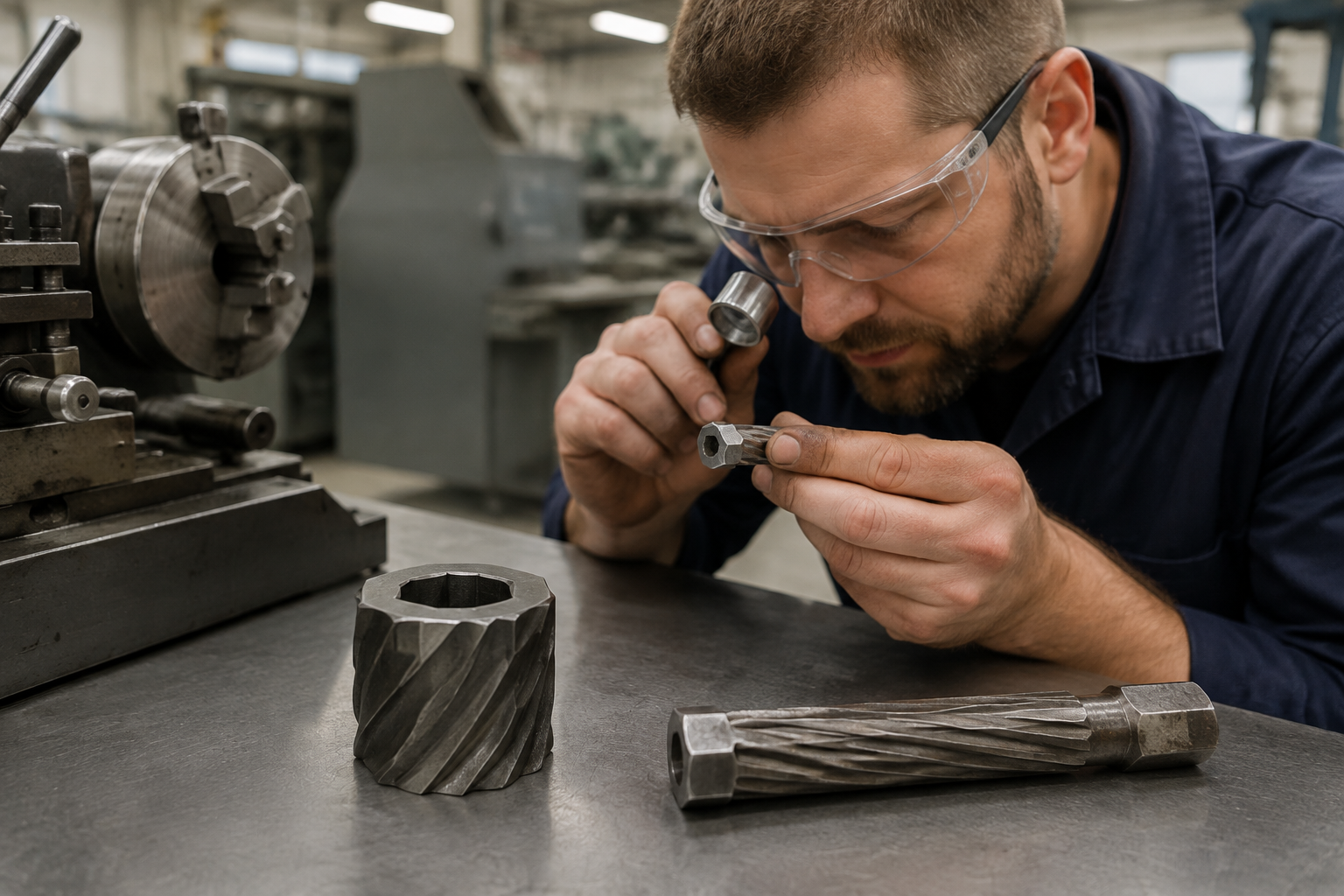
A shaft rarely carries just a journal and a thread. In power transmission, the shaft is the functional surface: external splines that slide into mating hubs, pinion teeth that mesh with driven gears, ratchet teeth that transmit torque one direction only, serrations and counting teeth that locate and lock. Special shaft tooth broaching cuts these external tooth forms on shaft blanks in one axial pass of a multi-tooth cutter — no generating motion, no tooth-by-tooth indexing cycle, no secondary finishing for most designs.
Most of the spline literature — including our complete guide to spline broaching — deals with the internal side: splines cut inside a hub bore. This article is about the mirror image. External tooth broaching on shafts has its own tooling concepts (pot broaching versus flat surface broaching), its own dividing-the-work question (when does a shaft tooth job belong to broaching and when to hobbing?), and its own workholding physics, because a slender shaft is nothing like a rigid hub blank. If you manufacture transmission or pinion shafts, this guide maps what broaching can do for those parts — and what it cannot.
What Is Special Shaft Tooth Broaching?
Special shaft tooth broaching is external broaching applied to tooth forms on cylindrical parts. A broach — a long bar of progressive cutting teeth, or a ring-shaped assembly of toothed inserts — moves axially along the shaft. Each tooth takes a thin chip; the finishing teeth carry the exact final profile. The geometry is not calculated into existence by a coordinated machine motion, as in hobbing or shaping: it is copied from the cutter. Whatever profile the tool designer grinds into the finishing teeth appears on the shaft.
That distinction explains almost everything about the process. Copying means any grindable profile is cuttable — involute splines, straight-sided splines, triangular serrations, ratchet teeth, asymmetric locking teeth, non-standard sprocket teeth — with no generating constraint. Copying means part-to-part consistency is exceptional, because every shaft is cut by the same finishing teeth. And copying means the tooling is part-specific: one broach per tooth design, which is why shaft tooth broaching earns its keep at production volumes rather than in one-off work.
The word special in the name is deliberate. Standard external gears and splines at high volume are, in most plants, the territory of hobbing, form rolling or powder metallurgy — established, economical processes. Shaft tooth broaching steps in where those processes struggle: tooth forms that cannot be generated, cycle times hobbing cannot meet, and parts where several external features must finish in one setup. The next section puts boundaries around that territory.
The Shaft Tooth Family: Which Teeth Fit Broaching?
Any transmission plant has the same families of external teeth on its shafts. They are not equally good broaching candidates, so sort them before making process decisions:
- External splines. Involute, straight-sided and triangular splines connecting sliding or fixed hubs — the classic broaching application on shafts. High volumes, tight pitch requirements, cut by pot broaching (all teeth in one pass) or flat surface broaching with indexing.
- Pinion teeth. Spur or helical pinions cut directly on a shaft. Broaching competes only in niches — small pinions at very high volumes, or pinions combined with other broached features — because hobbing handles the general case so well.
- Sprocket teeth. Standard roller chain sprockets are hobbed in huge quantities, but non-standard forms — odd pitches, sprockets merged with other shaft features — are natural broaching work.
- Ratchet teeth. Saw-tooth profiles for one-way torque transmission in hand tools, winches and jacks. Asymmetric and ungeneratable — a textbook forming-broaching part.
- Counting and indicator teeth. Small, uniformly spaced teeth on counters, meters and position indicators. Simple profiles, high counts, perfect for one-pass forming.
- Serrations and detent teeth. Fine-pitch serrations for press-fit joints, and detent teeth that index against a spring plunger.
Three questions decide whether a given tooth family belongs on a broaching machine. Can the profile be ground into a cutter? If yes, broaching can copy it — the forming advantage. What cycle time is required? Broaching finishes a toothed shaft in seconds; generating processes cut tooth by tooth and take far longer. Is the tooth one of several features on the part? When a shaft needs a spline plus a keyway plus a ratchet, a broaching line can sequence all of them in one machine or cell, eliminating setups between features. Three yeses — or two strong ones — and the part is a candidate.
External Spline Broaching: Flat Broach vs. Pot Broach
External splines on shafts are cut by two distinct broaching concepts, and choosing between them is the biggest process decision in shaft spline work.
Flat (surface) broaching. A flat spline broach is a long bar of teeth carrying the tooth-slot profile on its cutting edge. The shaft is held on a surface broaching machine — the family covered in our surface broaching machine guide — and the broach travels along the shaft axis, cutting one spline slot per pass. The part then indexes to the next tooth position until the full circle of teeth exists. Alternatively, two or more broaches attack the shaft from opposite sides in the same stroke, halving the index steps. Flat broaching suits longer shafts and larger sections, and pitch accuracy depends on the fixture’s dividing mechanism as well as the tool.
Pot broaching. The pot concept inverts the geometry. Instead of a bar of teeth passing along the outside of the shaft, a stack of ring-shaped cutter segments — the “pot” — encircles it. As the shaft passes axially through the ring stack, cutting edges arranged around each ring open all spline slots simultaneously and progressively; the final rings carry the finished profile. Every tooth is generated by the same stroke, so pitch-to-pitch accuracy is built into the ring assembly rather than accumulated through indexing. Cycle time is one pass — load, stroke, unload — which is why which is why pot broaching is the highest-production method for external splines. We treat the tooling system, ring design and process economics in the pot broaching process and tooling guide.
| Flat surface broaching | Pot broaching | |
|---|---|---|
| Cutter form | Flat bar broach, slot-profile teeth | Ring-shaped segments stacked around the shaft |
| Teeth cut per pass | One slot (or one per opposing broach) | All teeth simultaneously |
| Indexing | Required between passes, or multi-broach stations | None — one pass completes the spline |
| Pitch accuracy source | Tool profile plus fixture dividing accuracy | Ring segment positioning — built into the tool |
| Best fit | Long shafts, larger sections, spline sections located mid-shaft | High-volume splined shafts, sections near the shaft end, maximum output |
| Changeover | Swap broach and fixture | Swap pot assembly and pilot tooling |
Two practical notes from spline production. First, where the spline sits matters: a pot tool needs the shaft to pass completely through the ring stack, so end-of-shaft splines are ideal, while a spline mid-way along a long shaft may argue for flat broaching. Second, both methods cut in the soft state — broach before heat treatment and control distortion afterward, exactly as in the transmission gear internal spline and steering wheel hub spline cases. The assembly-line view of the mating hub work is covered in our steering wheel assembly broaching case; the same logic applies to the external teeth on the mating shaft.
Special Tooth Forms: Ratchets, Detents and Non-Standard Sprockets
Here forming broaching has no real rival. Generating processes — hobbing, shaping, power skiving — cut tooth forms that can be produced by a coordinated rotary feed between cutter and work. Ratchet teeth cannot: the saw-tooth profile with its steep driving flank and shallow back flank is not a generatable shape. The same holds for many detent and locking forms, asymmetric serrations, and sprocket teeth that deviate from chain standards. These profiles go to form cutters, and among form cutting processes, broaching finishes the complete toothed surface in a single stroke.
Consider a ratchet shaft for a load binder or a jack: dozens of asymmetric teeth around a medium-carbon steel shaft. On a shaping or slotting machine, each tooth is cut stroke by stroke and the part indexes dozens of times. A form broach — or a pot tool for end-of-shaft teeth — produces the entire ratchet in one pass. Tooth count stops being a cost driver: forty teeth take no longer to broach than twenty, because all are cut at once. That insensitivity to tooth count is why broaching dominates high-volume ratchet production, and why counting rings and serrations are so often broached even when a generating alternative technically exists.
Non-standard sprockets deserve a special mention. Designers sometimes need sprocket teeth merged into a shaft that also carries bearing journals, threads or a spline — a configuration that would force a gear-cutting machine into multiple setups. A special shaft tooth broaching sequence can cut the sprocket form, the spline and auxiliary keyways in one fixture family, keeping everything concentric to a common datum. When a toothed shaft starts to look like a system of features rather than a single gear, broaching’s one-setup capability becomes the argument.
Helical External Teeth: Spiral Splines on Shafts
Helical external teeth — spiral splines and helical pinion forms — add one variable: the cutting edge must advance around the circumference as it advances along the axis, tracing the helix. In broaching that rotation is not programmed; it is guided. A helical broaching guide biases the tool (or workpiece) to rotate through a precise arc over the stroke, so the copied profile follows the designed lead. Ring-type pot tooling achieves the same result by cutting the segments with the helix angle built in and letting the part rotate as it passes through.
The machine requirement is the point to check early: a helical broaching job needs stroke length, guide hardware and tool design matched to the lead angle, and not every surface broaching machine is equipped for it. Our helical broaching guide explains the guide mechanics and lead accuracy considerations — written around internal helical forms, but the rotation-guiding principle is identical for external teeth. If your shaft print calls out a helix angle, treat the machine’s helical capability as a selection criterion from day one.
Shaft Tooth Broaching vs. Hobbing: Where Each Process Wins
Hobbing is the default answer for external gear teeth, and it deserves to be. One hob cuts a wide range of tooth counts; the process generates true involute curves; machines and tooling are everywhere; and for standard pinions at moderate to high volumes, hobbing’s cost per part is hard to beat. Shaft tooth broaching does not replace that. The two processes divide the work:
- Tooth form flexibility. Hobbing wins for standard involute families — one hob covers many parts. Broaching wins for ungeneratable forms (ratchets, serrations, asymmetric teeth) and wherever a form-ground broach is the shortest path to the print.
- Cycle time. Broaching finishes all teeth in one stroke — seconds per part. Hobbing generates tooth by tooth across several work revolutions; per-part times run an order of magnitude longer. At high volumes this difference decides line architecture.
- Consistency. Every broached part is cut by the same finishing teeth — repeatability is structural. Hobbed accuracy depends on machine kinematics, hob wear and setup discipline.
- Tooling economics. A hob is generic; a broach or pot is part-specific. Low volumes amortize badly in broaching, while high volumes amortize the tool into insignificance.
- Feature integration. A broaching machine can cut spline, keyway, flats and special teeth on one shaft in sequence; a hobbing machine cuts teeth and hands the part on.
The rule of thumb: standard external gears → hobbing (or forming and rolling at the highest volumes); special tooth forms, extreme cycle demands, and multi-feature shafts → broaching. We have written a full head-to-head — accuracy, tooling cost, batch crossover points — in broaching vs. hobbing, worth reading before committing a pinion family to either process.
Workholding Slender Shafts: Centers, V-Blocks and Steady Rests
A hub blank is short and stiff; a shaft is long and compliant. That difference drives every workholding decision in shaft tooth broaching. The cutting force on an external tooth pass has radial components that push the shaft away from the tool, and a slender shaft bends under that load — bent during the cut means shallow teeth at mid-span and scrapped parts. Preventing deflection is the fixture’s whole job.
Three elements do that job. Centers: shafts machined between centers on turning and grinding carry that datum into broaching — the fixture supports the part by its center holes, keeping broached features concentric with the bearing journals that matter in assembly. V-blocks: cold-drawn bar stock and shafts without usable center holes locate on their outer diameter in hardened V-blocks — a fast, robust clamping for round blanks. Steady rests: wherever the toothed section sits far from the end supports, a steady rest clamps the shaft mid-span, dividing the unsupported length. The same support discipline that keeps long parts straight in our barrel broaching applications governs long spline shafts — support close to the cut, and the process becomes as rigid as the machine behind it.
For flat broached splines and multi-tooth sequences, add the indexing fixture: a dividing mechanism that rotates the shaft by one tooth pitch between passes, locked hard against cutting loads before each stroke. Pitch accuracy is shared between the broach’s profile and this dividing device, so its rigidity is quality-critical. And for shafts that arrive from turning lines with center holes in place, insist that broaching uses the same datum — mixing datums between operations is the quiet source of runout rejects in shaft plants.
The Special Shaft Tooth Broaching Machine: Configuration and Tooling
When shaft tooth work grows beyond occasional jobs, it earns a machine configured for it. A special shaft tooth broaching machine is a surface broaching machine at heart — the special shaft tooth broaching machine page shows the family — but built around shaft realities rather than slab-like workpieces. It adds four things:
- Stroke and frame for shaft lengths. The ram stroke must cover the toothed section plus tool approach and exit; horizontal layouts frequently win floor-space and handling arguments on long parts, which is why much shaft broaching is done on horizontal machines.
- Shaft-specific workholding. Tailstock centers, V-block fixtures and steady rests engineered into the bed, plus indexing dividers for multi-pass spline sequences.
- Tooling stations. Pot tooling with pilot and ring-change handling for end-of-shaft splines; flat broach clamps for indexed slotting; form broaches for special teeth — often several stations on one machine.
- Sequencing and automation. Multi-station layouts that cut spline, keyway and special teeth in one clamping sequence, with loading automated to match seconds-level cutting times.
The economic logic of such a machine is the logic of every broaching investment: tooling carries the geometry, the machine carries the rhythm. A line producing splined shafts for steering columns, actuator drives or pumps pairs the machine with turning upstream and heat treatment downstream — and the broaching station is rarely the bottleneck, because one stroke per feature is a cycle time the rest of the line chases. Related shaft-work configurations we build include the journal-cutting turn broaching machines for crankshaft lines. For the wider equipment spectrum, see our broaching machines overview.
Frequently Asked Questions
Can gear teeth on a shaft be broached instead of hobbed?
Yes, when conditions favor it: small-to-medium pinion teeth at high volumes, tooth forms hobbing cannot generate, pinion sections combined with other broached features, or cycle times hobbing cannot reach. The trade is tooling specificity — a hob cuts many tooth counts, a broach cuts one part family — so volume must amortize the cutter. For standard pinions at moderate volumes, hobbing usually remains the better answer.
What is the difference between pot broaching and flat broaching an external spline?
Flat broaching cuts one slot per pass with a bar-type broach and indexes the shaft between passes; pot broaching passes the shaft through a stack of ring cutters that open all spline teeth simultaneously in one stroke. Pot broaching is faster and holds pitch accuracy in the tooling itself, but requires axial passage through the ring stack — typically end-of-shaft splines. Flat broaching handles longer shafts and mid-shaft sections at lower productivity. Many plants run both, on different part families.
How is pitch accuracy controlled when spline broaching a shaft?
By the accuracy source you choose. In pot broaching, tooth-to-pitch accuracy is ground and assembled into the ring stack, so it repeats structurally from part to part. In flat broaching with indexing, accuracy is shared between the broach profile and the fixture’s dividing mechanism — its indexing repeatability and lockup rigidity under load are critical. On helical teeth, lead control depends on the helical guide. Exact tolerances depend on module, tooth count and material; a tooling review against your part print is the right way to pin them down.
What shaft materials are suitable for tooth broaching?
The standard transmission shaft materials: medium-carbon steels, alloy steels in the forged condition, and cold-drawn bar stock — all broached in the soft state, with heat treatment and any finishing afterward. The same machinability logic that governs hub broaching applies to shafts. Very slender shafts in free-machining steels broach particularly well; the constraint to watch is distortion through heat treatment, not the cutting itself.
Plan Your Shaft Tooth Broaching Production
Special shaft tooth broaching is a volume decision wrapped around a forming advantage: the tool copies the tooth form, so ungeneratable profiles, one-stroke cycle times and multi-feature shafts all land on the same machine family. Standard external gears stay with hobbing; special splines, ratchets, serrations and integrated tooth forms belong in the conversation once volumes justify part-specific tooling.
We build special shaft tooth broaching machines and their tooling — pot assemblies, flat spline broaches, form tools for ratchet and special teeth, and the center, V-block and steady-rest workholding that keeps slender shafts cutting straight. Start on the special shaft tooth broaching machine page, then send us your shaft print and annual volumes: our engineers will review the tooth forms, recommend flat versus pot methods, and give you the cycle time to expect in production.