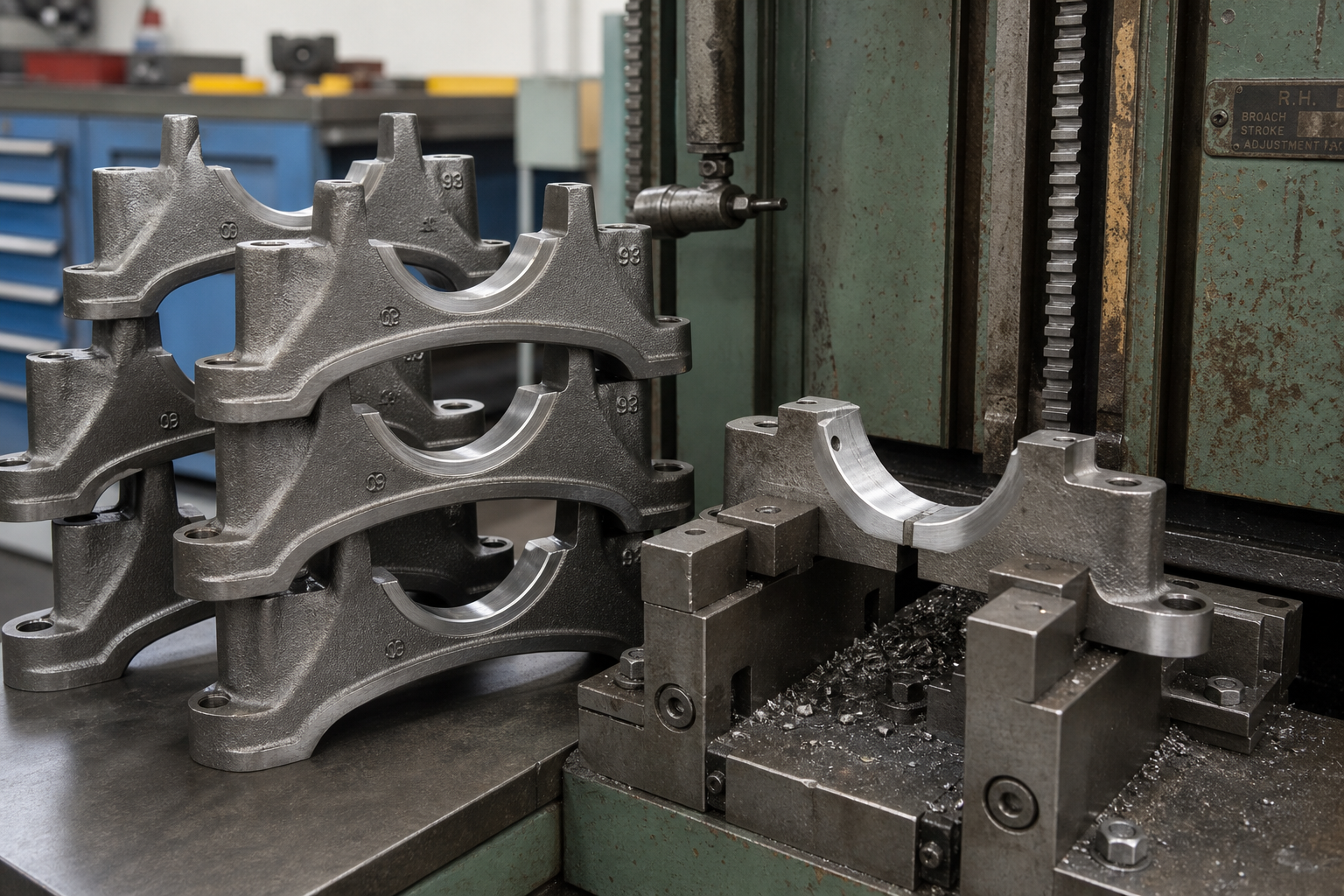
A part drawing lands on your desk with an internal spline, a keyway, a hexagon bore or a profiled slot — and your plant has no broaching machine. Every sourcing engineer then faces the same fork: send the work to a broaching services provider, or bring the process in-house and buy the machine yourself. This guide explains what contract broaching is, when outsourcing beats buying, how the pricing is structured, how to evaluate a provider, and what belongs in a serious RFQ.
As a broaching machine manufacturer that also runs contract production for customers worldwide, we sit on both sides of this decision every week. If outsourcing fits your volumes, our production broaching services page describes what we run in-house; if a machine of your own is the better answer, the equipment resources on this site take you the rest of the way.
What Are Broaching Services?
Broaching is a machining process in which a multi-toothed cutter — the broach — is pushed or pulled through or across the workpiece in a single linear stroke. Each successive tooth takes a slightly deeper cut than the one before it, so the full profile of a keyway, spline, polygon bore or flat surface is generated in one pass. The geometry lives in the ground tool, which is why broaching holds tight tolerances and repeats them across thousands of parts.
Contract broaching — often listed by suppliers as production broaching or job-shop broaching — is an arrangement in which you supply the workpiece and the drawing, and the provider supplies everything else: the broaching machine with the right tonnage and stroke, the part-specific broach, the fixtures, the cutting parameters, the labor and the inspection. You ship blanks or finished-machined parts; parts come back with the feature cut. Some providers run broaching as their entire business; many general machine shops keep one or two broaching machines alongside their milling cells.
Two facts about this arrangement matter to a buyer. First, broaching is tool-defined: the profile and tolerances of your feature are built into a broach designed for your part, so tooling is a first-class commercial topic — who designs it, who pays for it and who owns it. Second, the process is machine-capacity-defined: the provider needs a machine whose pulling force, stroke length and configuration match your part.
The Make-or-Buy Decision: Outsource, Buy, or Both
Whether to outsource broaching or buy a machine is a classic make-or-buy problem, and it resolves on the same variables every time: volume, stability of demand, tooling investment, quality risk and capital availability. The table below summarizes how each factor points; the sections after it describe the three landing zones in practice.
| Decision factor | Outsource to a broaching service | Buy a machine in-house |
|---|---|---|
| Annual volume | Low or intermittent — hundreds to a few thousand parts per year | High — tens of thousands of parts per year or more |
| Demand stability | Uncertain programs, prototypes, seasonal or declining products | Multi-year programs with committed volumes |
| Tooling investment | Provider spreads a shared or amortized broach across customers | You fund the part-specific broach and fixtures as capital items |
| Cost per part | Higher unit price that includes setup, labor and provider margin | Low marginal cost once machine and tooling are absorbed |
| Quality control | Depends on the provider’s inspection system; requires supplier qualification | Direct control of process, first-article approval and SPC on your floor |
| Logistics and lead time | Transit, freight and queue time added to every batch | Feature cut in-line with your other operations; no transit exposure |
| Capital and skills | No machine capital; process knowledge stays with the provider | Machine, tool room and operator skills must be funded and kept current |
When Outsourcing Wins
Outsourcing is the right call when the math of a dedicated machine cannot close. That includes low and intermittent volumes, where a machine would sit idle most of the year; new or unproven programs, where committing capital before the design stabilizes is premature; and parts whose broached features are few, so a broaching cell would be an orphan capability inside your plant. It also includes one-off batches, overflow surges, and parts needing more tonnage or stroke than you own. Contract broaching converts all of these from capital problems into purchasing problems.
When Buying the Machine Wins
Buying wins when volume is high and stable enough that the machine earns its floor space: annual demand in the tens of thousands of parts or more, a program with years of committed life, a takt-driven line where shipping parts out and back would break the flow, and quality stakes — tight concentricity to a machined datum, for example — that you want under your own control. At that scale, the service’s per-piece price starts looking like margin paid away every month. Sizing the machine correctly is the next problem, and our broaching machine tonnage calculation guide walks through the force estimate that anchors the specification.
The Middle Path: Outsource First, Convert Later
The most common landing zone is a sequence rather than a choice: outsource during ramp-up, watch actual demand accumulate, and convert to an in-house machine when the run rate crosses the threshold. This path has a benefit beyond deferring capital — the contract period is a live process-development phase. A competent provider will have proven the broach design, fixture concept, cutting parameters and real cycle time on your actual part before you ever spec your own machine. When the conversion point arrives, you are replicating a proven process, not designing from theory.
How Contract Broaching Services Are Priced
Reputable providers quote broaching work as a structure, not a single number. The first component is the setup charge: fixturing the part, piloting the broach and proving the first pieces. Setup is charged per lot, so lot frequency matters as much as lot size — twenty small orders cost twenty setups. The second component is the per-piece price, covering machine time, labor and margin, which falls with volume because setup and tooling amortize across more parts. The third is tooling, treated below, which is frequently the largest single number on a first quote for a new part.
Two consequences follow. First, comparing providers on per-piece price alone is meaningless: a low piece price paired with a high setup charge wins at large lots and loses at small ones. Second, anything that reduces setup repetition reduces price: consolidated orders, consistent blanks and a frozen drawing let the provider re-run a proven job instead of re-proving it.
Tooling Ownership: Who Owns the Broach
A broach designed for your part is a high-value, part-specific tool, and the industry handles its ownership in two ways. In the first model you buy the broach outright — the tool is your property, held at the provider for your work only; you pay sharpening as it wears, and you can move it to another provider if the relationship ends. In the second model the provider owns the broach and amortizes it into the piece price; you pay nothing up front, but the tooling cost never ends and switching suppliers later means buying a new broach from scratch. Neither model is wrong: tool ownership suits committed volumes or portability, provider ownership suits uncertain ones. What is never acceptable is ambiguity: ownership, sharpening responsibility and exit terms belong in the quotation, not in a dispute.
How to Evaluate a Broaching Service Provider
Two broaching suppliers can look identical on a website and differ completely on the floor. The evaluation that matters covers four dimensions, each of which you can probe directly.
Machine Capability: Tonnage, Stroke and Configuration
The provider’s machines must fit your part in three respects. Force is tonnage — the total broaching load of your feature must sit comfortably inside the machine’s rating, not at its edge. Stroke is travel length — the machine must accommodate the broach your profile requires. Configuration is orientation: internal pull-up and pull-down work, horizontal machines for long parts, surface and pot broaching for external forms. Ask for the machine list with ratings and what happens at capacity — a shop running one qualifying machine at full utilization is a queue risk.
Broach Design and Manufacturing Capability
The broach is the process, so find out who makes it. Providers with in-house broach design and grinding shorten the loop on first articles, geometry corrections and reconditioning, because the people cutting your parts and the people regrinding the tool are one organization. External procurement is not disqualifying, but every iteration travels through two companies, and delivery time on a new custom broach typically dominates first-article lead time. Ask directly: who designs and grinds the broach, where is it reconditioned, and what is the resharpen turnaround.
Quality System and Inspection
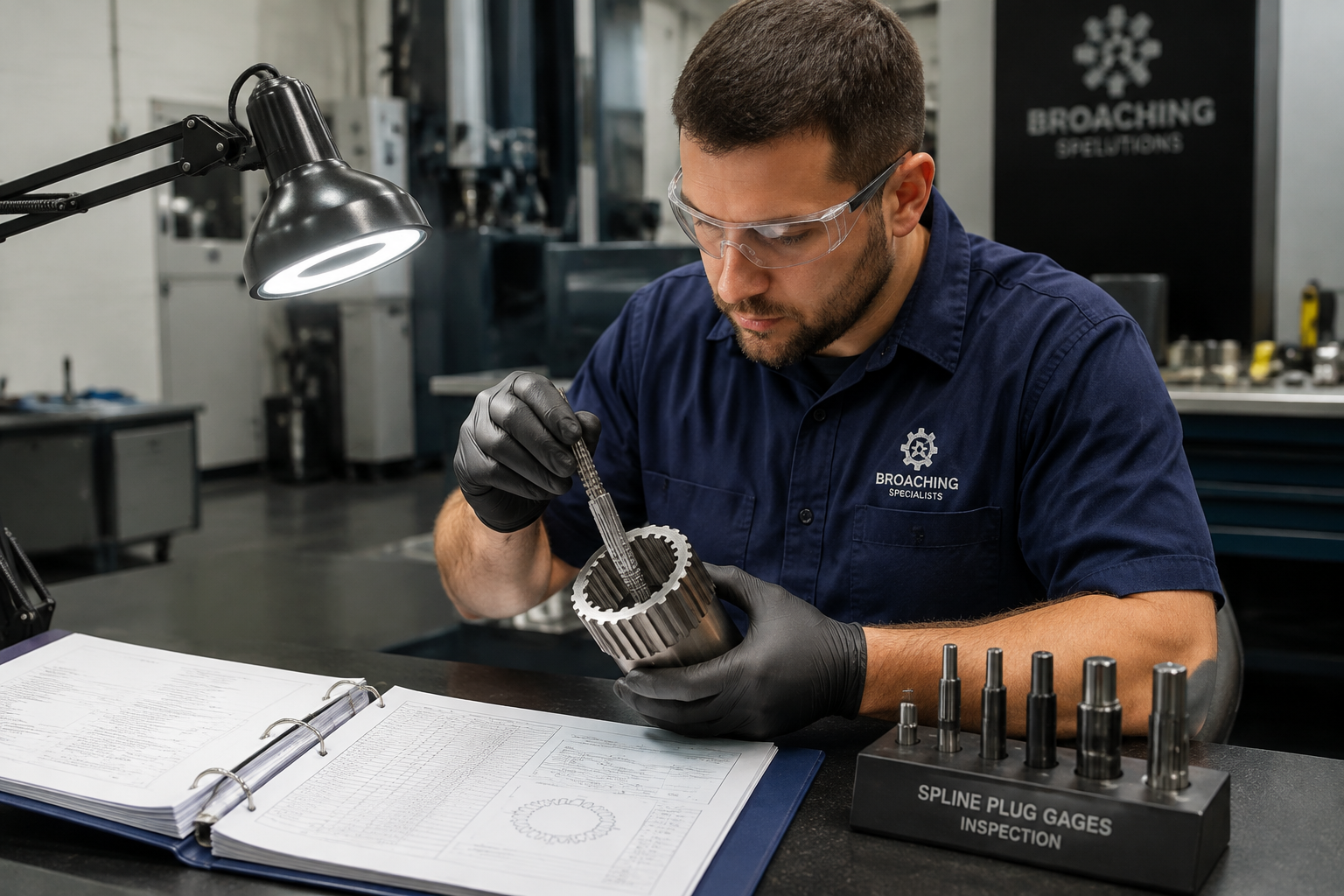
Broaching holds tolerances in the tool, but only a working quality system proves it part after part. Establish how the provider inspects your feature — the gauging method for spline or profile conformity, the frequency, and how results are reported. If your industry expects them, ask about first-article reports, capability studies, PPAP-style documentation and SPC on the dimensions that matter. Also probe the failure path: is there in-process detection when a worn tooth drifts a dimension, or does the customer discover it? A provider who can describe their out-of-control procedure has actually had one.
Industry Experience and References
Finally, weigh what the provider has already cut. Parts like yours — similar materials, feature families and tolerance stakes — mean the process risks were retired before you arrived. Ask for examples in your industry and references you can call, and watch for engineering fluency: a supplier who asks about your datum scheme, material condition and gauge plan is demonstrating competence; one who asks only for quantity and target price will transfer the work rather than understand it. Fixture thinking is a good tell — providers who treat workholding as a designed artifact, in the way our broaching fixture design guide describes, tend to hold tolerances the others lose.
Local vs. Offshore: What “Broaching Services Near Me” Really Buys
Many buyers begin this search with “broaching services near me,” and the intent is legitimate: proximity matters for some jobs. A local or regional provider offers short truck routes, which matters when heavy blanks ship repeatedly; fast turnaround on small and rush lots; on-site audits and first-article reviews; and easy handling of rework and prototype iterations. For low-volume, high-iteration, deadline-critical work, or where freight on bulky blanks would eat the savings, nearby capacity is often worth a higher piece price.
But proximity is not automatically the winning criterion, and the other side deserves an objective statement. Offshore sourcing — China in particular, which maintains one of the deepest concentrations of broaching equipment, broach manufacturing and skilled labor in the world — typically offers lower piece prices at production volumes, more elastic capacity when volumes spike, and a structural advantage local job shops rarely match: the provider can be the machine manufacturer, with tool design, fixture engineering and process development under one roof. The trade-offs mirror locality: ocean transit and customs add weeks of pipeline that must be planned, communication runs on drawings, and first articles travel before production does. The mature position is not “local or offshore” but matching the channel to the work — local for the urgent and iterative, offshore for the stable, high-volume and cost-sensitive — with a qualification process that makes distance safe.
Sourcing Broaching Services from China
If your volumes point offshore, Chinese contract broaching can be sourced with the same discipline as any other qualified process, through three mechanisms. The first is drawing-based communication: a complete drawing with material specification, heat-treatment state, datum scheme, tolerances and inspection requirements replaces the shop-floor conversation, and a supplier’s questions about those items are your first quality signal. The second is the first-article stage: a pilot batch is produced, fully inspected and shipped for your approval before series production is released — converting distance into a documented gate rather than a risk. The third is logistics planning: stable, forecasted volumes on a scheduled cadence turn ocean freight from a threat into a constant.
Our own production broaching services run on exactly this model: keyway, spline, surface and helical broaching carried out in-house on our own machine platforms, with broach and fixture engineering on site. That dual identity is why this guide can afford to be even-handed about the make-or-buy decision: we earn the work either way it resolves.
What to Include in a Broaching RFQ
The quality of the quotation you receive tracks the quality of the inquiry you send. A broaching RFQ that produces comparable, complete quotes contains:
- Part drawing and revision. The controlled drawing, revision level, the feature or features to be broached, with tolerances and GD&T callouts referenced to datums.
- Material and condition. Alloy and specification, and the heat-treatment state at broaching — soft, hardened and tempered, carburized — because it changes the broach design and the force required.
- Blank condition. The pre-machined state you supply: pilot bore diameter and tolerance, surface finish, and how the part is presented.
- Volumes and cadence. Annual quantity, expected lot sizes and order frequency, plus any forecast ramp — this is what lets the provider structure setup and tooling amortization honestly.
- Takt or lead-time requirements. Required turnaround per lot and any firm dock dates the program depends on.
- Inspection requirements. Gauging method expected, first-article documentation, PPAP or capability studies, certificates of conformance and retention samples.
- Commercial terms. Tooling ownership model, who pays reconditioning, packaging and freight responsibility, and the qualification sequence you intend to follow.
Send the same package to every candidate and the quotes come back comparable line by line — which is where the evaluation above does its work.
Common Mistakes When Buying Broaching Services
The failures repeat, and all of them are avoidable at the RFQ and qualification stage.
- Comparing piece price only. Setup charges, tooling amortization, freight and reconditioning all sit outside the unit price, so the comparison must be total cost at your actual order pattern.
- Leaving broach ownership undefined. Tooling settled verbally or not at all is the most common dispute in contract broaching — sharpening responsibility and the right to move the tool both hinge on it. Put it in writing before the first order.
- Assuming tolerance interpretation is shared. Your drawing’s spline callout, datum scheme and gauge method must be confirmed by the provider in the same words you use, or you will both be right about different parts. First-article approval against an agreed inspection method is the correction.
- Skipping the first-article gate. Releasing series production on a quote and a delivery promise — without an approved first article inspected on your gauges to your interpretation — is how entire lots are discovered nonconforming after they arrive.
From Contract Broaching to Your Own Machine
Programs grow, and the outsourcing decision you made correctly at five thousand parts per year becomes the wrong one at fifty thousand. Your contract period has already proven the broach design, fixture concept and cycle time, so the machine purchase becomes an exercise in replicating known physics. Start from the force and stroke the proven process implies — the tonnage calculation guide covers the method — then work through the commercial layer with the broaching machine price guide and the used versus new machine comparison for buyers weighing secondhand capacity. The full broaching machines range covers the configurations these guides point to: vertical and horizontal internal machines, servo-driven platforms, and surface broaching systems for external forms.
Frequently Asked Questions
What is contract broaching?
Contract broaching is a service arrangement in which a customer supplies the part drawing and the workpieces, and a provider cuts the broached features — keyways, splines, polygon bores, profiles — using the provider’s own machines, broach tooling, fixtures and labor. The customer pays a quoted structure of setup charges, per-piece pricing and, depending on the agreement, tooling; the provider carries the equipment and process responsibility.
How much do broaching services cost?
Not as a single number, and any supplier quoting one before seeing the part is guessing. Cost is structured from four elements: a setup charge per lot covering fixturing and first-piece proving; a per-piece price covering machine time and labor; tooling, either purchased outright as your property or amortized into the piece price under provider ownership; and the logistics of getting blanks to the provider and parts back. Volume is the dominant variable: setup and tooling amortize across the run, so the same part can cost several times more per piece at small lots.
When does outsourcing broaching beat doing it in-house?
Outsourcing wins when volumes are low or intermittent, when the program is new or unproven, when the part needs machine capacity you lack — more tonnage or longer stroke — or when broaching would remain an isolated capability in a plant organized around other processes. Buying the machine wins when annual volumes are high and stable, when the part must flow with your line rather than ship out and back, and when direct control of quality documentation matters. Between the two sits the common middle path: outsource through ramp-up, convert to in-house equipment when the run rate defends the capital.
How do I choose a broaching service provider?
Evaluate four things. Machine fit: tonnage, stroke and configuration matched to your feature, with capacity headroom rather than utilization at the limit. Tooling capability: whether broaches are designed, ground and reconditioned in-house or purchased externally, and what that means for first-article lead times. Quality system: inspection methods for your feature, first-article and PPAP documentation, and a coherent answer on out-of-control handling. Industry track record: parts like yours, references, and engineering questions that show the supplier studying your drawing rather than your quantity. Then lock the commercial terms — especially broach ownership — in the quotation itself.
If you are weighing this decision on a live part, we can help from either direction. Send the drawing, material and heat-treatment condition, annual volume and tolerance requirements, and our engineers will respond with a contract production proposal through our production broaching services, a machine-and-tooling configuration for bringing the process in-house, or an honest reading of which one your volumes actually support. That is the advantage of a supplier who builds the machines and runs the work: the recommendation does not depend on which one you choose.