Rotary broaching lets you cut a hexagon, square, or spline form inside a part on the same machine that just turned and drilled it—no second setup, no dedicated broaching machine, no extra operator handling. This guide explains what the process is, how the tool geometry actually works, which shapes and materials it handles, and when it makes more sense than conventional broaching.
What Is Rotary Broaching?
Rotary broaching, also widely known as wobble broaching, is a metalcutting process that produces internal polygon forms—most often hexagons and squares—in a single pass on a lathe, machining center, or mill. A form-ground cutting tool shaped like the finished opening is mounted in a special rotary broach holder and fed into a pre-drilled round hole. As the tool advances, it shears the corners of the polygon into the hole one small chip at a time until the complete form is cut to depth.
The process looks almost paradoxical the first time you watch it run: a square or hexagonal tool appears to drill a square or hexagonal hole. The trick is that the broach never machines the entire outline at once. Because of a deliberate 1-degree tilt inside the holder, only one cutting corner engages the workpiece at any instant, so the form is generated progressively rather than punched in all at once. That is what keeps cutting forces low enough for a live tool in a lathe turret or a small end-mill-style holder in a machining center.
The reason the process exists is economic as much as technical. Turning a bar, drilling a hole, and then cutting a hex in the same setup eliminates a second clamping operation on a secondary machine. For parts where the form is relatively shallow and volumes are moderate, rotary broaching is often the fastest route from bar stock to finished bore, which is why it has become a standard capability in high-mix CNC production shops.
How Does Rotary Broaching Work? The 1-Degree Principle
The heart of the rotary broaching process is a controlled misalignment. The holder mounts the broach tool so that its axis is inclined at approximately 1 degree from the axis of the workpiece, with the two axes intersecting at the leading cutting edge of the tool. This small tilt is what separates rotary broaching from simply pushing a shaped punch into a hole: at any moment, only one corner of the broach is inside the cutting zone.
As the tool and workpiece rotate relative to each other, successive cutting edges enter the shear zone in a continuous slicing action known as the chisel effect or scalloping effect. Each edge takes a small curved scallop of material, then hands off to the next edge. Instead of displacing the full polygon cross section at once, the broach shaves the form into existence, corner by corner, with modest radial force and minimal heat concentration. The chip load per edge is tiny, which is exactly why the process can run inside a bearing-mounted holder without fighting the machine.
The holder itself contains an internal live spindle—a free-spinning, bearing-supported spindle that accepts the shank of the broach tool on a steep taper. On a lathe, the holder is clamped stationary in the turret while the rotating workpiece friction-drives the broach, so the tool spins on its own bearings. On a machining center or mill, the holder goes into the machine spindle, the tool rotates, and the workpiece is clamped stationary. In both cases the broach is free to revolve inside the holder, and that freedom is what allows the 1-degree wobble to generate the form.
In practice, the rotary broaching process on a lathe or mill breaks down into four steps:
- Pre-drill a round hole slightly larger than the across-flats dimension of the intended form, with good surface finish and straightness.
- Index the turret or spindle so the broach axis is aligned with the hole centerline—alignment within a few thousandths of an inch directly affects form accuracy.
- Start rotation and feed the broach into the hole at approximately 0.001–0.002 IPR, letting the scalloping action generate the form in one pass to depth.
- Retract the tool at the end of the pass; no dwell, pecking cycle, or secondary finishing operation is required for most forms.
Rotary Broaching vs. Conventional Broaching
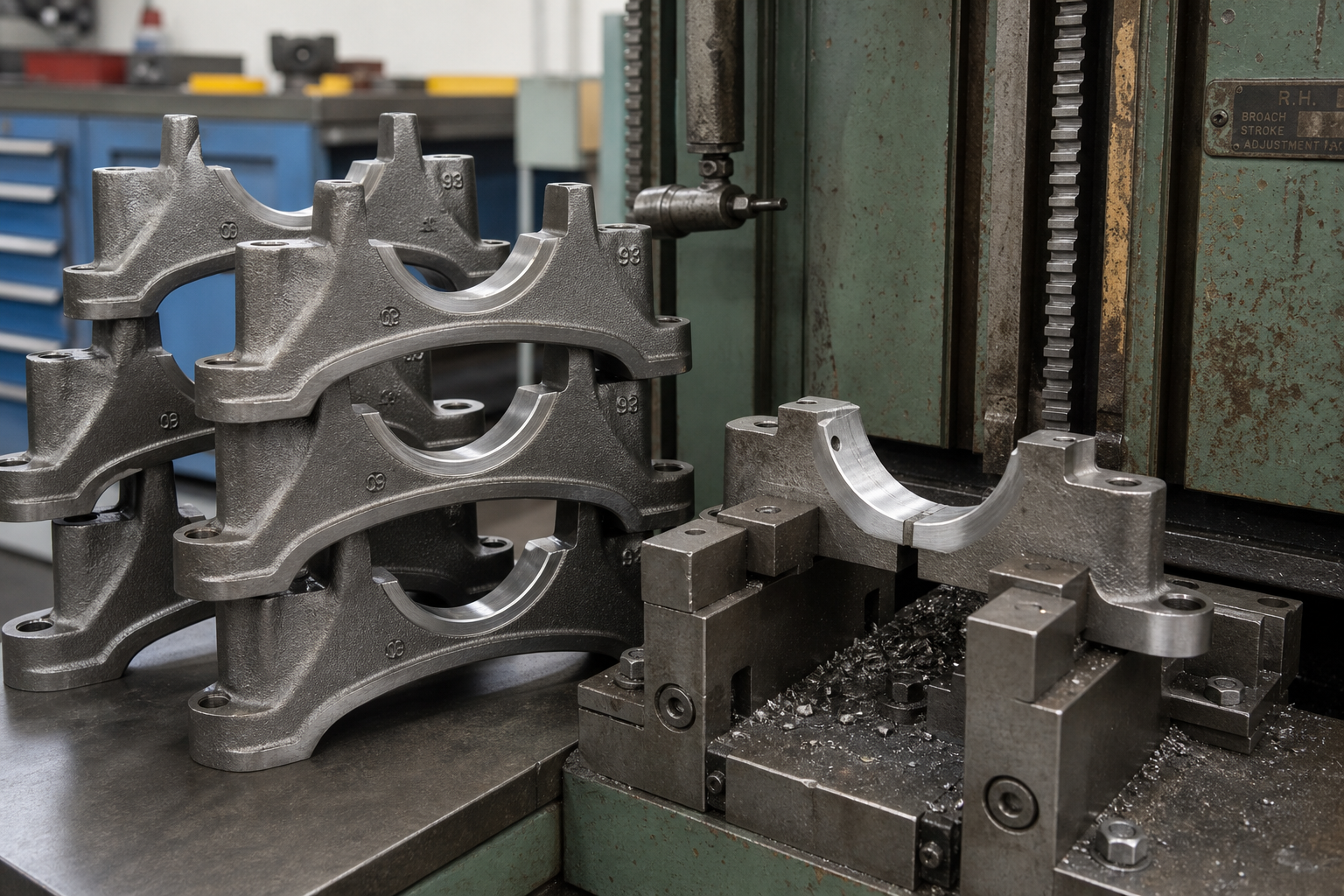
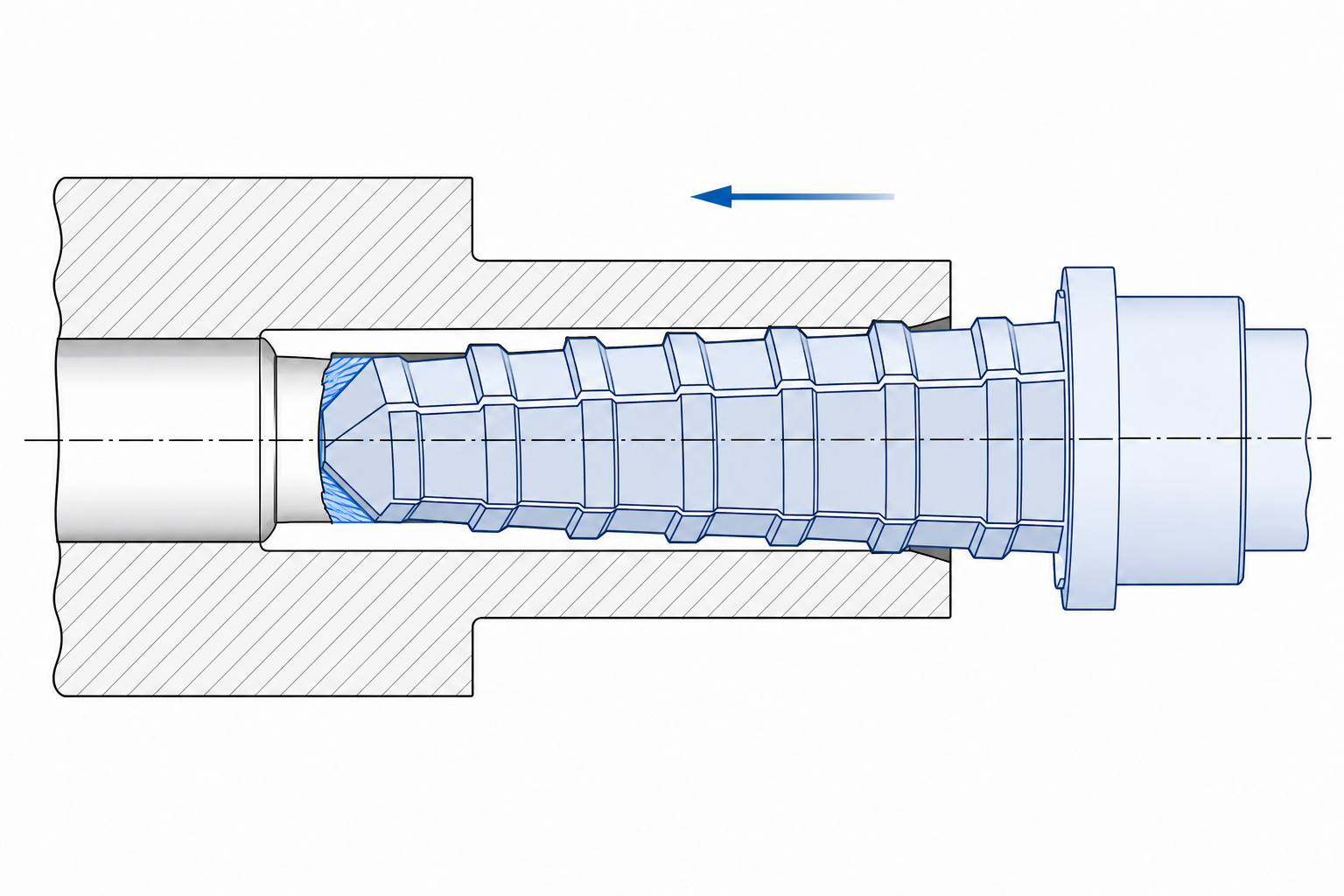
Rotary broaching is a specialized branch of a much older process. In conventional broaching, a long, straight, multi-tooth broach is pulled or pushed through (or across) the workpiece on a dedicated broaching machine. Each tooth of a linear broach stands slightly taller than the one before it, so the full form is cut progressively along the length of the tool in a single linear stroke. The two processes use similar form-grinding logic but completely different kinematics, and they solve different production problems.
The most important difference is depth capability. A rotary broach is a short tool doing all its cutting at one end, so its practical depth limit is roughly twice the diameter of the tool—deeper than that and chip evacuation, tool deflection, and wall friction work against you. A linear broach, by contrast, distributes the cut along many teeth and its length can simply be extended, so conventional broaching is effectively unlimited in how deep a form can be pulled. Deep keyways, long splines, and through-forms in thick parts remain squarely in conventional territory.
The second difference is machine tool investment. Rotary broaching runs on general-purpose CNC lathes, mills, and machining centers you already own, using a holder that costs about like a good collet chuck. Conventional broaching requires a dedicated broaching machine—vertical, horizontal, or rotary-table style—plus a custom-built broach for each form. That investment pays for itself at volume, because a broaching machine strokes a finished part in seconds with minimal operator attention.
As a rule of thumb:
- Choose rotary broaching for shallow forms (up to about 2× tool diameter), small-to-medium polygon sizes, prototype-to-medium volumes, and parts that are already being turned or milled in one setup.
- Choose conventional broaching for deep forms, large across-flats dimensions, high-volume production where cycle time is king, and multi-surface forms cut in a single stroke.
For a deeper comparison focused on hex and square production methods, see our guide to hex broaching and double hex / square profile methods.
What Shapes Can You Rotary Broach?
Nearly any through-bore cross section that can be ground on the end of a rotating tool is a candidate for rotary broaching. The practical constraint is that the form must fit within the tool diameter the machine and holder can carry, which is why the process is associated with small and medium internal forms. Common shapes include:
- Hexagon (single and double hex)
- Square and double square
- Double D
- Torx and Torx-style recesses
- Serration forms
- Keyways
- Involute splines
- Spur gear forms
Hexagons and squares dominate production because they mate with standard fasteners, tool bits, and shaft interfaces. A hex socket lets a mating screw or handle transmit torque without spinning; a square bore locks a mating member against rotation entirely. These are also the forms where the scalloping action of a wobbling broach is most naturally suited, since the evenly spaced corners shear cleanly one after another.
Spline forms deserve special mention. Involute splines can be rotary broached for lighter-duty connections and prototype volumes, but precision splines with long engagement lengths, tight major-diameter fit, or demanding torque ratings are usually better served by a purpose-built spline broach on a broaching machine. Our spline broaching guide covers that process in detail.
Rotary Broach Tool Materials, Coatings, and Accuracy
Standard rotary broaches are made from M-2 high-speed steel, which grinds cleanly to sharp, accurate form edges and handles the interrupted, light-chip-load cutting of the wobble action well. For abrasive workpiece materials or higher volumes, tool manufacturers offer upgrades: cobalt-alloyed grades such as M-42 for hot hardness, and powder-metallurgy grades such as PM T-15 and PM M-4, which pack fine, uniform carbides into the HSS matrix for substantially better wear life at a higher tool cost. The upgrade pays for itself when the extra edge life eliminates tool changes inside a production run.
Coatings extend life further. TiN is the general-purpose workhorse; TiCN adds hardness and performs well on abrasive steels; TiAlN provides the best heat resistance for harder workpiece materials and higher cutting speeds. Because rotary broaching is fundamentally a low-speed, low-force process, coatings mainly buy edge life rather than speed, but on gummy materials they also reduce built-up edge on the shearing corners.
Form accuracy for a quality rotary broach held in a good setup is on the order of 0.0005 in., assuming the pre-drilled hole is round, straight, and correctly sized and the holder is aligned to the spindle. Tool life varies with material and form size: a 1/8 in. hex broach cutting aluminum can run well over 1,000 parts before regrinding, while an 8 mm square broach in medium-carbon steel typically yields a few hundred parts between sharpenings. Worn tools can be re-sharpened and re-ground to form, preserving most of the original value. For background on how these tools compare with the longer broaches used on dedicated machines, see our complete guide to broaches and broach types.
Workpiece Materials: What Cuts Easily and What Fights Back
Rotary broaching is at its best in free-machining materials. Aluminum, brass, mild steel, and thermoplastics shear cleanly with standard parameters and give long, predictable tool life. The low cutting force of the scalloping action also means thin-walled parts can be broached without distortion, which matters for fittings and housings.
Stainless steels and titanium alloys are workable but demand respect. Work hardening at the shearing edge is the main enemy: if the tool rubs instead of cutting, the surface hardens and edge life collapses. The standard approach is to reduce the feed to about 0.001 IPR so every corner takes a definite cut, and to start conservatively at 50–100 RPM while you verify clean chip formation, then raise spindle speed progressively toward the 700–800 RPM range once the process proves stable. Rigid setup, sharp tools, and adequate coolant at the cutting zone complete the recipe.
Pre-hole quality is the other half of the equation in any material. An undersized, bell-mouthed, or wandering pre-drill forces the first broach corners to remove too much stock and pushes the form out of position. Reaming or boring the pilot hole when tolerances are tight is cheap insurance for holding the 0.0005 in. class of accuracy the tool is capable of.
Industries and Typical Applications
Medical. Bone screws, surgical instrument handles, and implant components are classic rotary broaching parts. Titanium and stainless constructions make the reduced-parameter approach essential, and the ability to cut a hex or Torx drive feature in the same setup as fine turning keeps tight-tolerance parts off secondary machines.
Automotive. Sensor bodies, gearshift components, power-window and seat-motor shafts, and transmission bushings use hex and square bores to secure mating parts against rotation. High part families with moderate per-family volumes are exactly where rotary broaching on a turning cell beats a dedicated machine.
Aerospace. Actuator end fittings, linkage components, and specialized fasteners frequently call for double hex, double square, or spline forms in alloy steels and titanium. First-article and small-batch runs favor the low tooling cost of a rotary broach over a custom linear broach.
Plumbing and fluid power. Valve stems with square drives, faucet components, and hose fitting hexes are high-volume, form-simple parts where rotary broaching on screw machines and CNC lathes has been a shop-floor staple for generations.
Advantages and Limitations of Rotary Broaching
Used inside its envelope, rotary broaching is one of the highest-leverage operations in a machine shop:
- Cuts a finished internal form in a single pass measured in seconds.
- Eliminates second-setup handling—the form is machined in the same operation as turning and drilling, so positional accuracy between features is as good as the machine itself.
- Runs on general-purpose CNC lathes, mills, and machining centers; no dedicated broaching machine required.
- Tooling cost is modest, and standard hex and square broaches are catalog items rather than custom ground parts.
The limitations are equally real, and honest process selection means weighing them up front:
- Depth is capped at roughly twice the tool diameter; deeper forms are not practical with a wobbling tool.
- Large across-flats forms are limited by holder capacity, machine spindle bore, and available tool diameter.
- Stainless steel and titanium cut slowly, with reduced feeds and careful speed development, so cycle time and tool cost per part rise.
- Accuracy depends on pre-hole quality and holder alignment, so process discipline is required to hold tight tolerances consistently.
Frequently Asked Questions About Rotary Broaching
Can you use a rotary broach in a drill press?
Yes. A rotary broach holder can be mounted in a drill press spindle with the workpiece clamped stationary, which mirrors the machining-center configuration. It works for one-off jobs, repairs, and light-duty work. The caveats are spindle runout, quill alignment, and speed control: a drill press that cannot hold the broach axis concentric with the pre-drilled hole will cut an oversize or bell-mouthed form. Verify runout and start at conservative RPM before committing a part.
How deep can you rotary broach?
The working rule of thumb is about twice the diameter of the broach tool. A 1/2 in. hex broach, for example, is comfortable broaching a hex roughly one inch deep. Beyond that ratio, chip packing, tool deflection, and friction against the form walls degrade accuracy and surface finish. Deeper requirements call for special tooling arrangements or, more often, a conventional broaching operation where the form length is limited only by broach length.
Can you rotary broach a keyway?
Yes, keyways are a standard rotary broaching form for shallow internal keyseats in bores, particularly on turned parts where the keyway can be cut in the same setup as the bore itself. The same 2× depth rule applies, so long keyseats and deep internal keyways remain the territory of linear broaching or milling. For a comparison of those two approaches, see our article on broaching vs. milling for internal keyways and profiles.
Can you use a rotary broach in a mill?
Yes, and it is one of the two most common configurations. In a machining center or manual mill, the rotary broach holder is clamped in the spindle, the tool rotates, and the workpiece is fixed—typically in a vise or fixture on the table. Concentricity between the rotating broach and the pre-drilled hole is the critical setup requirement, so a trued holder and a carefully located pilot hole are worth the extra minutes. Horizontal and vertical spindle orientations both work.
When to Step Up to a Dedicated Broaching Machine
Rotary broaching is the right answer when forms are shallow, part volumes are moderate, and the work already lives on a lathe or machining center. When your requirement grows beyond that envelope—internal forms deeper than the 2× rule allows, large across-flats dimensions, hardened or difficult materials at volume, or production runs where seconds per part decide the contract—a dedicated broaching machine with a purpose-built broach will outproduce and outlast any live-tool alternative. A linear broach cuts the complete form in one stroke, holds accuracy over long engagement lengths, and turns the broaching operation into a high-cycle production asset rather than a bottleneck.
At broachingmach.com, we design and build broaching machines and engineer custom broaches for exactly those deeper, larger, higher-volume internal form requirements—hexagons, squares, keyways, splines, and irregular profiles. If you are hitting the limits of rotary broaching on parts where depth, size, or throughput matter, talk to our engineering team about a broaching solution sized to your production.