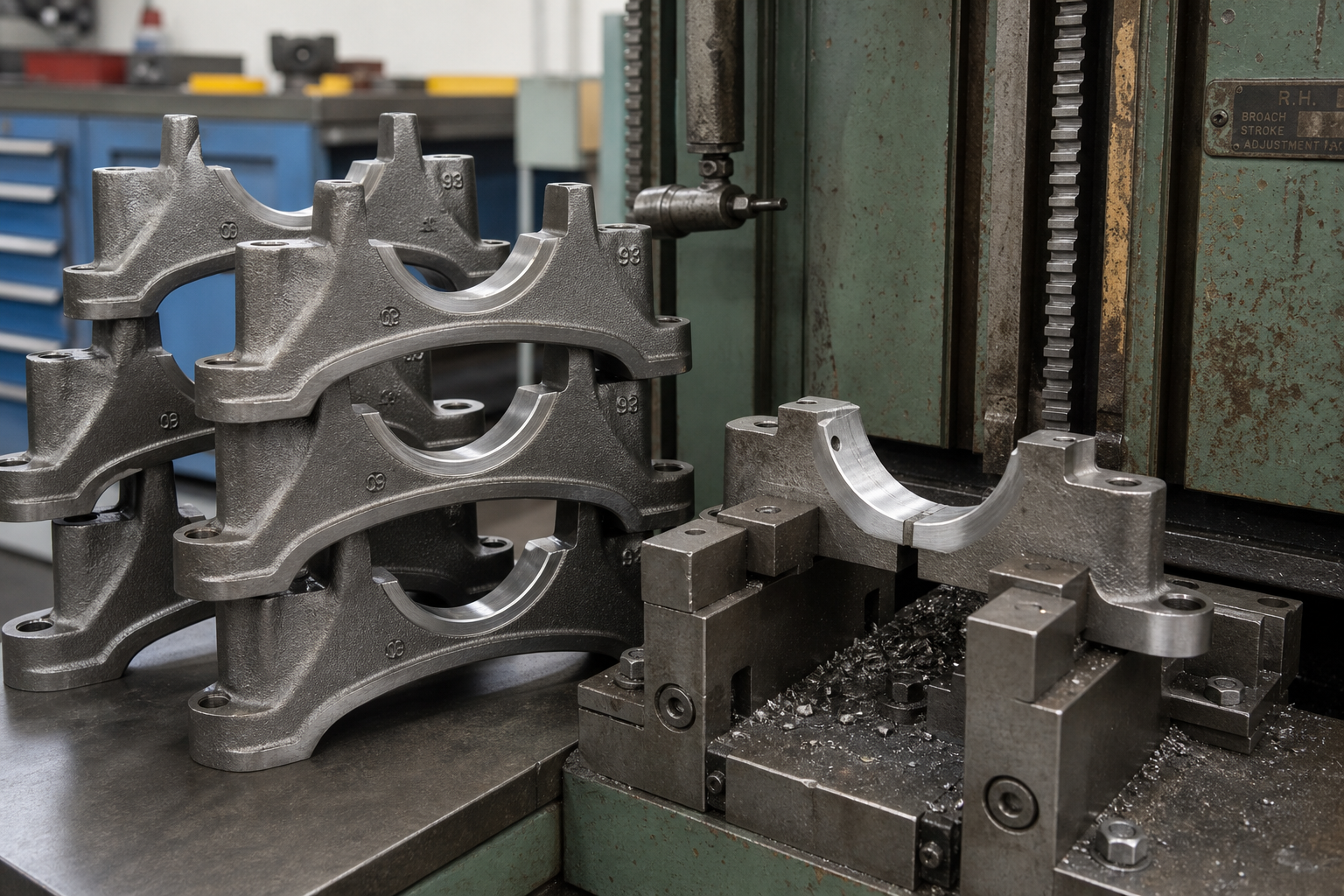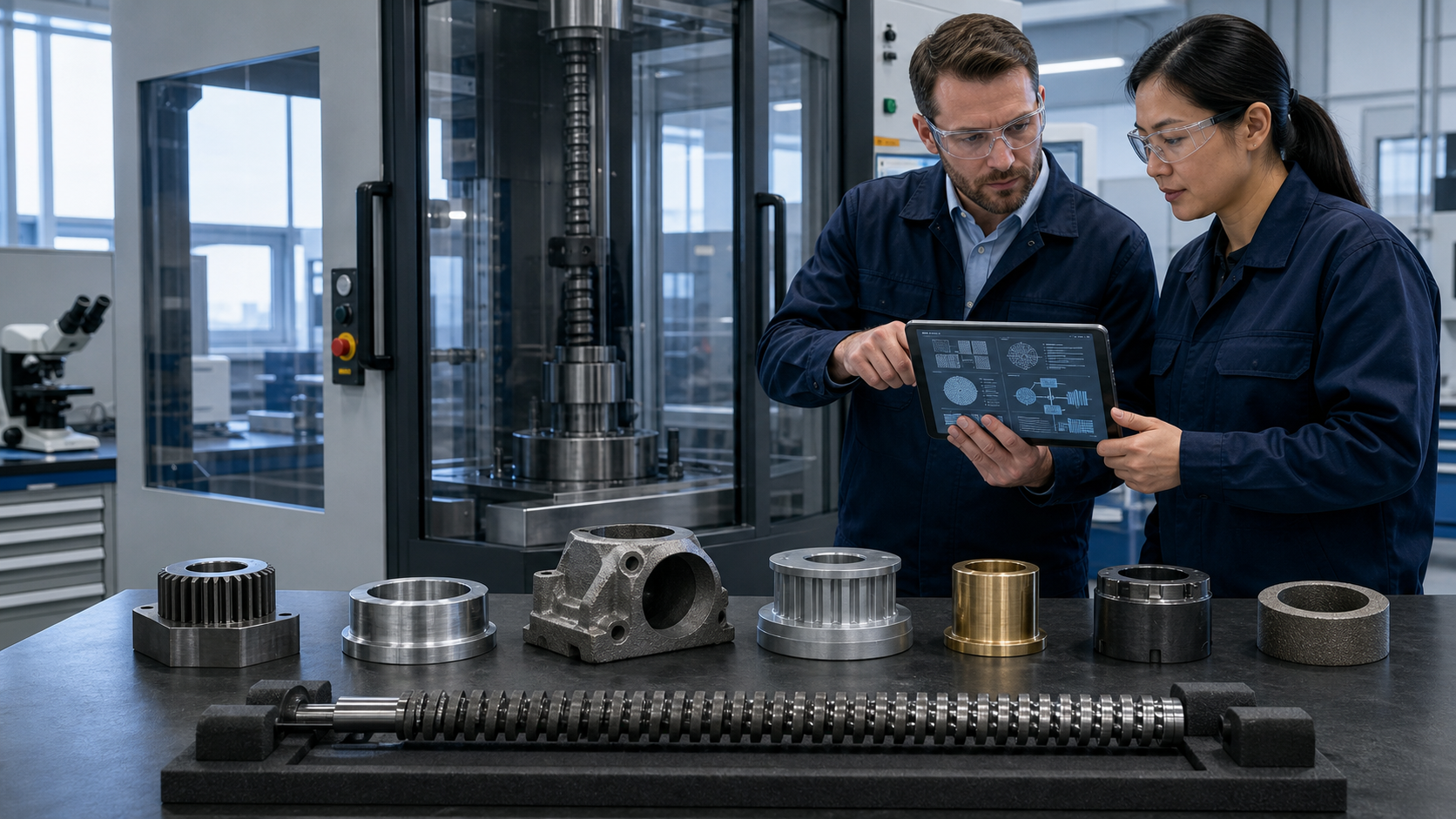
Conceptual illustration of several workpiece materials being evaluated for broaching. The image is illustrative, not a material-certification or process drawing.
Many steels, stainless steels, cast irons, aluminum and copper alloys, and selected nickel alloys, titanium alloys, powder-metal parts, polymers and composites may be broached. That is a starting point, not a production approval.
The useful question is not only, “What is the alloy?” It is:
Can this exact material, in its supplied and heat-treated condition, be cut with the required profile, tool life, machine load, surface finish and process capability?
Hardness matters, but so do microstructure, ductility, work hardening, abrasiveness, chip behavior and lot consistency. Geometry, stock allowance, tooling, lubrication and machine rigidity can change the answer again.
If you first need a process overview, see what broaching is and how it works. This guide concentrates on screening the workpiece material and manufacturing route.
Quick Reference: Common Broaching Material Families
| Material family | General starting assessment | Main risks to evaluate | Typical process response |
|---|---|---|---|
| Free-machining carbon steels | Often favorable in a controlled condition | Smearing in very soft stock, inclusions, hardness variation | Match tooth geometry and lubricant to the grade and cut |
| Medium-carbon and alloy steels | Common, but condition-sensitive | Heat-treatment distortion, strength, local hard spots, tool load | Prefer an appropriate pre-hardening condition; validate any hard-finishing step separately |
| Stainless steels | Feasible in many applications with careful control | Work hardening, long adhesive chips, heat and edge wear | Sharp tooling, stable engagement, effective lubrication and chip evacuation |
| Gray, ductile and malleable irons | Common for suitable castings | Abrasive constituents, casting skin, hard spots, porosity, dust | Inspect casting quality; select geometry and fluid strategy for the actual iron |
| Aluminum alloys | Often easy to cut but not automatically easy to broach | Built-up edge, smearing, poor chip release, thin-wall distortion | Prevent rubbing, control adhesion and support the part |
| Brass, bronze and copper alloys | Frequently suitable, grade-dependent | Ductility differences, lead-free grade behavior, chip form | Confirm the exact alloy and adjust geometry and lubrication |
| Powder-metal components | Possible with engineered stock and tooling | Porosity, abrasive particles, interrupted microstructure, edge breakout | Validate density, condition, allowance and tool wear on representative parts |
| Nickel and titanium alloys | Specialized, higher-risk candidates | Low thermal conductivity, edge heat, work hardening, adhesion, high force | Application-specific tooling, rigid equipment and controlled trials |
| Engineering polymers and composites | Possible for selected parts | Delamination, fiber abrasion, elastic recovery, melting or burrs | Treat each resin, reinforcement and layup as a different material system |
These are screening categories, not accept/reject rules. Batches with the same alloy designation can behave differently after processing.
What Makes a Material Broachable?
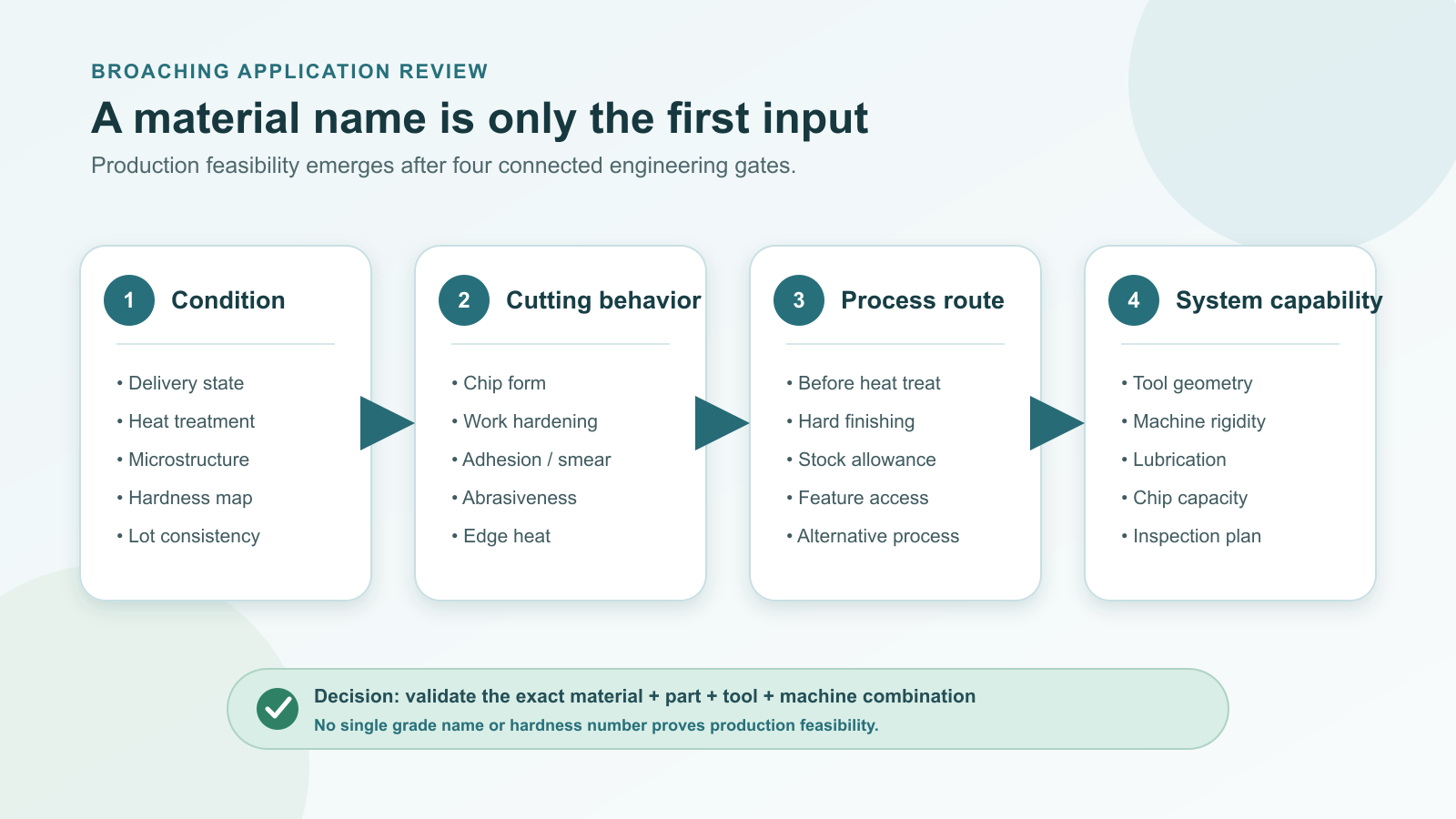
A material name opens the review; condition, cutting behavior, process route and system capability determine whether production broaching is realistic.
Material condition and microstructure
“4140,” “316,” or “aluminum” is not a complete cutting specification. Annealing, aging, cold work, quenching, tempering or case hardening changes strength, residual stress and chip formation.
Microstructure should be reasonably uniform through the cut. Local hard spots, casting skin or an uneven case can expose successive teeth to different loads even when average hardness appears acceptable.
Machinability and chip behavior
Broaching asks multiple teeth to cut in sequence while the tool stores and carries chips. A material that produces controlled chips is usually easier to stabilize than one that forms long, sticky chips that pack the gullets.
Very ductile stock can smear or form a built-up edge. Brittle or porous material may form short chips but break at the feature edge. Hook angle, rise per tooth, pitch, gullet volume and surface treatment must match that behavior.
For an introduction to those tool features, use our complete guide to broaches and broach design guide.
Hardness, strength and abrasiveness
Increasing hardness or tensile strength commonly raises cutting load and wear, but one number cannot predict the whole process. A tough, adhesive alloy at moderate hardness may be more troublesome than a harder but more predictable workpiece. Abrasive carbides, oxide scale, sand inclusions or reinforcement fibers can accelerate wear independently of bulk hardness.
Record hardness range and location, not just a nominal target. Include case depth for case-hardened parts, skin and hard spots for castings, and density or reinforcement for powder metal and composites.
Consistency across production lots
A successful sample does not prove production stability. Supplier, melt, casting practice, heat-treatment load and cold-work history can shift cutting behavior.
Qualification should include representative production material plus hardness sampling, first-piece inspection and defined triggers for revalidation.
How Major Material Families Behave
Carbon and free-machining steels
Low- and medium-carbon steels are widely broached for keyways, splines and surface forms. Free-machining additions can improve chip control.
Very soft stock may smear if the edge rubs. Cold-drawn stock may carry residual stress or surface hardness not represented by the grade name, so do not transfer settings blindly between suppliers.
Alloy steels
Alloy steels used for gears, hubs, couplings and drivetrain parts are common broaching candidates before final hardening. The major planning question is whether the profile will remain capable after heat treatment.
If distortion is acceptable, broach before heat treatment and inspect afterward. If a critical profile moves outside tolerance, a planned finishing operation may be required. This does not prove that every hardened alloy can be broached.
Stainless steels
Stainless steels vary widely. A free-machining grade can behave differently from an austenitic grade that work hardens and produces adhesive chips, or from a precipitation-hardening grade in another heat-treatment condition.
Avoid rubbing that hardens the cutting zone. Sharpness, alignment, chip space and lubricant delivery are critical; a coating cannot correct overloaded teeth or packed gullets.
Cast irons
Gray, ductile and malleable irons can be broached successfully in many production applications, including cast housings and automotive components. Their relatively short chip behavior can help evacuation, but casting quality remains decisive.
Review casting skin, hard spots, porosity and inclusions. An average hardness reading away from the cut may miss a damaging local condition. Brittle edges and thin walls need support.
Aluminum and copper alloys
Aluminum, brass and bronze are often described as “easy” broaching materials. Their lower strength can reduce force, but soft and adhesive alloys can create built-up edge, smeared surfaces or poor chip release.
Keep the edge cutting rather than rubbing. Geometry, engagement, lubrication, clean gullets and support matter. Lead-free brass or high-strength aluminum should not inherit assumptions from easier grades.
Nickel alloys and titanium
Nickel-based and titanium alloys can be broached, but they belong in a specialized engineering review. Their combination of heat at the cutting edge, adhesion, strength and work-hardening behavior can make tool life and process stability sensitive to small setup changes.
Select tooling, coating and fluid from the actual alloy, condition, feature depth and volume. A trial should evaluate force, wear, chip evacuation, size and surface integrity—not simply whether one part can be completed.
Powder metal, polymers and composites
Powder-metal parts may contain porosity and hard particles. Review density, sintering condition, heat treatment and edge support.
Selected polymers, graphite and composites can also be broached. Yet “plastic” or “carbon fiber” is too broad: resin, reinforcement, fiber direction, recovery and delamination can control the result.
Can Hardened Steel Be Broached?
Yes, some hardened-steel applications can be broached, but the statement needs boundaries. Conventional broaching is commonly planned while the workpiece remains in a machinable condition. Specialized hard broaching is usually a controlled finishing or recalibration step after heat treatment, particularly for accessible internal profiles affected by distortion.
It should not be assumed to be full-profile generation from solid hardened stock. Feasibility depends on:
- Alloy, microstructure, bulk hardness and hardness variation.
- Case depth or local hard layer.
- Profile access and uninterrupted tool travel.
- Finishing allowance left before hardening.
- Amount and direction of heat-treatment distortion.
- Tool substrate, edge design and coating.
- Machine rigidity, alignment, speed control and force capacity.
- Lubrication, chip evacuation and inspection.
There is no responsible universal hardness cutoff across all broaching methods and parts. A rotary broach forming a shallow polygon, a long HSS pull broach generating a spline and a carbide hard-finishing broach are different systems.

BroachingMach product photo: CNC high-speed hard broaching machine for post-heat-treatment internal-profile work. Suitability for a specific alloy, hardness, allowance and profile requires an application review.
BroachingMach’s CNC high-speed hard broaching machine is positioned for post-heat-treatment internal holes, splines and internal teeth. That product category does not make every hardened part feasible; the complete route must be reviewed.
Choose the Material and Process Route Together
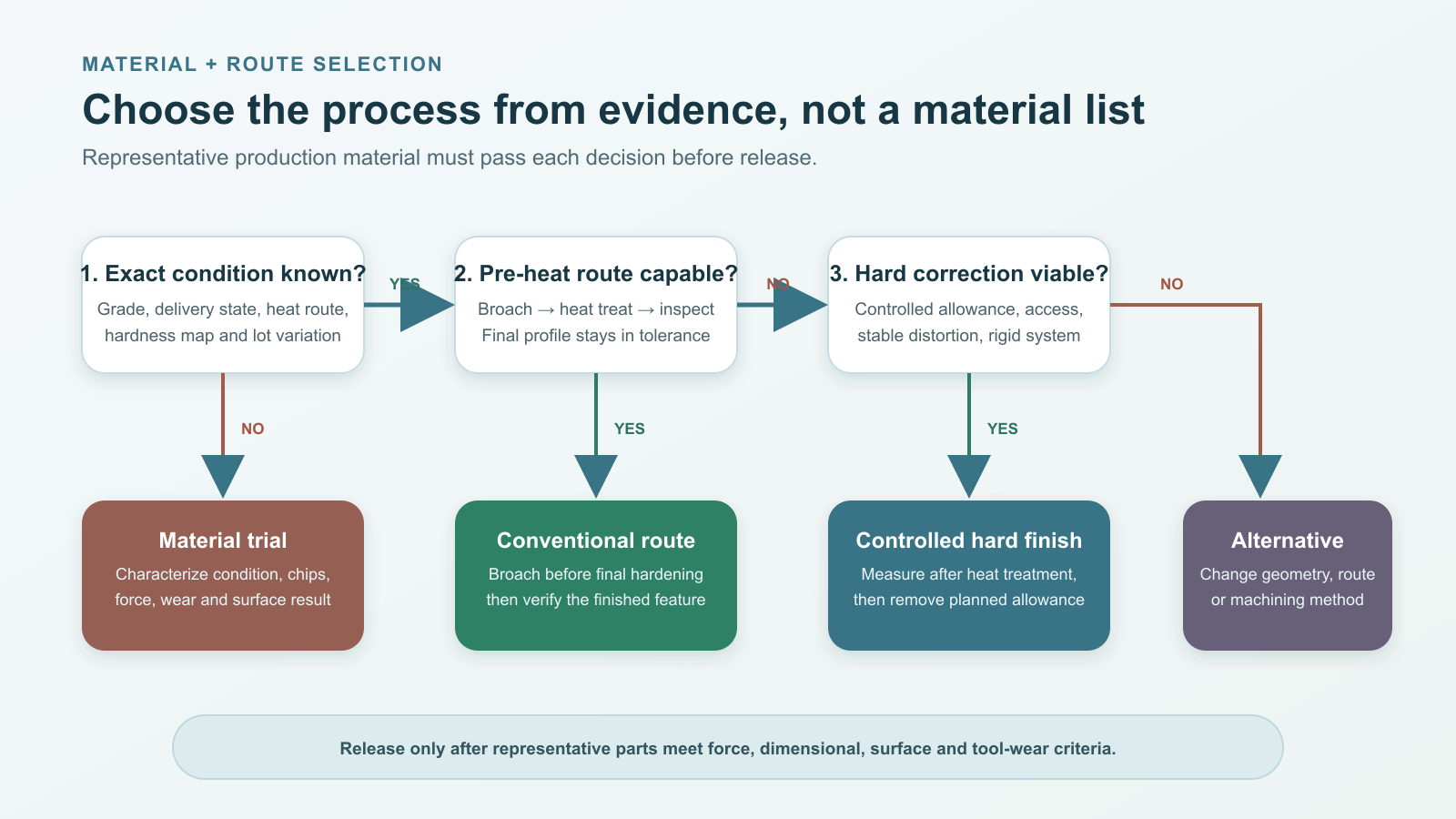
The preferred route is proven by representative parts: broach before heat treatment when the final profile remains capable, add controlled hard finishing when distortion is correctable, or choose another process when access or stability is unsuitable.
Use three route options:
- Broach before final heat treatment. Generate the profile while the material is easier to cut, then heat treat and inspect. Use this when the final feature remains capable.
- Pre-broach, heat treat, measure and hard finish. Leave a controlled allowance and correct a predictable, accessible hardened profile with specialized equipment and tooling.
- Select another process or redesign the route. Consider keyseating, shaping, grinding, honing, skiving, EDM or a geometry change when the feature is obstructed, distortion is unstable, stock cannot be controlled or tool life is unacceptable.
Do not choose route two only because the drawing specifies high hardness. Measure representative heat-treated parts first; correction must suit one stable tool and datum plan.
How Material Changes the Machine, Broach and Fluid
Material data should flow directly into system design:
- Machine: verify stroke, cutting force, speed range, guidance and structural rigidity. Our broaching-machine overview and tonnage calculation guide explain the equipment inputs.
- Broach: select substrate, tooth geometry, rise per tooth, pitch, chip space, edge preparation and coating as one system. Start with BroachingMach’s broach-tool categories.
- Fluid: match lubricity, cooling, filtration and chip transport to the workpiece and coating. Review the broaching cutting-fluid guide.
- Maintenance: define load, dimensional and surface signals for inspection. Tool wear can quickly become breakage when chips pack, alignment shifts or local hardness rises; use the broach-breakage prevention guide as a setup check.
A “stronger” coating or larger machine is not an automatic fix. If chip space is insufficient or the feature bends under load, more force can make the failure more severe.
Geometry Can Disqualify an Otherwise Broachable Material
Material feasibility and part feasibility must be checked together. Confirm:
- A starter hole or surface that locates the broach correctly.
- Clear entry, cutting travel and exit for the selected broaching method.
- Cutting length compatible with tooth pitch and chip capacity.
- Wall thickness and support sufficient for cutting force.
- Relief for chips where the operation needs it.
- Stock allowance that is positive, controlled and consistent.
- Datums that locate the functional feature through each manufacturing stage.
- A measurable tolerance and surface-finish requirement.
An obstructed blind feature may prevent conventional pull broaching, while a thin aluminum ring may distort at modest load. The drawing—not the material list—settles these issues.
Qualify the Application Before Production
A controlled qualification must answer more than “Did the broach pass through?”
- Freeze the material specification, supplier, delivery and heat-treatment condition.
- Measure hardness or relevant condition at locations that represent the cut.
- Review feature access, stock, wall support, datums and chip exit.
- Calculate an initial force range and confirm machine capacity.
- Design the tool and fluid strategy for the expected chip behavior.
- Broach representative parts across normal material variation.
- Record force trend, chip form, edge condition, dimensions and surface finish.
- Inspect parts after every remaining heat-treatment or finishing step.
- Establish tool-life and regrind triggers from measured drift, not an arbitrary part count.
- Define when a material, supplier or heat-treatment change requires revalidation.
Production broaching services can support sample and process evaluation before equipment is committed.
Information to Send for an Application Review
Provide:
- Finished part drawing and 3D model, if available.
- Exact material standard, grade, supplier and delivery condition.
- Heat-treatment sequence, target range, case depth and available hardness data.
- Pre-broach feature, stock allowance and cutting length.
- Required profile, tolerance, datum relationship and surface finish.
- Expected annual volume, batch size and takt target.
- Current machine, stroke, force, connection and cutting-fluid details.
- Known failures such as smearing, chatter, excessive load, chipping or rapid wear.
- Representative workpieces from normal production material.
Clear inputs let the supplier distinguish a routine broaching application from one that needs a material trial, special tooling, hard finishing or another process.
Frequently Asked Questions
What is the easiest metal to broach?
Many free-machining steels, aluminum and copper alloys are favorable starting candidates, but softness can cause smearing. Judge the grade, condition, geometry and cutting system.
Can stainless steel be broached?
Yes. Grade and condition matter because work hardening, heat and adhesive chips can increase wear. Stable engagement, sharp tooling, chip space and lubrication are important.
Can cast iron be broached?
Yes. Check casting skin, hard spots, porosity, inclusions, edge strength and local hardness before choosing tooling and stock removal.
Can aluminum be broached?
Yes, but soft aluminum can adhere, smear or distort in a weak section. Geometry, lubrication, engagement and workholding must prevent rubbing and movement.
Can plastic or composite parts be broached?
Some can. Resin system, reinforcement, fiber direction, temperature, elastic recovery, delamination and abrasive wear must be evaluated. A successful result in one polymer or laminate does not transfer automatically to another.
Can hardened steel be broached?
Some hardened profiles can be finished by specialized hard broaching. Do not apply a universal hardness limit. Review the alloy, hardness distribution, case, allowance, access, distortion, tool, machine and inspection plan as one system.
Final Recommendation
Use material-family lists only to begin the conversation. Approve the process from the exact workpiece condition, cutting behavior, geometry, heat-treatment route and production evidence.
For a new application, send BroachingMach the drawing, material specification, condition, hardness data, stock allowance, required profile, volume and available machine information. The result should be a documented route—conventional broaching, controlled hard finishing, a trial, or an alternative process—not an unsupported promise that a material is “broachable.”