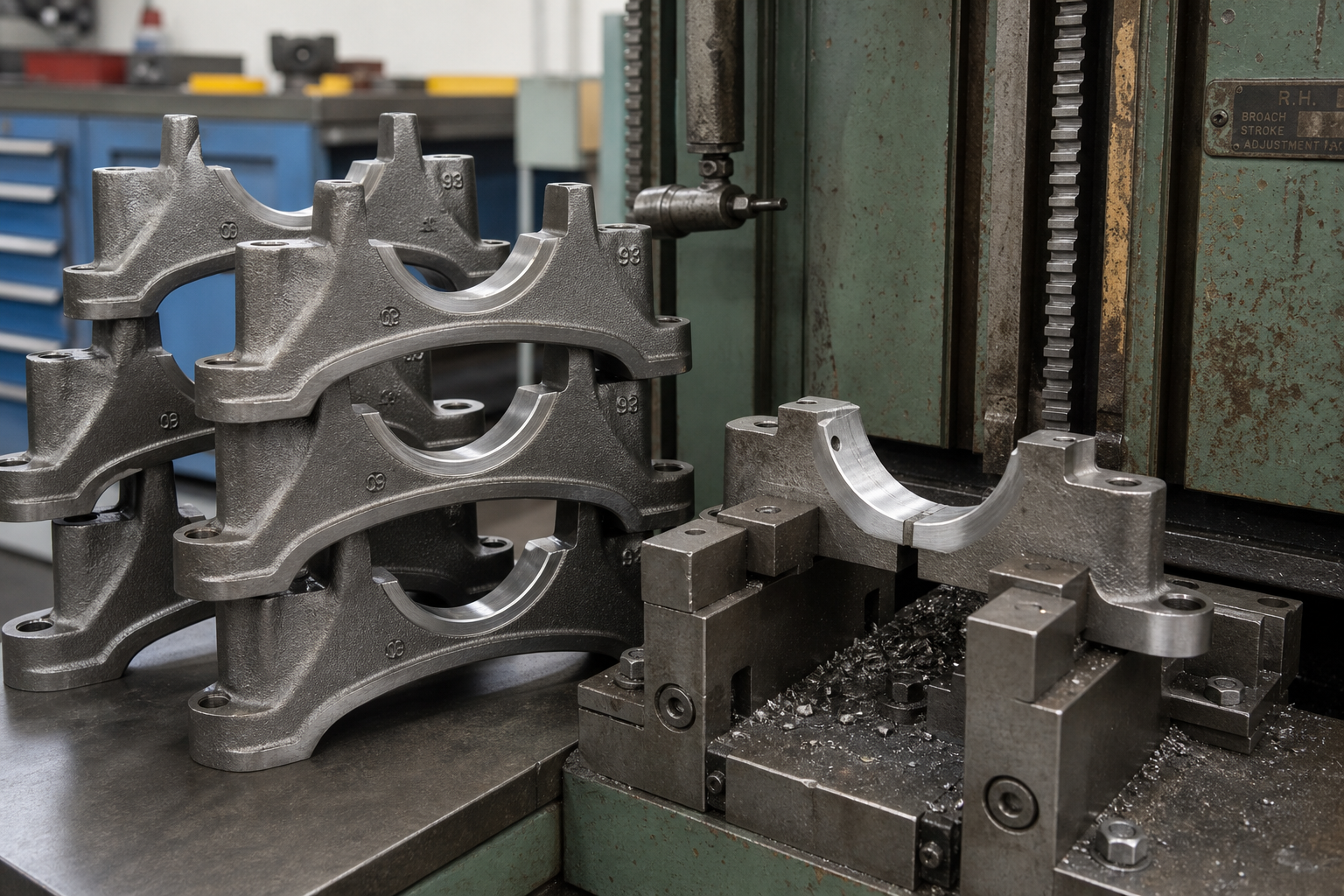
Original non-dimensional engineering concept. It is not a customer part, an EDM capability claim or a photograph of BroachingMach equipment.
Broaching and EDM must be reviewed against the actual drawing; an internal-keyway label alone does not select either route. A possible broaching route needs its own tool, machine, fixture, access and inspection review. If EDM remains a candidate, the responsible EDM provider must define the material, access, workholding and acceptance inputs for that route.
For a stable through feature, progressive broaching may be one route to evaluate. A restricted path or changing part-family condition does not select EDM automatically; it creates additional questions for the responsible providers. The released drawing, material state, functional datum, inspection method and supplier-specific process review decide the route.
This is a neutral selection framework. BroachingMach’s published machine and tool content supports a broaching-route discussion; it does not establish that BroachingMach provides wire EDM, sinker EDM, electrodes or EDM production services.
The Short Answer
Start by asking four questions:
- Is the internal feature through, blind or interrupted, and is there a safe entry and exit for a progressive broach?
- Is the workpiece electrically conductive, and can the required EDM wire or electrode approach the feature without violating the drawing’s protected areas?
- Is the profile stable enough across the part family to justify a dedicated progressive tool and its validation?
- How will the finished feature be located and accepted relative to the functional bore, face, tooth pattern or other drawing datum?
Progressive broaching distributes stock removal across successive teeth. EDM uses an electrical-discharge route rather than a mechanically cutting tooth sequence. The useful comparison is therefore not “which process is better?” It is which route can make the specified feature from the specified blank while preserving the required datum and acceptance plan.
For the fundamentals of an internal keyway, see Keyway Broaching: The Complete Guide. A closed-end form needs the separate Blind Keyway Broaching analysis; it must not be treated as a standard through-broach operation.
The Two Routes Commit the Process Differently

The diagram compares process questions, not machine sizes, cutting parameters, electrical settings or achievable tolerances.
Progressive broaching
For a conventional progressive-broaching candidate, ask the responsible provider to review the prepared opening, guidance, tool path, machine stroke, fixture support, chip handling and exit/handling path as one system. This article does not prescribe a tooth sequence or process setting.
When the profile is released and repeated, the complete tool-and-part system can be evaluated as a candidate route. Apparently small drawing changes remain material: a different keyway width, depth, corner condition, material state, bore relation or heat-treatment stage can change the tooling and validation review. A catalogue term such as “internal keyway” does not prove that a particular tool fits the part.
EDM
EDM should be treated as a provider-specific route review, not a single substitute for broaching. Ask the responsible provider to define the material, approach, workholding, route and acceptance inputs for the actual drawing. This article does not define EDM eligibility, settings or performance.
Where feature access, blank condition or change frequency creates an unresolved route question, EDM may be included in the provider comparison. That does not make it a universal answer for any geometry or material. The actual EDM provider must review the drawing and inspection plan.
Gate 1: Feature Access Comes Before Method Preference
The most important early distinction is the physical path through the part.
Through internal keyways and profiles
A through feature can provide a natural path for a conventional progressive broach: enter under guidance, traverse the feature and clear the far face. The design review must still confirm the pull or push connection, bushing or guide, workpiece support, chip clearance and tool handling.
An EDM route may also be possible, but the question changes to how a wire or electrode reaches and leaves the cut. A wire route can require a legitimate start condition and path; an electrode route can require physical approach and flushing space. Do not assume that “through” automatically makes either route simple.
Blind or interrupted features
A blind feature is not merely a shorter through feature. For broaching, relief, retraction, chip control and tool geometry require a dedicated route review. For EDM, electrode shape, approach, flushing and required corner/termination condition become central. If the drawing calls for a blind keyway, begin with its end condition and functional datum rather than forcing it into a generic comparison.
Obstacles and protected zones
Splines, cross holes, shoulder faces, thin walls, finished surfaces and nearby features can constrain both methods. List them on the controlled drawing. A broach must travel without interference and a fixture must support the part against the cutting load. An EDM route must maintain access, holding stability and a valid approach without compromising protected zones.
Gate 2: Material and Blank State Change the Question
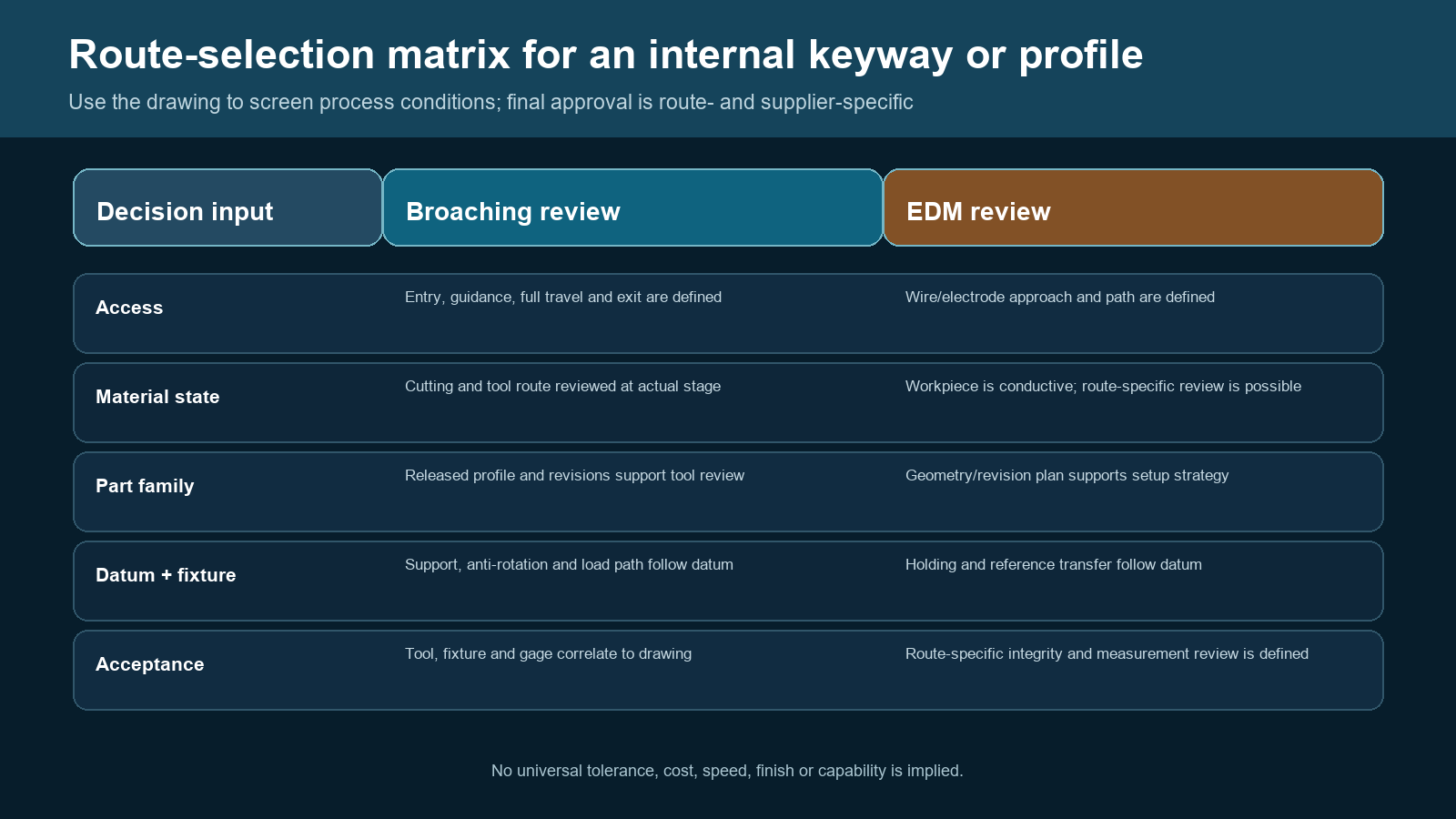
Screening matrix only. It does not provide universal material limits, cost comparisons, finish values or an approved process route.
If EDM remains a candidate, ask its provider to confirm material eligibility, heat-treatment stage, blank preparation and section condition against the released drawing. This article does not turn one material input into a process decision.
For broaching, material condition influences cutting load, chip behavior, tool-life planning and whether the feature is reviewed before or after a heat-treatment stage. The existing Hard Broaching vs Soft Broaching guide explains why process timing cannot be separated from tooling and inspection planning.
Before comparing routes, record the material callout, hardness/heat-treatment condition where it is on the drawing, pre-machined bore or opening, stock condition, feature length, part wall/support condition and revision status. Avoid replacing those inputs with a material name alone.
Gate 3: Dedicated Tooling Versus Revision Flexibility
A progressive broach is purpose-designed for the specified feature. Its roughing, sizing and finishing sections are evaluated together with the workpiece and machine route. This can make sense for a stable part family, but a tool change is not a minor administrative choice: profile revisions, material-state changes and datum changes may require a new engineering decision.
Where geometry changes or access prevents a conventional progressive path, EDM can be screened in the route discussion. Yet EDM also has commitment: wire/electrode strategy, setup, fixture, approach and inspection all require validation on the actual part. Flexibility should not be confused with freedom from process planning.
The right way to ask the question is: which part-family changes are expected, which geometry is frozen, and which route can be verified against the released acceptance method? Do not choose from an assumed annual quantity, generic cycle-time comparison or an unverified cost claim.
Gate 4: Datum, Fixture and Inspection Are the Release Criteria
An internal feature is only useful if it is correct relative to the feature that matters in assembly. That may be a bore, face, spline, tooth relation or another datum identified on the drawing. Both routes need a fixture that locates and supports the part from that functional scheme.
For a broaching route, the review includes guide/bushing alignment, anti-rotation, support, load path, tool-machine interface and chip exit. For an EDM route, the review includes workholding, reference transfer, approach, cut orientation and how the completed feature will be measured. Neither route should be accepted solely because a visual slot appears present.
Use an acceptance method that matches the drawing. Depending on the feature, the controlled plan may use a functional gauge, width/depth measurement, profile measurement, pins/span or coordinate measurement. This article does not imply that BroachingMach supplies any particular gauge, calibration service or CMM inspection service. For spline-specific context, see the Spline Broaching: The Complete Guide.
A Practical Selection Workflow

Use this checklist to prepare an engineering review. It is not a quotation, tolerance commitment, tooling specification or production-release record.
- Freeze the feature. Identify whether it is an internal keyway, repeated profile, spline-adjacent form or another geometry. Mark through, blind and interrupted conditions.
- Identify the functional datum. Mark the bore, face or related feature that controls the keyway/profile relationship.
- Record blank and material state. Include material, heat-treatment stage, opening condition, stock and protected surfaces.
- Screen the broaching path. Confirm entry, guidance, full travel, exit, chip route, tool connection and fixture support.
- Screen the EDM path. Request the EDM provider’s required material, access, approach, workholding and acceptance inputs for the drawing; this article does not prescribe the EDM route.
- Compare the part family. Record expected revisions, variants, quantities and validation needs without assuming a generic threshold decides the answer.
- Define inspection before release. Select the drawing-led method and confirm how fixture datums correlate with inspection datums.
- Validate representative parts. Treat the result as a route-specific engineering confirmation, not a conclusion drawn from a generic web article.
Keep the comparison record with the drawing revision
When a route is screened, retain the revision of the drawing, the blank condition reviewed, the functional datums, the candidate fixture concept and the proposed inspection method. That record prevents a result from being silently reused after a profile, material condition, heat-treatment stage or related datum changes. It is especially important when one workpiece family has several nominally similar variants: a shared name does not prove that their entry path, exit condition or acceptance requirements are the same.
The record should also identify unresolved questions instead of disguising them as assumptions. Examples include whether an EDM approach is physically available, whether a broach can clear the far face, how chips are controlled, and which measurement is functionally meaningful. Those questions are inputs to an engineering review, not deficiencies that a generic article can solve.
Common Mistakes in a Broaching-versus-EDM Review
The labels in this section are warnings against unsupported method promises. They are not evidence that EDM is more precise, more complex-capable or more suitable for a particular part.
Treating EDM as only a “precision” label
EDM may be associated with complex geometry, but the route still requires a defined access strategy, material eligibility, workholding and acceptance plan. Do not infer a process result from a method name.
Treating broaching as only a “high-volume” label
Volume is one planning input, but it does not override an impossible entry/exit path, an unstable blank, a changed datum or an inspection problem. Start with geometry and control of the cut.
Ignoring surface-integrity requirements
If the drawing, customer specification or application has a surface-integrity requirement, capture it early. An EDM provider should review EDM-specific requirements; a broaching review should separately examine cutting, fluid, tool condition and inspection inputs. Do not transfer requirements or acceptance values from one route to the other.
Measuring the feature from the wrong reference
Checking width or visual appearance without the functional bore/face/datum relationship can miss the actual assembly risk. The fixture and inspection plan must reference the drawing’s functional scheme.
When to Request a Broaching Review
For a potential BroachingMach broaching-route review, provide the controlled drawing, workpiece material and stage, feature access, pre-machined opening, expected part-family stability, available machine constraints, functional datums and required inspection method. This lets the tool, machine, fixture, chip-path and inspection discussion begin from the actual feature rather than a generic comparison.
If EDM remains a candidate, validate that route independently with the EDM supplier. The final process selection belongs to the engineering review of the real part, not to this article.
Editorial Scope Note
Current search results and public competitor pages establish that internal-keyway EDM and broaching comparisons are researched. They do not establish BroachingMach EDM capability, settings, finish, tolerance, cost or production results. This page is a drawing-led screening guide; any EDM route must be assessed by its responsible provider.
FAQ
Can EDM replace broaching for every internal keyway?
No. EDM and progressive broaching have different material, access, tooling, fixture and inspection requirements. The drawing and actual process review determine whether either route is suitable.
Does this mean BroachingMach offers EDM services?
No. This is a neutral educational comparison. It does not claim that BroachingMach supplies EDM equipment, electrodes, programming or EDM production service.
Is a blind keyway automatically an EDM job?
No. A blind feature needs a specific review for its end condition, access, material, tooling/process route, fixture and inspection. It should not be selected from a generic label.
What should be compared before requesting a quote?
Compare the released drawing, feature access, material/heat-treatment stage, blank preparation, functional datum, part-family revisions, fixture/support and the required acceptance method. Then review each viable route with the provider responsible for that process.