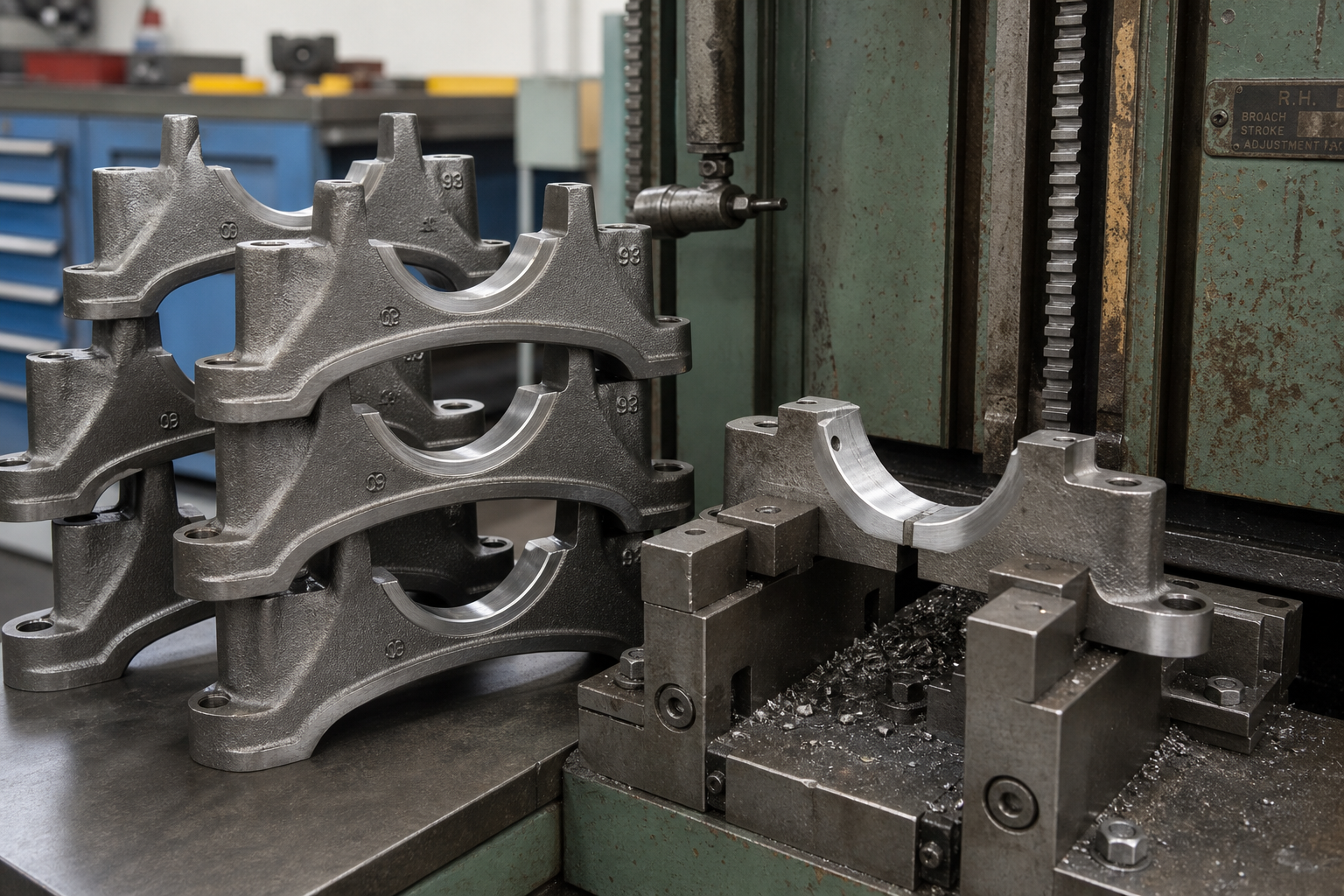
A woodruff key is a removable machine key shaped like a segment of a circular disc: flat on top, curved on the bottom, with two parallel sides that do the actual work of carrying torque. It nests half-hidden in a curved recess milled into the shaft, and its exposed top engages a straight slot in the hub. The result is a compact, self-aligning joint that locks gears, sprockets, pulleys, and impellers to rotating shafts.
Engineers also call it a half-moon key, and the nickname is honest about the geometry. What separates it from the familiar square key is not just the shape but everything the shape drives: how the two slots are cut, how the joint finds its own alignment during assembly, how much torque it can transmit, and how much shaft material it removes. This guide walks through the geometry, the working principle, where designers apply the key, its advantages and limits, and a point-by-point woodruff key vs. square key comparison — including the different machine tools behind each kind of slot.
What Is a Woodruff Key?
Within the family of keyed joints, the woodruff key sits alongside square keys, rectangular keys, and feather keys as a parallel-sided drive element. It is essentially a thin slice of a disc: imagine a circular blank sawn to a chord, leaving a flat upper face, two parallel side faces, and a full-radius bottom. The key itself is a catalog part, produced from keystock grades in standard sizes, never custom-machined for a single joint. You pick a standard key number, cut the matching recesses, and drop it in.
The design takes its name from the American inventor who patented it in the late nineteenth century, when growing engine and machine-tool production needed drivetrain joints that workers could assemble quickly and repeatably. That origin still shows in where the key is used today: high-volume engines, pumps, and small machines assembled by the thousands, where the joint has to go together without fitting or handwork.
Reading the part is straightforward once you know that two dimensions define it. The width of the parallel sides sets the bearing area, and therefore the torque the joint can carry. The diameter of the parent disc sets how deeply the key can nest into the shaft. Standards tabulate these two dimensions into key numbers, so a designer never specifies a woodruff key by free-form dimensions — only by number.
Woodruff Key Geometry: Keyseat and Keyway
Every keyed joint uses two slots, and the woodruff system is no exception — it just makes the two slots strikingly different from each other. Machinists and drafters distinguish them by name, though shop-floor usage often blurs the terms.
The Curved Keyseat in the Shaft
On the shaft, the recess is called the keyseat. For a woodruff key it is a semicircular pocket, not a straight groove. It is cut with a woodruff keyseat cutter — a milling cutter whose teeth sweep the same radius as the underside of the key — plunged into the shaft in a single pass. The arc of the seat wraps the bottom of the key over a large contact angle, which is what allows the key to rock and float inside the seat. Seat depth is not a free choice: for each key number, the standard fixes the depth so the key projects above the shaft surface by a known amount.
The Straight Keyway in the Hub
On the hub side, the slot is called the keyway, and here the woodruff system looks entirely conventional: a plain, parallel-sided rectangular slot through the bore, just wide enough for the key sides and deep enough to seat the key’s full projection. Because the hub slot is an ordinary straight keyway, it can be produced by any of the usual processes — broached in production quantities, or milled and wire-cut in the toolroom. For a full treatment of how the two slots are dimensioned against each other, see our guide to keyway dimensions and standards for shafts and bores.
The terminology is worth one more sentence. In strict usage, a keyseat is a slot in a shaft and a keyway is a slot in a hub. In practice, many drawings and shop orders say “keyway” for both. The distinction matters most when you specify machining: a curved woodruff keyseat is a milling job by definition, while the matching hub keyway can go to a broach.
How a Woodruff Key Transmits Torque
Side Bearing Does the Work
Like every loose parallel key, a woodruff key transmits torque through side bearing, not through its top. When the shaft turns, torque flows from the shaft wall into one side face of the key, through the key in shear, and out the opposite side face into the hub keyway. The flat top of the key is not the primary load path — it centers the hub radially and clears the bottom of the hub slot. The curved bottom simply holds the key in position on the shaft. The design consequence: key width and shaft diameter govern capacity, which is why the standards tie joint capability to key size rather than leaving it to each designer to derive.
The Self-Aligning Property
The feature that defines the woodruff key is that it aligns itself. Because the seat is a circular arc, the key can rock through a few degrees of tilt and still keep its sides parallel to the hub slot. As the hub slides home, the key pivots in its seat to whatever angle brings its sides into register with the keyway. Small angular or indexing errors between the shaft seat and the hub slot — the kind that would jam a square key or bend it in service — are simply absorbed. On tapered shaft ends the effect compounds: the taper pulls the hub concentric while the key rotates in its seat to match the hub’s clocking, then locks as the load settles onto the side faces.
This is also why the key is a favorite at shaft ends. It goes in after the shaft is otherwise finished, stays put in its curved pocket instead of sliding out at an awkward moment, and forgives the modest tolerances of high-volume production.
What Is a Woodruff Key Used For?
Scan real applications and a pattern repeats: a hub at or near the end of a shaft, light-to-medium torque, small or medium shaft diameter, and an assembly line behind it. The woodruff key is a shaft-end specialist.
- Timing gears and sprockets on crankshafts and camshafts. Combustion engines have used woodruff keys to drive timing components for over a century, and the key often doubles as the timing reference between shaft and gear.
- Small-engine flywheels and rotors. Mower, generator, and pump engines typically seat the flywheel on a tapered crankshaft end with a single woodruff key.
- Pump shafts. Impellers, coupling hubs, and drive pulleys on water, fuel, and hydraulic pumps, where shaft diameters are modest and the hub sits close to the shaft end.
- Small electric motors. Fans, worm gears, and pulleys on fractional-horsepower motor shafts.
- General shaft-end accessories. Levers, collars, handwheels, and PTO-driven components that must come on and off a shaft cleanly over the machine’s life.
Notice what is absent from the list: heavy gearboxes, large couplings, and hubs that must slide under load. Those are square-key territory. The woodruff key earns its place where the joint sits at the end of the shaft — where bending moments are low and the strength cost of a deeper seat is small — and where the self-aligning trait pays for itself on every assembly.
Woodruff Key Advantages
The woodruff key has survived since the nineteenth century because it solves several production problems at once:
- Self-alignment. The key rocks in its seat to match the hub slot, absorbing small angular and clocking errors without fitting.
- Fast, foolproof assembly. The key stays captive in its curved pocket; the hub slides on and the joint squares itself as load comes onto the side faces.
- One-cutter shaft machining. A standard woodruff keyseat cutter forms the seat in a single plunge — no multiple passes, no corner work, no tooling beyond the catalog cutter.
- No end-of-slot stress step. A square keyseat milled along a shaft ends in an abrupt step, a classic fatigue initiator. A woodruff seat is a smooth pocket whose arc blends into the shaft surface without that end ramp.
- Full standardization. Keys, shaft seats, and hub slots are all catalog items; design, procurement, and service all reduce to quoting a key number.
Woodruff Key Limitations
Honesty about the weaknesses matters, because they explain exactly where the key should not be used:
- Deep seat, weaker shaft. The curved seat cuts deeper into the shaft cross-section than an equivalent square keyseat, removing more load-bearing material — the decisive reason the key is confined to shaft ends and lighter duties.
- Lower torque ceiling. For the same shaft size, a woodruff joint carries less torque than a square key joint; heavy or reversing loads point to square keys.
- No sliding hubs. The woodruff key is not a feather key. If the hub must slide along the shaft — clutches, shift gears, sliding couplings — the joint needs a square key guided in straight slots.
- Impractical on very small shafts. Below a certain shaft diameter, a code-size seat would consume too much of the section, so designers move to smaller keys or other shaft-locking methods.
None of these limits disqualify the woodruff key; they define its lane. Kept at the shaft end, at light-to-medium load, on a hub that does not slide, it is arguably the most economical keyed joint to manufacture and assemble.
Woodruff Key vs. Square Key
The square key — a straight bar in straight, parallel-sided slots on both shaft and hub — is the default keyed joint in general machinery. Setting the two side by side clarifies where each belongs. The machining story behind the second row gets its own section below.
| Dimension | Woodruff Key | Square Key |
|---|---|---|
| Basic shape | Segment of a disc: flat top, curved bottom | Straight bar with square cross-section |
| Shaft-side slot and process | Curved keyseat, milled in one pass with a woodruff cutter | Straight square keyseat, end-milled or side-milled |
| Seat depth and shaft strength | Deeper seat; removes more shaft material | Shallower seat; preserves more of the shaft section |
| Torque capacity | Light to medium duty | Medium to heavy duty; wide size range |
| Alignment and assembly | Self-aligning; tolerates small angular and clocking errors | Requires well-aligned slots; fitting is more exacting |
| Typical applications | Shaft-end hubs: timing gears, flywheels, pump and motor shafts | General power transmission, gearboxes, couplings, sliding hubs |
The selection logic follows directly. Choose a woodruff key when the hub lives at the shaft end, loads are light to medium, assembly speed matters, and the shaft can afford the deeper seat. Choose a square key when torque is higher, the hub sits mid-shaft where the section must stay strong, or the hub must slide. In many machines the two coexist: woodruff keys at accessory shaft ends, square keys in the primary driveline.
Cutting the Slots: Milling vs. Broaching
Woodruff Keyseats Are Milled
The curved seat is the woodruff system’s signature, and only milling produces it. A woodruff keyseat cutter — a disc-shaped cutter ground to the key’s radius — plunges into the clamped shaft and generates the semicircular pocket in one pass. The hub-side slot, being an ordinary straight keyway, can be milled or wire-cut in low volumes. We compare the two slot-making routes process by process in broaching vs. milling for internal keyways and profiles.
Square Keyways Are Broaching Territory
When a design calls for a square key in a hub bore, the economics change completely. An internal keyway in a bore cannot be reached by a milling cutter, and production volumes will not tolerate slow alternatives. This is the classic case for keyway broaching: a single-row broach with progressively rising teeth is pulled through the bore in one pass and cuts the keyway to size — accurate, repeatable, and measured in seconds per part. Our keyway broaching guide covers tool design, tonnage, and the full process chain, and the keyway broaching set guide walks through ready-made broach-and-guide combinations for common bores. In the woodruff system the same logic can apply to the hub — its slot is a standard straight keyway too — though the small batches typical of shaft-end work usually keep it on a mill.
A word of scope, since we build broaching machines: woodruff keyseats belong to the milling department, not to ours. We cover the woodruff key because our customers design complete key systems, and in those systems the square-key hub bores are exactly where our machines and broaches do their work.
Sizing, Standards, and Assembly
Two standards govern the woodruff system worldwide: ANSI B17.2 in inch dimensions and DIN 6888 in metric. Each tabulates key numbers, key dimensions, keyseat depths, and hub keyway dimensions so that a shaft from one shop, a key from a supplier, and a hub from another shop fit together without adjustment. A key number encodes the key’s width and parent-disc diameter; the tables then fix everything else — seat depth, projection above the shaft, and the width and depth of the hub slot.
For assembly, the standardization does the designer’s work. Both slots are cut to tabulated dimensions; the key drops into the shaft seat and stays there; the hub slides on and the key floats to align itself. No fitting, no shims, no handwork. Our companion woodruff key size chart lists key numbers with their widths, disc diameters, and seat depths for both standard families.
Часто задаваемые вопросы
What is a woodruff key used for?
A woodruff key locks a hub to a shaft at light-to-medium torque, almost always at or near the shaft end. Typical uses include timing gears and sprockets on engine crankshafts and camshafts, flywheels on small-engine tapered crankshafts, impellers and pulleys on pump shafts, and fans and pulleys on small electric motors — anywhere a compact, self-aligning, quickly assembled joint is wanted.
Why use a woodruff key instead of a square key?
Three reasons dominate: the key aligns itself as the hub goes on, so assembly tolerances can stay loose; the shaft seat is cut in a single pass with one catalog cutter; and the seat’s smooth arc avoids the end-of-slot step a milled square keyseat leaves in the shaft. The trade-offs — a deeper seat that costs shaft strength and a lower torque ceiling — are why heavy or mid-shaft duties still go to square keys.
How deep is a woodruff keyseat?
Depth is not a single number: it depends on the key number and shaft size, and the standard fixes it for each combination. As a rule, a woodruff keyseat runs appreciably deeper than the square keyseat for the same key width — that depth is the key’s main structural cost. Exact depths by key number are tabulated in our woodruff key size chart.
Are woodruff keys standard?
Yes. Woodruff keys, keyseats, and hub keyways are fully standardized — by ANSI B17.2 in the inch system and DIN 6888 in the metric system — and the keys are stocked catalog parts. A design only ever references a key number; every dimension downstream of that number is tabulated.
If your designs put square keys in hub bores, keyway broaching is the production answer: one pass per bore, tight tolerances, and seconds of cycle time at volume. Explore our протяжные станки for configurations matched to your part sizes and volumes, or start from a standard keyway broaching set sized to your bore and key width.