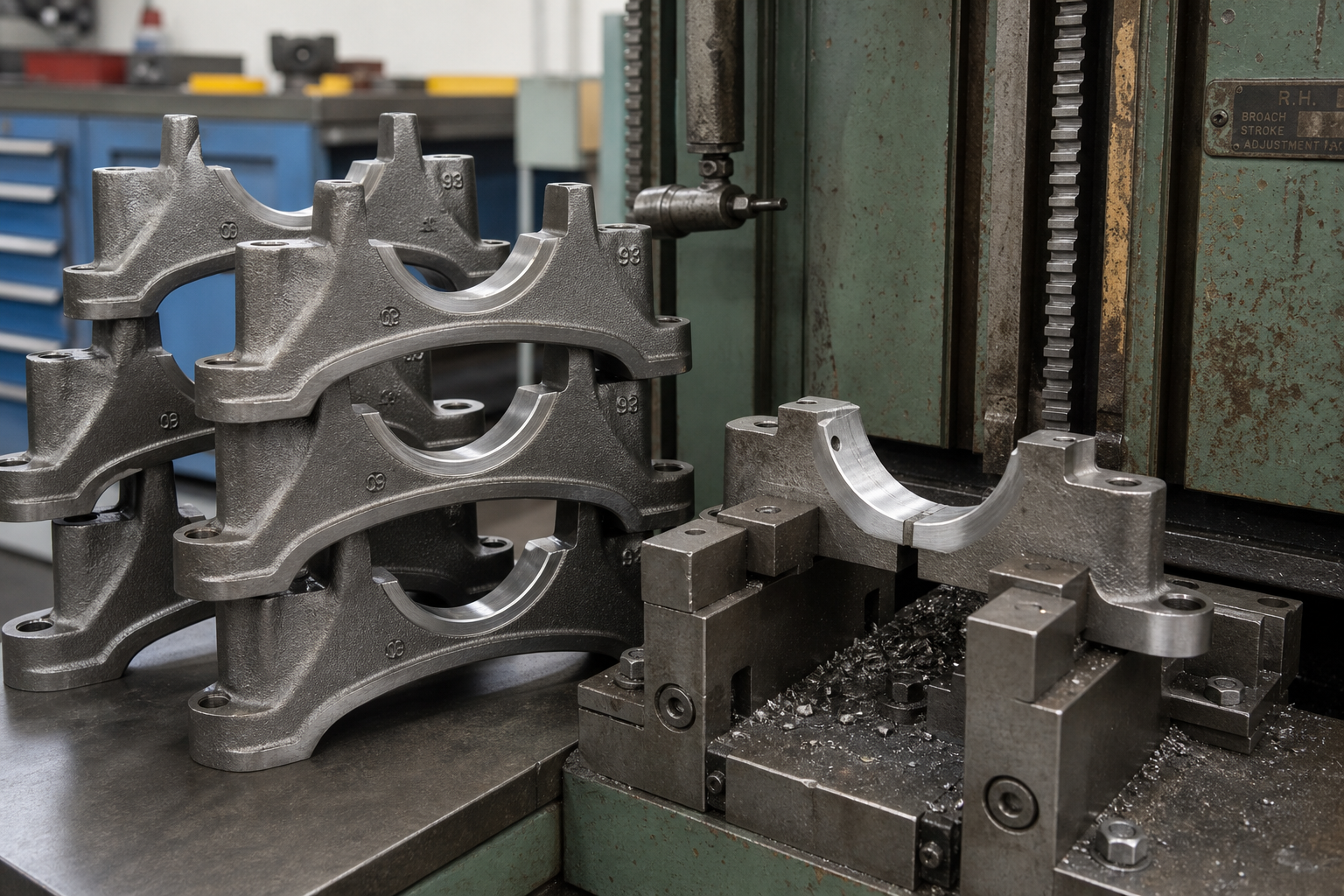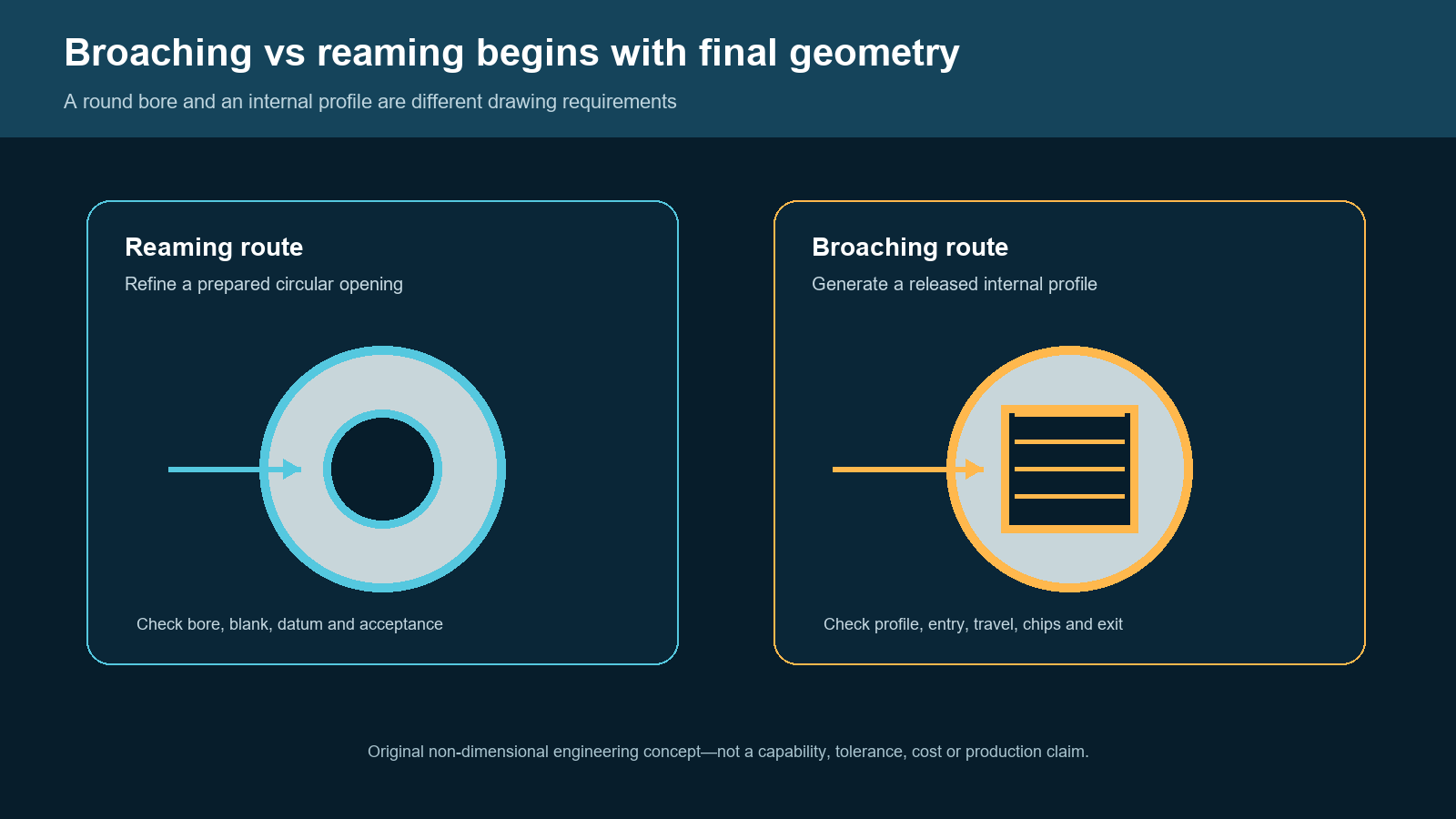
Original non-dimensional engineering concept. It does not show a customer component, a BroachingMach machine, a measured result or a process-capability claim.
Broaching and reaming can both appear after a hole has been made, but they answer different drawing questions. Reaming is commonly considered when a circular hole needs controlled sizing and surface condition after drilling or boring. Progressive broaching is considered when a defined internal form—such as a keyway, spline, polygon or another repeated profile—must be generated from a prepared opening with a suitable entry, guidance and exit route.
That distinction matters because a bore diameter and an internal profile are not interchangeable requirements. A drawing can include both: for example, a circular locating bore plus a torque-transmitting keyway or spline. In that case, the process plan has to preserve the relationship between them, not simply select the operation with the most familiar name.
This article is a drawing-led selection framework. It does not claim that BroachingMach provides reaming services, nor does it prescribe universal tolerances, finishes, speeds, tool lives, costs or machine capacity. A released part drawing, material state, blank condition, functional datum, fixture concept and acceptance method must be reviewed for the actual route.
The process descriptions below are screening boundaries, not independent reaming or broaching specifications. The responsible process provider and drawing owner must supply the route-specific technical evidence.
The Short Answer
Evaluate reaming when the finished requirement is principally a round hole and the responsible provider confirms the prepared-bore route. Evaluate progressive broaching when the finished requirement is a defined internal profile and the responsible provider can review the opening, access, tooling, fixture and inspection conditions.
Before choosing either process, answer these questions:
- What final geometry is controlled: a circular diameter, a non-round profile, or both?
- What does the blank provide before the final operation: drilled hole, bored hole, cast opening, preformed profile or another condition?
- Where is the functional datum, and which feature must remain related to it?
- Is the internal feature through, blind or interrupted, and is there physical access for the proposed route?
- How will the finished characteristic be accepted against the drawing?
For a broad introduction to broaching, see What Is Broaching?. Process preparation questions specific to internal broaching should be reviewed against the actual opening, access, material stage and tool route. Use the public Keyway Broaching: The Complete Guide to review an internal-profile example.
Start With Final Geometry, Not With the Word “Hole”
The word hole can conceal several different requirements. A reamed bore is still circular. Its acceptance may involve diameter, form, surface condition, depth, relationship to a face or axis, and any functional fit stated on the drawing. A broached feature can start from a circular opening, but its final output may be a keyway, spline, square, rectangular form or another profile with distinct flanks, roots, corners and angular relationships.
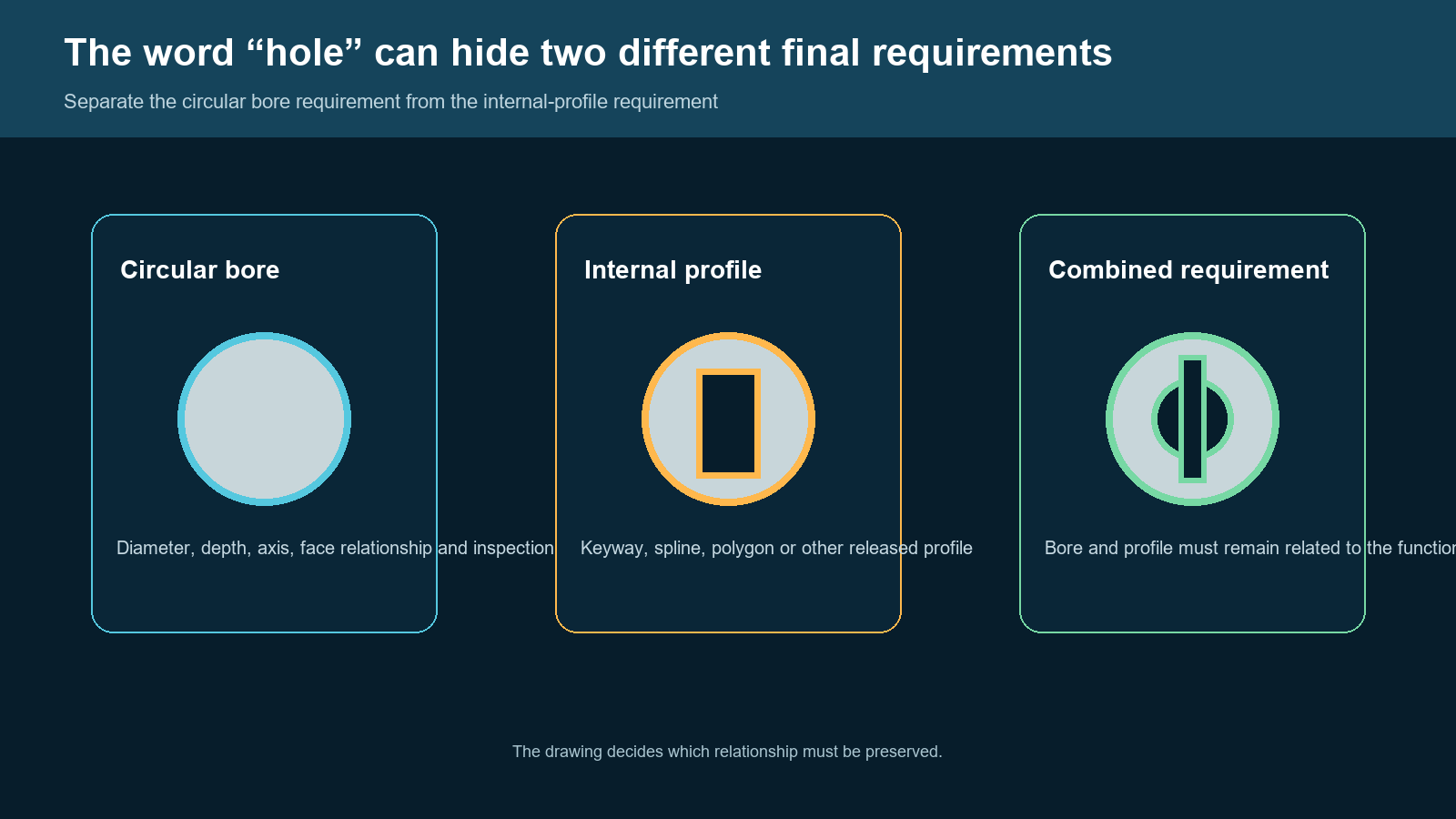
The map separates geometry questions only. It does not rank processes or establish tolerances, finish, cost or capability.
When the final feature is round
The reaming discussion is intentionally provider- and drawing-led. It does not prescribe stock, coolant, tooling, tolerance, finish or a final bore result.
If the controlled feature is a round bore, reaming may be part of the discussion after drilling or boring. The relevant review is not merely “use a reamer.” It includes the starting-hole condition, stock left for the operation, material state, alignment to the functional datum, tool guidance, coolant and chip control, workholding and the method used to verify the finished bore.
A separate keyway or spline requirement does not disappear because the bore is reamed. If the part needs both a bore and a profile, the sequence must account for their relationship. The team should identify which feature establishes location, which feature transmits function, and whether one operation affects the surface or datum used by the other.
When the final feature is an internal profile
The broaching discussion is intentionally provider- and drawing-led. It does not establish that a particular tool, machine, fixture or inspection route is feasible.
If the final requirement includes an internal profile, a progressive broach may be evaluated. The workpiece must provide a compatible prepared opening, an entry condition, guidance, sufficient support and a route for the tool and chips. The process review also has to account for the tool connection, stroke path, fixture load path, anti-rotation method and inspection strategy.
A profile name alone is not enough. “Spline,” “keyway” or “internal form” does not state whether the feature is through, blind, interrupted, near a shoulder, located from a bore or face, or affected by a heat-treatment stage. These conditions can change whether a conventional progressive route is feasible.
For internal keyway-specific access questions, see Blind Keyway Broaching. A blind end condition must not be treated as a normal through-broach condition shortened in length.
The Two Process Routes Commit the Plan Differently
Reaming and broaching differ in how they engage the part and in what they require from the preceding operation.
Reaming route: refine a prepared circular opening
Reaming normally follows an opening produced by an earlier operation. The starting bore, material condition and alignment matter because the reamer follows and refines what the process has presented to it. A route review should identify the controlled axis or face, the expected starting condition, the amount and distribution of remaining stock as defined by the process plan, and the inspection method.
This does not mean a reamed hole is automatically independent of the fixture. Holding method, part support, runout sources, machine/tool condition and datum transfer can affect whether the result can be accepted. These are route-specific engineering questions, not generic claims about what any reamer can achieve.
Broaching route: generate a released profile through a system
A conventional progressive broach uses successive teeth to create the released form. The broach, prepared opening, guide or bushing, machine path, pull or push connection, fixture and chip route work together. A change in blank condition, material stage, profile, feature length, datum relation or exit condition can require a different review.
The point is not that broaching is “better” than reaming. It is that a progressive tool is intended to make a profile, while a reamer is evaluated for refining a round hole. A part that needs both may use a carefully sequenced combination, but that combination must follow the drawing and validated process route.
Gate 1: Blank Condition and Access
The final feature can only be assessed after the starting condition is known.
| Drawing / process input | Reaming question | Broaching question |
|---|---|---|
| Starting opening | Is the drilled or bored hole suitable for the planned refinement route? | Is the prepared opening compatible with the profile tool, entry and guidance? |
| Feature geometry | Is the requirement primarily circular and defined by the bore callout? | Is there a released internal form beyond the circular opening? |
| Access | Can the tool approach and traverse the required depth without interfering features? | Can the broach enter, travel, clear chips and exit or retract through the actual part condition? |
| End condition | Does the controlled bore terminate at a face, shoulder or blind depth? | Is the feature through, blind or interrupted, and does that change the conventional route? |
| Material stage | Is the material and prior operation state defined for the refinement plan? | Is the cutting/material state defined for the tool, fixture and inspection review? |
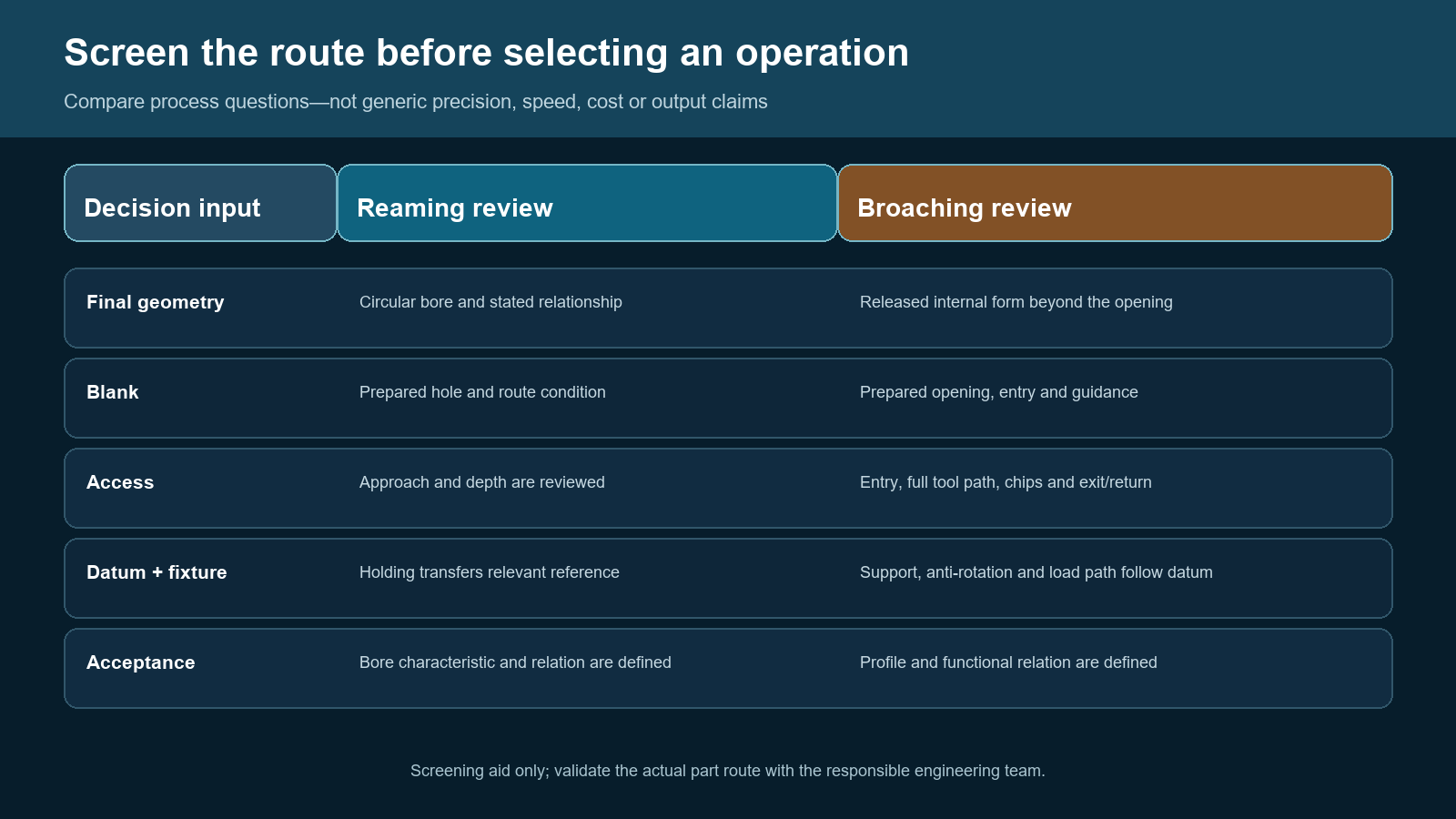
Screening matrix only. It does not provide a universal method preference or a production specification.
Through, blind and interrupted conditions
A through feature may allow a conventional broach path when all other entry, guidance, support and exit requirements are satisfied. It still needs a real fixture and inspection plan. A blind or interrupted profile changes the problem: relief, retraction, chip control, geometry and protected areas can become dominant factors.
For a circular blind bore, the review centers on the stated depth, bottom condition, approach and measurement plan. For a blind internal profile, the correct answer may be a special route, an alternative process or a redesign discussion. Do not select a process simply because another part family has a similar name.
Gate 2: Datum, Function and Fixture Must Stay Connected
Process selection should follow the functional drawing relationship. A bore may locate an assembly; a keyway or spline may transmit torque; a face may establish axial position. The selected route must maintain the relationships that matter to function.
Identify the functional datum scheme
Mark the relevant bore, face, axis, profile and positional relationships on the controlled drawing. Then ask how the workpiece will be located during each operation and how the final feature will be measured relative to that datum. This prevents a planning error in which a round bore and an internal profile are evaluated separately even though the assembly depends on their relationship.
Review support and load path for a broaching route
For a broaching route, the fixture concept should support the part and resist rotation or movement without damaging functional surfaces. Tool travel, guide alignment, chip clearance and the pull or push load path must be reviewed together. A generic fixture image or a competitor's workholding claim cannot establish that the site has the required fixture or machine arrangement.
Review holding and alignment for a reaming route
For a reaming route, workholding and datum transfer remain important. The preceding operation, machine alignment and tool approach must be compatible with the bore acceptance method. It is not safe to infer a final result from a generic claim such as “reaming is precise.” The drawing and validation plan decide what is acceptable.
Gate 3: Inspection Is Part of Process Choice
The inspection question should be written before the route is committed. It connects the manufacturing plan to the functional drawing.
For a round hole, the plan may need to establish what characteristic is checked, which datum relation matters, when the feature is measured and how the team distinguishes a tooling/setup issue from a blank-condition issue. For an internal profile, the plan may need to distinguish functional fit from an isolated measurement, and it must establish how the profile is located relative to the bore, face or other functional reference.
Avoid assuming that one instrument, plug, pin, gage or CMM strategy fits every part. The feature class, datum scheme, access and drawing requirements determine the appropriate method. For an internal spline, separate functional acceptance from analytical feature evaluation before choosing the inspection route.
A Practical Drawing Review Sequence
Use the following sequence before asking a process provider to commit a route:
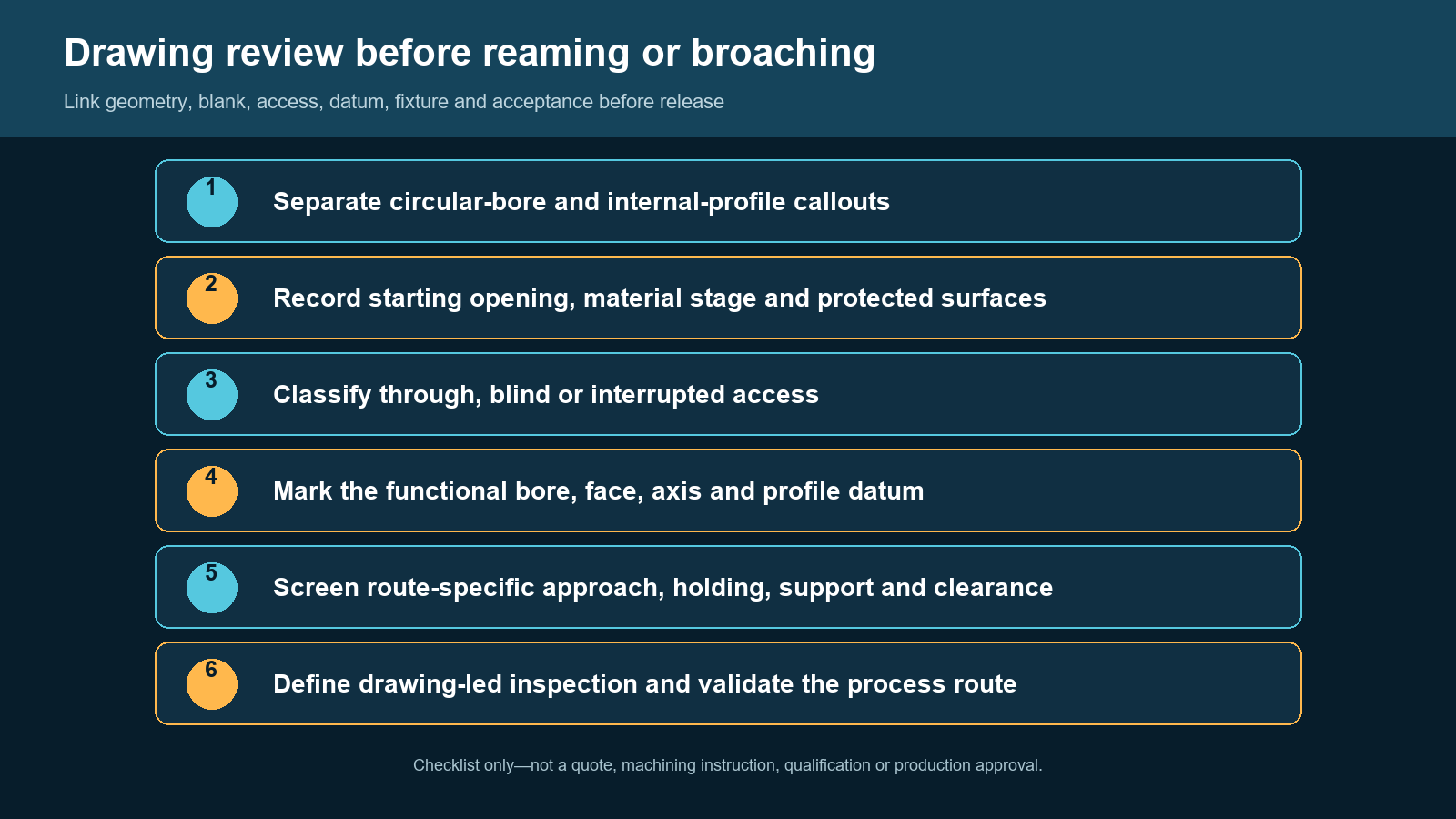
Original planning checklist. It is not a quote, a machining instruction, a process qualification or production approval.
- Separate the bore from the profile. Mark whether the final callout is circular, profiled or combined.
- Record the starting condition. Identify the preceding opening, material stage, relevant faces and any protected surfaces.
- Classify access. State through, blind or interrupted condition and note shoulders, cross holes, thin walls or obstructions.
- Name the functional datum. Make clear how the finished feature relates to the bore, face, axis or mating component.
- Screen the route. For reaming, review prepared-hole and approach conditions. For broaching, review entry, guide, tool travel, chip path, fixture and exit/return conditions.
- Define acceptance before release. State the drawing-led inspection question and validate the actual process with the responsible supplier or engineering team.
Common Misclassifications to Avoid
“Any hole can be broached instead of reamed”
Broaching is not a generic synonym for finishing a circular hole. A progressive tool is evaluated against a defined profile, the prepared opening and a complete tool-machine-fixture route. A circular-hole refinement task may be a reaming, boring, honing or another process decision depending on the drawing and manufacturing context.
“A reamer can make the keyway relationship later”
A reamer can be part of the bore route, but it does not create an internal keyway or spline form. If a profile is required, the plan must preserve the relevant bore/profile relationship and evaluate the separate feature route.
“A generic tolerance selects the process”
Numbers without a complete drawing context do not select a method. The material state, feature geometry, access, functional datum, blank condition, fixture and inspection method must be understood together. Do not turn a catalogue value, competitor claim or generic online chart into a process commitment.
“A competitor’s route proves our capability”
Competitor content can reveal a search task and a useful decision structure. It cannot prove BroachingMach equipment, tooling, fixture, reaming service, inspection system, tolerance, output or customer result. Any production decision must be reviewed with first-party information and the actual part requirements.
When to Request a Broaching-Route Review
Contact BroachingMach with a controlled drawing when the part has a stable internal profile and you want to assess whether a broaching route is appropriate. Include the feature geometry, through/blind/interrupted condition, material and heat-treatment stage, starting opening, functional datums, anticipated part-family changes, inspection requirement and available fixture context.
If the final requirement is a round bore or the route includes reaming, involve the provider responsible for that process in the same drawing review. A robust plan may include more than one operation; the important point is that each operation is chosen for the feature it must create and the acceptance relationship it must preserve.
Related Reading
- Complete Guide to Broaches
- Round Broaching: The Complete Guide
- How to Calculate Broaching Machine Tonnage
- Push Broaching vs Pull Broaching
- Troubleshooting for Broaching Operation
FAQ
Is reaming the same as broaching?
No. Reaming is generally evaluated for refining a circular opening. Broaching is evaluated for generating a defined profile with a compatible prepared opening and a complete tool, machine, fixture and inspection route.
Can a part use both reaming and broaching?
It can, when the drawing requires both a controlled bore and an internal profile. The sequence and datum relationship must be validated for the actual part rather than assumed from a generic process chart.
Does a round hole always need reaming?
No. The appropriate route depends on the released drawing, starting condition, material, functional requirement, access and acceptance plan. This article does not prescribe an operation for every circular hole.
What information is needed to evaluate an internal broaching route?
Provide the controlled drawing, final profile, starting opening, material and stage, feature access, relevant datums, expected changes, fixture context and drawing-led inspection requirement.