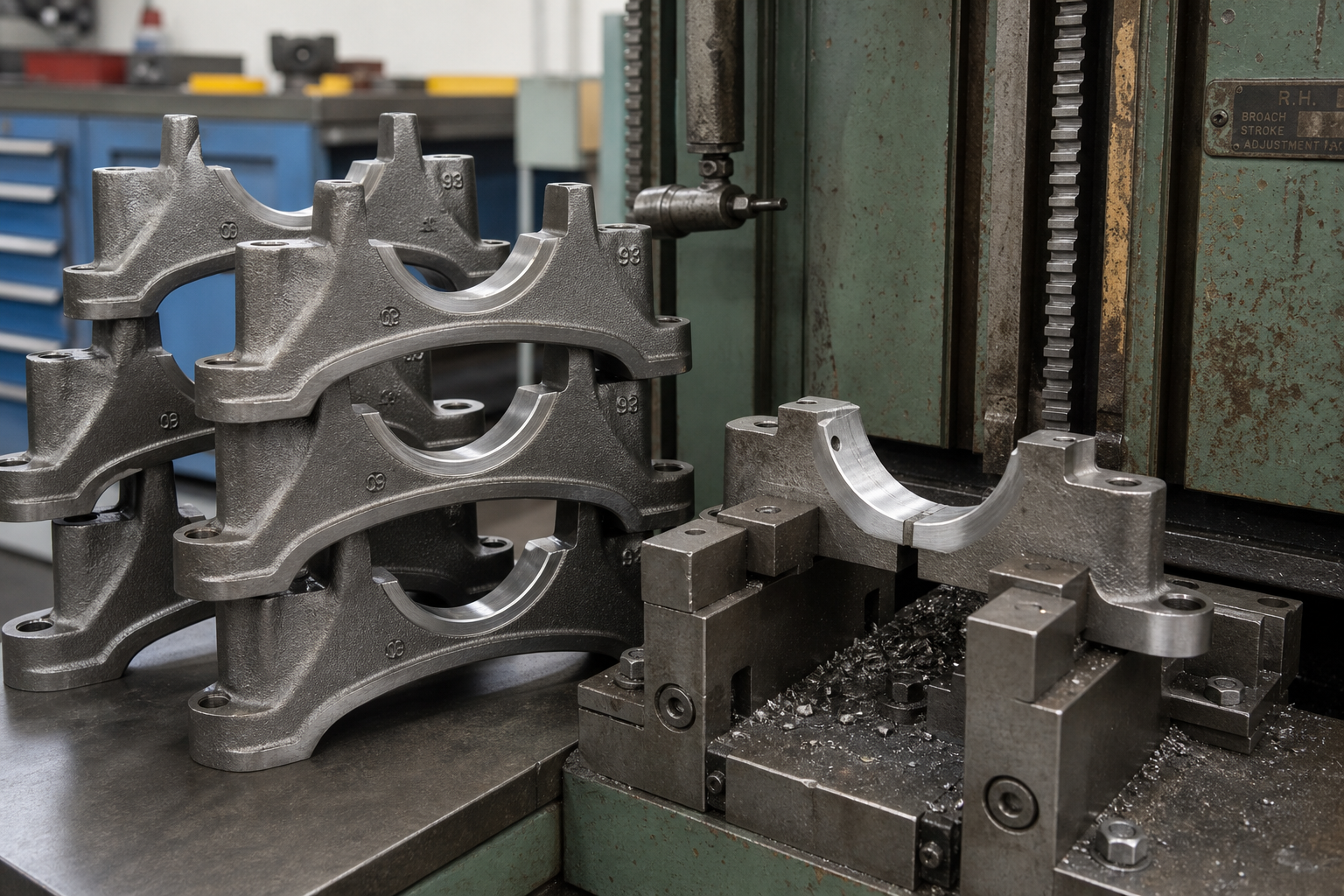
Ask a machine shop what a broaching machine is and you will usually get a working answer: the machine that cuts keyways and splines in one shot. That answer is correct as far as it goes, but it undersells the machine. A broaching machine is a metal-cutting machine tool that moves a long, multi-toothed cutting tool — a broach — in a straight line through or across a workpiece, and in that single straight pass produces a finished hole, slot or surface profile. No multiple passes, no tool changes mid-cut, no gradual approach to final size: the form emerges complete, to size, in one stroke measured in seconds.
That single-stroke capability is why broaching machines sit on some of the highest-volume production lines in manufacturing — transmission plants, steering system lines, appliance factories, aerospace turbine shops — quietly cutting the same splines, keyways and profiles into millions of identical parts. This article introduces the machine itself: what it is, how it works, the main types on the market, what it can cut, and what matters when you buy one. If you are looking for the cutting process in depth — chip formation, cutting parameters, tool geometry — our companion article What Is Broaching? covers the process side. This one stays with the machine: the equipment that turns that process into parts.
What Is a Broaching Machine? A Working Definition
Formally: a broaching machine is a machine tool whose sole function is to translate a broach — a segmented cutting tool whose teeth step progressively from roughing to finishing size — along a straight path relative to a clamped workpiece. Everything else on the machine exists to support that one motion. The frame carries the cutting load. The ram (or slide) moves the tool. The drive system — hydraulic cylinder, electromechanical servo, or on small machines a hand lever — supplies the force. A tool holder secures the broach at the ram; a fixture or workholder secures the part and backs it against the cutting reaction. On production machines, part handling, guarding and coolant delivery complete the picture.
What distinguishes a broaching machine from other machine tools is not the cutting action itself — the teeth shear metal exactly as any single-point or multi-tooth cutter does — but the economics of the pass. Because the broach carries its entire roughing-to-finishing sequence built into its own body, the machine needs only one motion, one direction, one stroke. The machine is therefore mechanically simple for the output it delivers: no complex interpolation, no multi-axis tool paths, no adaptive control. What it demands instead is force over distance — enough tonnage to pull (or push) the full set of teeth through the work, and enough stroke length to carry the longest broach the parts require.
The Machine, Not the Process
A note on scope, because the two words get tangled. Räumen is a machining process and can be performed on more than one kind of equipment — including rotary (wobble) broaching performed on a lathe or mill with no broaching machine in sight. A broaching machine is the dedicated machine tool built around linear broaching. When a sourcing engineer, a student or a plant manager asks “what is a broaching machine,” they are asking about that dedicated equipment class: the verticals, horizontals and CNC machines that populate this site’s product range. That is the frame for everything below.
How a Broaching Machine Works
The working principle rests on two ideas — progressive teeth and one-stroke completion — plus one design decision every machine embodies: whether the tool pulls or pushes.
Progressive Teeth: Many Small Cuts in One Stroke
A broach looks like a tapered file scaled up to cutting-tool standards. Along its length run rows of teeth, each slightly larger than the one before it. The difference in height between successive teeth — the rise per tooth — is the depth of cut each tooth takes. The first teeth bite small chips from the rough opening; the middle teeth carry the form toward size; the last rows, set at final dimension, finish and burnish the surface. By the time the tail of the broach exits the workpiece, every tooth has done its share of the work and the form is complete. The machine’s ram simply provides the straight, powerful motion that walks this staircase of cuts through the part in one continuous pass — effectively a production line of cutting edges compressed into a single tool.
One Stroke, Finished Form
This is the property that defines the machine’s role in a plant. Milling a keyway means multiple passes at increasing depth; broaching it means one stroke of a few seconds. The stroke is also repeatable: tooth geometry, not operator technique or tool-path programming, determines the outcome, so the first part and the ten-thousandth part carry the same form. That is why broaching machines earn their keep at volume — and why they are usually specified for a known family of parts rather than kept as general-purpose equipment. The trade-offs (tooling lead time, a tool dedicated to each form) belong to the process discussion in our broaching process guide; from the machine’s standpoint, one stroke is simply the whole job.
Pull or Push: Two Ways to Move the Tool
Every broaching machine moves its broach by tension or by compression. Pull-type machines draw the broach through the work — the classic arrangement for internal work, because a broach in tension cannot buckle, so it can be long and slender. Push-type machines force the broach through — simpler and common for shorter tools, surface work and smaller keyways, but a pushed broach must be kept short and stout relative to its cross-section or it will buckle under load. Internal spline and keyway production skews heavily toward pull-type; benchtop and arbor-press setups are push-type by nature. The decision interacts with tonnage, stroke and tool length, and we treat it in detail in push broaching vs. pull broaching.
Types of Broaching Machines
The market sorts broaching machines along three axes: spindle orientation (vertical or horizontal), cutting direction relative to the workpiece (internal or surface/external), and layout and control for volume production (manual, hydraulic with PLC, CNC, or continuous chain and rotary layouts). The seven rows below cover every machine class a buyer will encounter — plus the rotary tooling system that often serves as the entry door instead.; each links to the detailed guide for that type.
| Type | Configuration | Built for |
|---|---|---|
| Vertical broaching machine | Ram moves vertically; part sits below or above the tool | The most common production choice: internal keyways and splines plus surface work, with a small floor footprint and easy load/unload at operator height |
| Horizontal broaching machine | Ram moves horizontally along the bed | Long strokes and heavy cutting forces; large parts, long broaches, and surface/external profiling where tool access from the side matters |
| Internal broaching machine | Pull-type (typically); broach drawn through a pre-machined hole | Splines, keyways, hex and square bores, and precision round holes produced inside parts |
| Surface broaching machine | Broach travels across the outside of the clamped part | External flats, slots, steps and contoured profiles — cylinder block faces, turbo wheels, fixture-ready datum surfaces |
| Continuous broaching machine | Parts ride a chain or rotary carrier past fixed broaches | Very high volumes of small parts — the workpiece never stops moving, so cutting never pauses between components |
| CNC broaching machine | CNC-controlled ram — servo-driven or hydraulic with proportional valves — often with indexing axes | Smaller lots and faster changeovers: programmable stroke, position and feed let one machine serve multiple part families |
| Rotary (wobble) broaching | Not a standalone machine — a tool-and-holder system run on lathes and mills | Small polygon forms (hex, square, Torx-type) cut in-cycle on parts already being turned or milled; the entry door to broaching without buying a broaching machine |
Two orientations deserve a note before the table fades from view. The vertical-versus-horizontal choice is usually decided by floor space, part size and stroke length rather than by the cut itself — our horizontal vs. vertical comparison walks through the decision. And the CNC row is less a separate species than a control philosophy layered on the same mechanics: a CNC broaching machine is still a ram pushing or pulling a broach, but with the programmability that modern mixed-model production expects.
What a Broaching Machine Can Cut
Internal forms are the heartland. Through any pre-machined opening of adequate size, a broaching machine can produce:
- Keyways — the single most common broached feature; our keyway broaching guide is the deep dive on dimensions, standards and practice
- Splines — straight-sided and involute profiles transmitting torque in drives and gearboxes
- Polygon bores — hexagons, squares, double-hex and double-square forms for handles, fittings and drive connections
- Precision round holes — broached to final size and finish in one pass where reaming would follow drilling
External forms are the second half of the machine’s range. Surface broaching cuts flats, slots, steps, serrations and fully contoured profiles on the outside of a part — turbine disc slots, crankshaft flats, gear-shift fork grooves, cylinder block faces. Wherever an external profile repeats identically across a production run, surface broaching competes on the same single-stroke logic as internal work.
Materials span most of the metals a shop will ever hold: free-machining and alloy steels, stainless steels, cast iron, aluminum and aluminum alloys, brass, bronze and copper alloys. Harder grades shorten tool life, and above roughly 50 HRC conventional practice gives way to specialized hard broaching techniques. The full picture, including the difficult aerospace alloys, is in Welche Werkstoffe lassen sich räumen?.
Where Broaching Machines Work: Industries and Typical Parts
A quick tour by sector shows how wide the machine’s reach is. Each of the part families below has a dedicated case study in our applications library.
- Automotive is the anchor user, by volume and by history. Transmission gear spline bores, steering wheel hub splines, connecting rods, brake calipers and engine cylinder blocks all carry broached features, produced at line rates measured in parts per minute.
- Luft- und Raumfahrt relies on broaching for some of its most safety-critical geometry: the fir-tree slots that hold turbine blades in discs, cut in nickel superalloys to profiles with no tolerance for error.
- Home appliances hide broaching in plain sight — the drive splines and end-face features of washing machine and dishwasher tubs, produced in the millions; our appliance tub case study covers the family.
- Valves and fluid power use broached keyways, slots and seat geometry in pipe main valves, fittings and pump components; see the pipe main valve case.
- General industry rounds it out: pulley and sprocket bores, chain rail links, firearm components, hand tools, and any product line where an internal or external profile repeats at volume.
Why a Broaching Machine Instead of Milling, Slotting or EDM
Every feature a broaching machine cuts could, in principle, be produced some other way — so the machine has to justify itself against the alternatives part-family by part-family. In compressed form:
Versus milling: a mill produces a keyway or slot through multiple passes with a rotating tool; a broaching machine produces it in one stroke with a form-specific tool. Milling wins at prototype quantities and on features already reachable in an existing setup; broaching wins on cycle time and per-part cost once volumes rise — the comparison, including the break-even logic, is in broaching vs. milling. Versus slotting, shaping and keyseating: these reciprocating processes remove metal a chip at a time with a single edge walking across the form; broaching removes the whole form in one pass, at the cost of a dedicated tool. Versus EDM: wire and sinker EDM cut conductive materials of any hardness with no cutting force, but slowly and at a per-part cost that scales poorly with volume; broaching runs orders of magnitude faster in materials it can handle — the trade is laid out in broaching vs. EDM.
The common thread is a break-even lot size. Below it, the flexibility of general-purpose machines and the low tooling cost of alternatives win; above it, the broaching machine’s speed, repeatability and single-stroke economics dominate. Where exactly that point sits depends on the feature, the material and the cycle times involved — each of the head-to-head comparisons above works the numbers for its own case.
Buying a Broaching Machine: Three Specifications That Decide Everything
A broaching machine is specified around three linked requirements, and every quotation, every listing and every factory conversation resolves to them:
- Tonnage — the pulling or pushing force the ram must deliver. It follows from the total width of cut, the rise per tooth, the work material and the broach length; underestimate it and the machine stalls mid-stroke. The calculation method is in how to calculate broaching machine tonnage.
- Stroke length — the ram travel available. It must carry your longest broach plus its shank and the workpiece, with margin; it is the specification that most often separates a machine that “should work” from one that does.
- Drive technology — hydraulic or servo. Hydraulic drives deliver high force at moderate cost and dominate heavy production work; servo drives bring precision, programmability and cleaner, quieter operation, and pair naturally with CNC control. The comparison is in Servo- vs. hydraulische Räummaschinen.
Around those three, the buying process adds tooling lead time (a custom broach is engineered per form and is part of the project, not an accessory), workholding, automation and after-sales support. The step-by-step selection framework is in how to choose the right broaching machine, and the cost picture — price bands from manual benchtop setups to automated CNC lines — is broken down in our broaching machine price guide.
Where to Go Next on This Site
This article is the front door; behind it the site is organized as a library, and the fastest way deeper is by what brought you here. If the machine itself is your focus, the broaching machines section holds every machine-type guide plus the selection and pricing articles. If you came for a specific feature, the keyway broaching and spline broaching sections are the two deepest application tracks. If your interest is process fundamentals and how broaching compares with other cutting methods, start from the broaching process section. And if you buy by the part rather than by the process, the applications library collects part-level case studies across automotive, aerospace, appliances and valves — often the quickest way to find your own component, or its cousin, already solved.
Häufig gestellte Fragen
What is a broaching machine used for?
It is used to cut internal and external profiles that repeat across a production run: keyways, splines (straight-sided and involute), polygon bores such as hexes and squares, precision round holes, and external flats, slots and contoured surfaces. Typical workpieces span transmission gears, steering hubs, connecting rods, brake calipers, turbine discs, appliance tubs and valve bodies — any part family where a form must be produced identically at volume, in one stroke per part.
What are the types of broaching machines?
The main types are vertical and horizontal machines (by ram orientation); internal and surface/external machines (by cutting direction); and continuous machines, which carry parts past fixed broaches on a chain for very high volumes. Layered across these are the control options: manual, hydraulic with PLC control, and CNC/servo machines for flexible, faster-changeover production. Rotary (wobble) broaching is a related tooling system run on lathes and mills rather than a standalone machine. The table above links each type to its detailed guide.
How does a broaching machine work?
The machine clamps the workpiece and moves a multi-toothed broach through or across it in one straight stroke. Each tooth on the broach stands slightly taller than the one before it, so successive teeth take progressively deeper, then finishing, cuts — many small machining passes compressed into a single continuous motion. The ram either pulls the broach through the part (pull-type, standard for internal work, since tension prevents buckling) or pushes it (push-type, for shorter tools and surface work). When the stroke completes, the form is finished to final size.
How much does a broaching machine cost?
The range is wide because the machines are. Manual benchtop setups (arbor press plus broach set) sit under about $1,000; new small hydraulic vertical machines occupy roughly the $15,000–$25,000 band; used production machines trade broadly between about $10,000 and $80,000 depending on tonnage, brand and condition; new mid-size production machines land in the upper five figures; and large CNC or automated lines reach six figures as engineered projects quoted to specification. The bands, the cost drivers behind them and a budgeting workflow are covered in the broaching machine price guide.
From Definition to Production
A broaching machine, in one sentence: a machine tool that moves a staircase of progressively sized teeth through a workpiece in a single stroke, delivering a finished keyway, spline or profile every few seconds, part after part. The type you choose — vertical or horizontal, internal or surface, hydraulic or CNC — follows from your parts, your volumes and your floor; the economics follow from the break-even between tooling investment and per-stroke productivity.
If you have a part in hand rather than a general question, the fastest route is a direct one: send us the drawing. We manufacture broaching machines and broaches as an integrated Chinese builder serving export customers, and we can propose a machine specification — tonnage, stroke, drive and tooling — against your actual feature and volume. Start from the broaching machine catalog to see the standard models, or contact us with your part print and target output for a tailored recommendation and quotation.