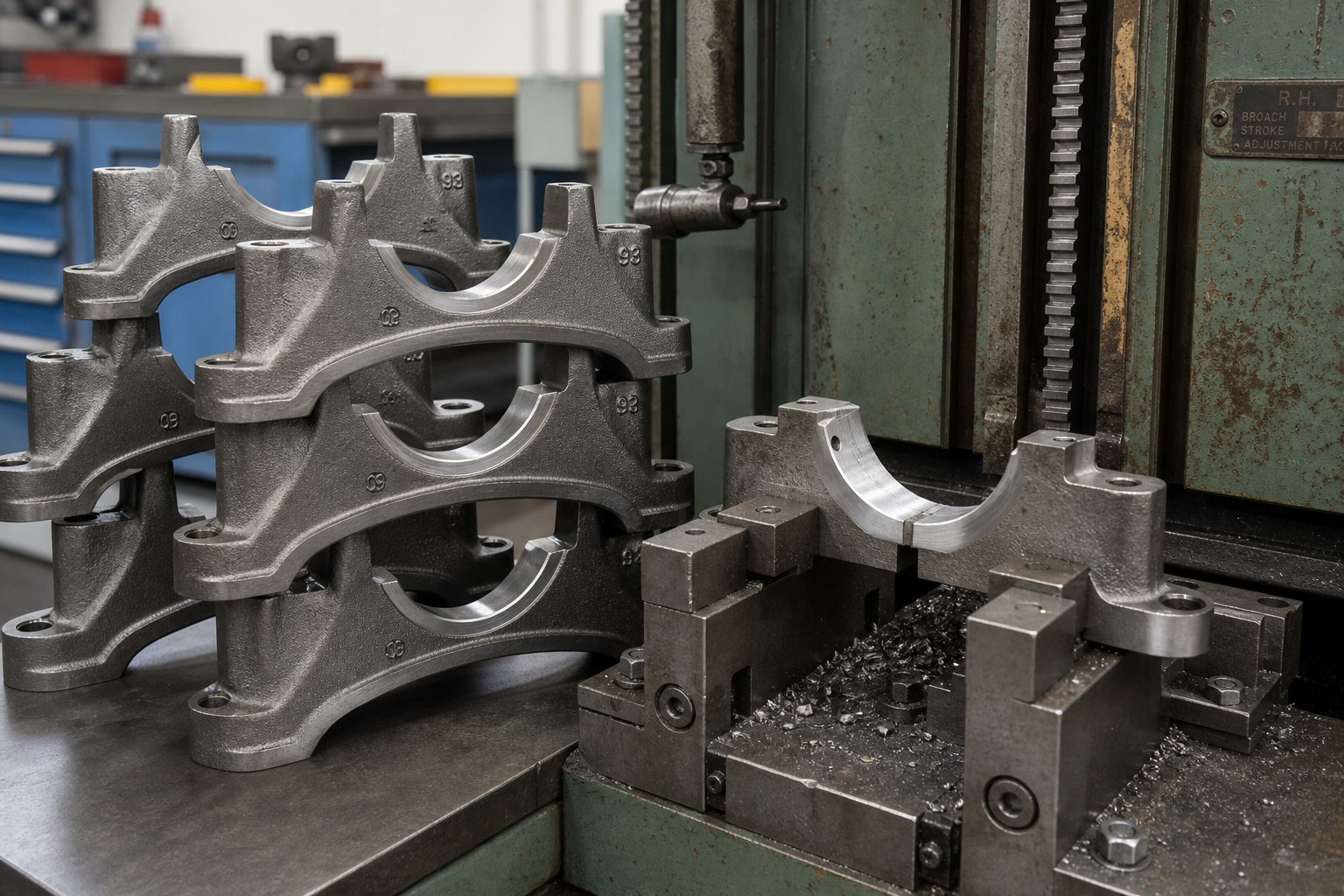
Choose cutting fluid for broaching by matching its lubricating chemistry to the workpiece and broach, then checking that the machine can deliver and maintain it. Shortlist an application-approved neat oil or water-miscible product. Compare the candidates using part quality, tool condition and the cost of keeping the fluid in service.
This guide is for production engineers and buyers selecting fluid for a dedicated broaching operation. The decision starts with the cutting contact, continues through the fluid system and ends with the finished part. A purchase price comparison becomes useful after those technical requirements are clear.
Key takeaways
- Qualify the formulation for the actual job before comparing purchase prices.
- Treat mixing water, filtration and cleaning as part of the fluid specification.
- Use published experiments to identify useful comparison measures, with their original test conditions attached.
Inhaltsübersicht
- Start with the Cutting Fluid Function
- Compare Broaching Oil with Water-Miscible Fluids
- Specify the Broaching Lubricant for the Material and Tool
- Read a Broaching Fluid Comparison Correctly
- Check the Machine and Fluid Delivery System
- Decide Whether the Shop Can Maintain the Mix
- Compare Trial Results and Cost per Accepted Part
- Cutting Fluid Selection Questions
- Prepare a Job-Specific Fluid Enquiry
Start with the Cutting Fluid Function
A cutting fluid is a formulated process liquid that acts at the machining zone. The National Institute for Occupational Safety and Health (NIOSH) identifies heat reduction, friction reduction and removal of metal particles as its principal functions. Its metalworking-fluid resource also describes anti-weld additives, corrosion inhibitors and other ingredients. The base liquid is only part of the product.
For broaching, separate the purchasing question into lubrication, delivery and service requirements. Ask the tool supplier which contact conditions the lubricant must support. Ask the machine supplier how that lubricant will reach the working teeth and return to the tank. Ask the fluid supplier what conditions the formulation needs to remain usable.
An enquiry saying only “oil for steel” leaves essential choices unresolved. A more useful description identifies the alloy condition, broach material and coating, feature geometry, existing fluid and observed problem. Include the required washing or coating process after machining. This gives each supplier the same job to assess and makes competing recommendations easier to compare.
Compare Broaching Oil with Water-Miscible Fluids
Neat oil, also called straight cutting oil, is used without deliberate water dilution. Water-miscible fluids are concentrates intended for dilution: soluble oils form emulsions, while semi-synthetic and synthetic products differ in composition. NIOSH uses these categories to describe metalworking fluids. Select within the categories by the specific product's approved applications.
FUCHS's broaching application page lists both water-miscible products and neat cutting oils for steel broaching. Its neat-oil range includes viscosities of 8, 15 and 22 cSt at 40 °C. These are catalogued options for that range. Choose among viscosity grades with the supplier using the actual tool, delivery system and operation.
| Candidate route | Information needed before shortlisting | Question for the production team |
|---|---|---|
| Application-approved neat broaching oil | Viscosity, additive compatibility, delivery and cleaning requirements | Can the existing system handle and recover this oil? |
| Application-approved water-miscible fluid | Working concentration, water-quality limits and maintenance method | Can the shop consistently control the mixture? |
| Semi-synthetic or synthetic formulation | Explicit suitability for the broaching duty and materials | What evidence supports this product on the proposed job? |
Request the technical data sheet and safety data sheet for each actual candidate. Keep the proposed concentration or viscosity next to the product identity in the comparison. A quotation for a concentrate and a quotation for a ready-to-use oil describe different purchasing quantities. Ask suppliers to state the basis of their consumption estimates before entering them into a cost calculation.
Avoid deciding from appearance alone. A clear product may belong to a different formulation family from a milky emulsion, but appearance does not identify its broaching approval. The shortlist should name the formulation, its intended use and the conditions attached to the recommendation.
Specify the Broaching Lubricant for the Material and Tool
FUCHS's Cutting Fluids Manual distinguishes anti-wear additives from extreme-pressure, or EP, additives. It describes EP additives forming protective compounds at heavily loaded contact surfaces as temperature rises. The manual also explains that additive requirements vary with the operation and material. This is why a fluid's lubricating chemistry belongs in the selection discussion alongside viscosity.
Use a compatibility matrix rather than a broad material slogan. Put the exact workpiece alloy and condition in one column, the broach material and coating in another, and the machine components exposed to the fluid in a third. Have the relevant suppliers confirm the proposed formulation against those entries. Leave an unresolved entry visible instead of treating a general steel-machining claim as approval for every component.
Include downstream requirements in the same review. If parts will be washed, bonded, plated or stored, ask the responsible process owner to define acceptable residue and surface condition. Request a sample-part check when compatibility remains uncertain. This makes the cleaning requirement part of fluid acceptance rather than a problem discovered after purchasing.
Separate a fluid change from a tool-condition correction. A worn or damaged broach changes the comparison baseline. Use the broach resharpening guide to frame the tooling discussion, then agree with the tool supplier whether the current broach is suitable for the proposed trial. Keep that decision with the trial record.
Read a Broaching Fluid Comparison Correctly
Jozef Martinovic and Jozef Peterka's MM Science Journal paper, Technology of Broaching – Research of the Roughness and Machine Capability, compares process fluids while broaching an internal shaped surface. Its experiments included a cutting oil and an emulsion at 5% and 15% concentration. The lower-concentration condition rapidly lost cutting ability through tool wear; the higher-concentration condition produced a usable groove in that experiment.
The paper's Table 2 reports the following surface measurements for the oil and higher-concentration emulsion conditions:
| Tested condition | Ra, arithmetic mean roughness | Rz, reported roughness height |
|---|---|---|
| Cutting oil | 0.509 µm | 4.141 µm |
| Emulsion at the higher tested concentration | 0.771 µm | 8.731 µm |
Both conditions met that study's drawing requirement. The oil produced the lower reported roughness values. These results belong to the paper's particular groove, tool, material and fluids; a different formulation needs its own application recommendation.
For your comparison, ask which result distinguishes the candidates: compliance with the drawing, surface finish within the accepted range, or tool condition over the run. Choose the measures before ordering the trial material. Keep the same acceptance rule when reviewing every candidate so that the decision reflects the production requirement.
Check the Machine and Fluid Delivery System
The Occupational Safety and Health Administration (OSHA) best-practices manual treats delivery as part of metalworking-fluid control. It discusses directing fluid toward the cutting zone while limiting mist, and warns that high-pressure delivery can generate mist. Pressure therefore belongs in a review of the complete delivery arrangement.
Before selecting a replacement fluid, record the current tank, pump, filter, nozzle arrangement and return path. Ask the machine and fluid suppliers to identify which items can stay and which require modification. Include these changes in the quotation. A recommendation becomes more useful when the supplier identifies how it fits the installed equipment.
Keep the equipment review specific to the feature. For an internal spline or keyway, ask how the proposed supply reaches the relevant teeth and how chips and liquid leave the work area. For an external profile, ask where the stream should meet the moving contact. Use the Leitfaden zur Fehlerbehebung beim Räumen when documenting an existing delivery or chip-handling problem.
Consider minimum-quantity lubrication as a separate route
Minimum-quantity lubrication, or MQL, supplies a small controlled amount of lubricant to the cutting zone. Ming Xu, Xin Yu and Jing Ni's paper in Friction investigates soybean-oil formulations containing nanographite particles for broaching. The authors evaluated penetration and compared cutting force, surface roughness and chips; their abstract reports an optimum particle concentration for the tested formulation.
Consider such research when discussing a purpose-designed lubrication system with qualified suppliers. Request the proposed lubricant, delivery equipment and validation plan together. A production tank change and an MQL conversion should have separate scopes and quotations because the latter also changes the application method.
Decide Whether the Shop Can Maintain the Mix
For water-miscible products, make concentration measurement a purchase requirement. FUCHS's handling guidance says to zero a refractometer using the dilution water, then multiply its reading by the product's refractometer factor. That factor comes from the data sheet or packaging. A raw instrument reading and an actual working concentration are different entries in the maintenance record.
The same guidance specifies adding concentrate into water during mixing. It also notes that leaked oil affects refractometer readings. Ask the supplier how to assess a contaminated sample and when another measurement method is needed. Include the instrument, product factor and sampling location in the agreed service instructions.
| Control | Information to obtain with the fluid | Decision before purchase |
|---|---|---|
| Concentration | Product range, measurement method and correction factor | Who measures it and authorizes adjustment? |
| Mixing water | Product-specific quality limits and test method | Is the available water acceptable? |
| Contamination | Compatible removal and sampling methods | Can existing maintenance equipment support them? |
| Changeover | Cleaning, rinsing and refill instructions | When can production release the machine? |
Blaser Swisslube's fluid-testing guidance identifies concentration and water quality as important variables after machine cleaning. It explains that water hardness can affect foaming or emulsion stability and that the acceptable range depends on the product. It also describes filtering suspended particles and skimming tramp oil. Check the proposed fluid against the water and filtration materials actually available in the shop.
OSHA associates low concentration with lubrication, corrosion and microbial problems, while excessive concentration can cause foaming, residues and skin irritation. Include these service conditions in the fluid assessment rather than judging only fresh fluid. For exposure control, NIOSH identifies both inhalation of fluid aerosols and skin contact; have the site's responsible specialist review the safety data and operating controls.
Compare Trial Results and Cost per Accepted Part
Blaser Swisslube describes monitoring tool wear and cutting force during its machining-fluid tests and controlling fluid conditions for reproducibility. Use that approach to organize a job-specific comparison: define the cutting result, the state of the fluid and the equipment settings together.
Prepare a trial sheet with the following sequence. It is a planning checklist for your application review, with acceptance limits supplied by the drawing and responsible process owners.
- Record the approved baseline: part specification, broach condition, setup, fluid identity and delivery arrangement.
- Enter the candidate's supplier-approved operating range, measurement method and required system changes.
- Set the part-inspection measures, tool-inspection points, sampling stages and stop conditions before running.
- Inspect initial parts, review the agreed production interval, then compare the result against the same acceptance criteria.
- Decide whether to accept, reject or extend the trial, recording which unresolved question an extension must answer.
Use a separate row for each observation instead of a single “good/bad” result. For example, record surface acceptance separately from tool inspection and fluid consumption. If the drawing is satisfied but the cleaning result is unresolved, keep cleaning open as an acceptance item. This prevents one successful measurement from silently approving the entire process.
Compare cost per accepted part over a declared evaluation period. Request figures for fluid purchases, replenishment, filtration consumables, cleaning, disposal and any equipment changes. Add tool-service and rejected-part costs only where the trial provides attributable records. Keep estimated figures labelled as estimates and use the same accounting boundary for every candidate.
A lower purchase price can remain attractive after this comparison, or it may be outweighed by service requirements. The useful outcome is a traceable decision: which candidate met the requirements, which costs were observed and which remain provisional. Avoid entering promised tool-life savings as achieved savings before the trial supports them.
Cutting Fluid Selection Questions
Can hydraulic oil replace the specified broaching fluid?
FUCHS's manual distinguishes anti-wear lubrication from EP lubrication for heavily loaded machining contacts. Check the proposed product's intended application before considering substitution. Request written confirmation for the broaching duty and the equipment involved. Keep hydraulic-system requirements and cutting-zone requirements as separate lines in the application review.
Can a rotary-broaching recommendation be used for a pull broach?
Match the recommendation to the tool process. Slater Tools' fluid guidance specifically addresses rotary broaching and includes advice for trapped fluid in blind holes. A dedicated pull-broaching job needs instructions for its own tool and supply arrangement. Give the supplier the operation and feature geometry when requesting approval.
What if a central system supplies several machines?
Blaser Swisslube's guidance makes the product-specific concentration and water-quality limits part of fluid control. List the applications sharing the central system and ask the supplier to assess them together. Obtain a common operating recommendation before allowing one machine's successful trial to approve the fluid for all the others.
Prepare a Job-Specific Fluid Enquiry
FUCHS lists different formulated fluid routes for steel broaching, so an enquiry should identify the job closely enough to distinguish among them. Send the drawing requirements, alloy condition, broach details, installed fluid system and downstream cleaning needs. Ask for the proposed operating conditions and the evidence supporting that recommendation.
The right cutting fluid is the candidate that meets those requirements in an agreed trial and can be maintained economically in production. For help reviewing the machine and tooling side of a new application, contact our team with the feature, material and production requirements.
References
- Metalworking Fluids — NIOSH — Fluid functions, formulation classes, contamination and exposure routes.
- Broaching — FUCHS — Water-miscible and neat-oil application options and the listed viscosity grades.
- Cutting Fluids Manual — FUCHS — Anti-wear and extreme-pressure additive mechanisms.
- Technology of Broaching – Research of the Roughness and Machine Capability — Martinovic and Peterka — Experimental concentration conditions and measured groove roughness.
- Metalworking Fluids: Safety and Health Best Practices Manual — OSHA — Delivery, concentration management and mist control.
- Penetration and lubrication evaluation of vegetable oil with nanographite particles for broaching process — Xu et al. — Experimental broaching lubricant and evaluation measures.
- Handling and maintenance of cutting fluids/systems — FUCHS — Mixing, refractometer correction and contamination checks.
- Cutting and grinding fluid tests – what needs to be considered in cutting and grinding fluid management? — Blaser Swisslube — Controlled comparison, water quality and system maintenance.
- Fluids, Lubrication, Parts and Tool Care — Slater Tools — Process-specific rotary-broaching guidance.