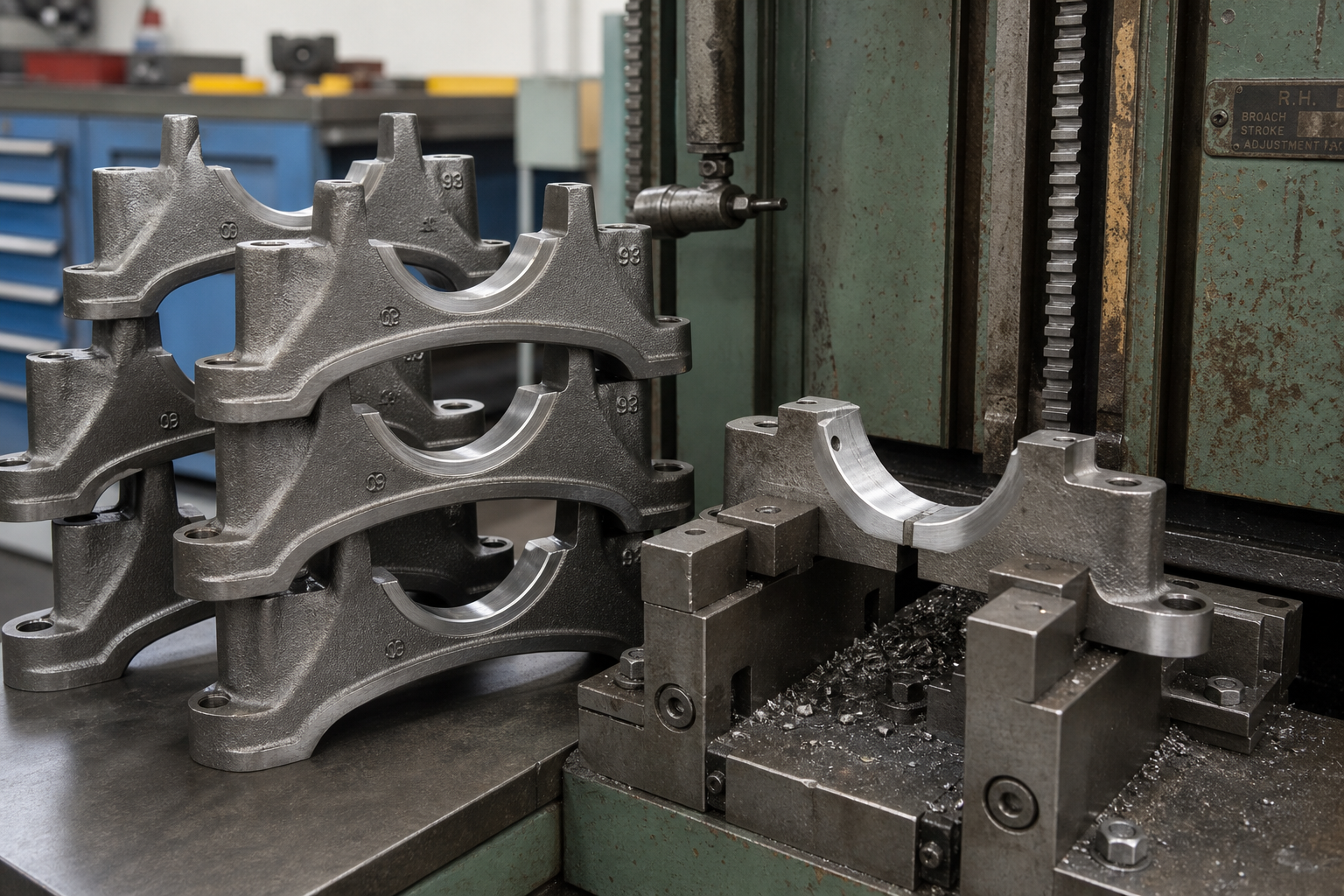
Push broaching drives the broach through the workpiece under compression, so the tool is normally shorter and must be protected against buckling. Pull broaching draws the tool through the workpiece under tension, allowing a longer broach and a longer cutting stroke. The right choice depends on the feature, cut length, production volume, tooling, fixture, and available machine.
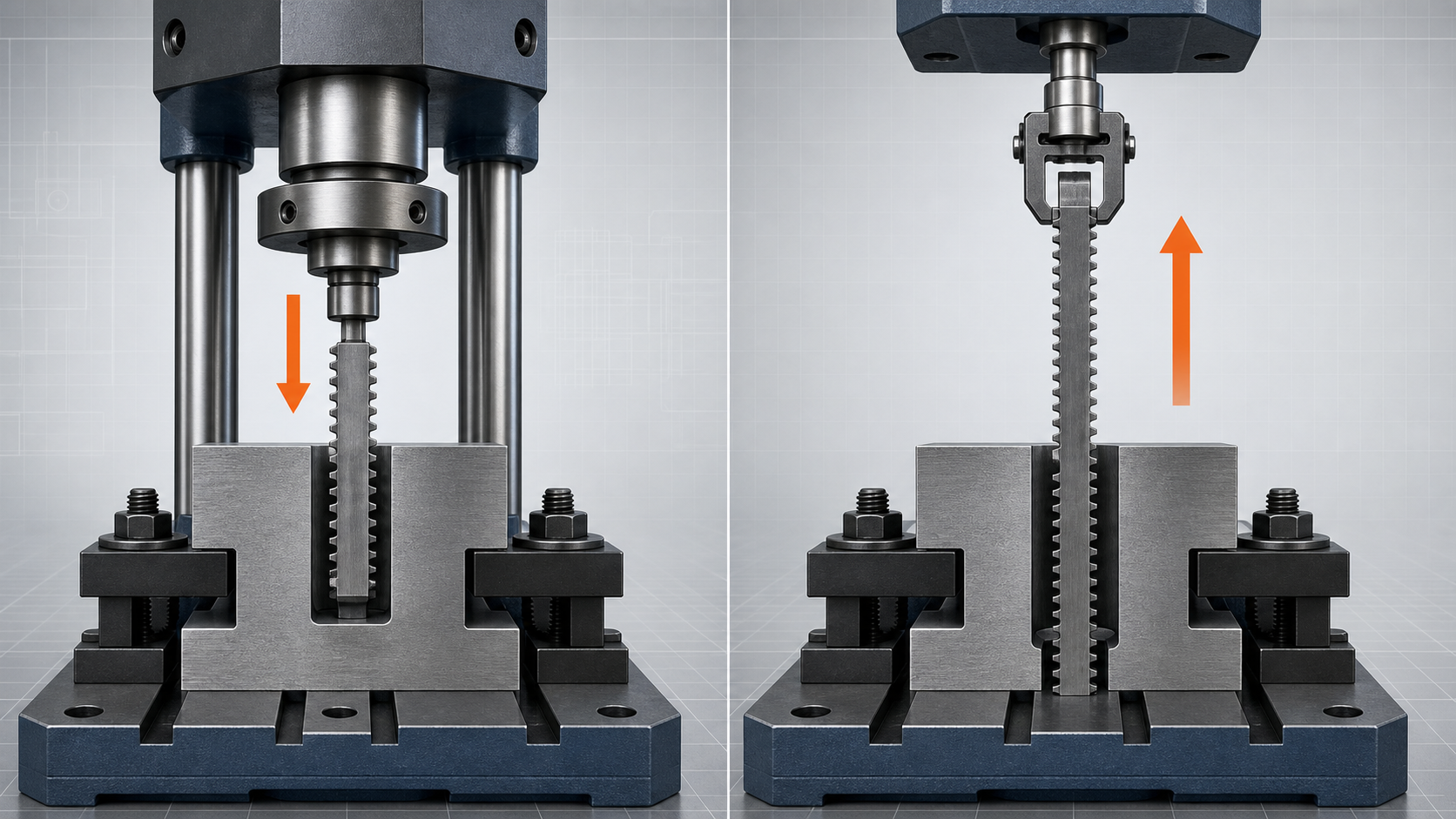
Conceptual technical illustration of push and pull broaching. It is not a photograph of a specific BroachingMach machine.
Although the two processes use the same basic cutting principle—a broach with progressively sized teeth—the way the machine loads the tool changes the tool design, machine arrangement, typical applications, and process risks.
This guide explains those differences and provides a practical selection method for manufacturing engineers and buyers.
Push Broaching vs Pull Broaching at a Glance
| Factor | Push broaching | Pull broaching |
|---|---|---|
| Tool loading | Compression | Tension |
| Typical broach form | Shorter and more rigid | Longer, often with a pull head or retrieval end |
| Main structural risk | Buckling or misalignment under compression | Tensile overload, pull-head connection, or alignment issues |
| Typical equipment | Arbor press, hydraulic press, dedicated push machine, or suitable vertical machine | Dedicated horizontal or vertical pull-type broaching machine |
| Common applications | Short internal forms, standard keyways, repair work, and lower-volume operations | Longer internal forms, splines, production keyways, and higher-volume work |
| Cut length | Generally shorter | Can accommodate longer cutting sections |
| Automation potential | Possible, but often used in simpler setups | Well suited to dedicated, repeatable production cells |
| Tool handling | The tool is driven into or through the part | The tool is gripped and drawn through the part |
The table describes common practice, not an absolute rule. A qualified process review must still consider tool strength, required tonnage, stroke, workpiece support, material condition, tolerance, and lubrication.
The Core Difference Is Compression Versus Tension

In push broaching, the machine or press applies force behind the broach. The tool behaves like a column under compression. As the broach becomes longer and more slender, its resistance to buckling decreases. This is why push broaches are normally kept relatively short and why alignment between the ram, broach, guide, bushing, and workpiece is essential.
In pull broaching, the machine grips the pull end of the tool and draws it through the workpiece. The broach remains primarily in tension during the cutting stroke. Because a tensile member is not exposed to the same column-buckling risk, pull broaches can be longer and can contain more cutting, semi-finishing, and finishing teeth.
The force direction affects process design, but it does not change the fundamental cutting action. Each successive tooth removes a controlled amount of material until the final teeth generate the required geometry and finish.
How Push Broaching Works
A typical push-broaching cycle follows this sequence:
- The workpiece is positioned and supported in a fixture or on a broaching bushing.
- The broach is aligned with the pilot hole or prepared opening.
- A press or machine ram pushes the broach through the workpiece.
- Progressive teeth remove material until the finishing teeth pass through the feature.
- The part and tool are removed, cleaned, and inspected.
Push broaching is frequently associated with standard internal keyways because a guided push broach and bushing can create a repeatable slot with relatively simple equipment. It can also be useful for short forms, maintenance work, prototypes, and production quantities that do not justify a larger dedicated pull-broaching system.
Advantages of Push Broaching
- The machine and fixture can be comparatively simple.
- Standard keyway broaches and bushings are widely understood.
- Setup can be practical for short, straightforward internal features.
- It can be economical when the required stroke and production volume are moderate.
Limitations of Push Broaching
- Compressive loading limits practical tool slenderness and length.
- Poor alignment can bend or break the broach.
- A long cut may require more teeth and tool length than a push design can safely accommodate.
- Manual tool handling may limit cycle consistency and automation.
- The workpiece, bushing, and fixture must support the cutting load without tilting.
For a standard keyway application, review our keyway broaches and the broader broach tools range.
How Pull Broaching Works
In pull broaching, the broach is introduced through the prepared opening and connected to a pulling mechanism. The machine then draws the tool through the stationary workpiece.
A typical cycle is:
- Load and locate the workpiece in the fixture.
- Insert or position the broach through the prepared opening.
- Connect the pull head or retrieval mechanism.
- Pull the broach through the workpiece at a controlled cutting speed.
- Return or transfer the tool for the next cycle.
- Unload and inspect the completed part.
Because the tool is loaded in tension, the broach can carry a longer sequence of teeth. That makes pull broaching a common choice for internal splines, longer keyways, accurate bores and forms, and repeat production.
Advantages of Pull Broaching
- A longer tool can distribute material removal across more teeth.
- The tensile loading reduces the buckling risk associated with a long push broach.
- Dedicated machines can provide controlled speed, alignment, stroke, and tool handling.
- The process can support repeatable production and automated loading.
- One pass can combine roughing, semi-finishing, and finishing.
Limitations of Pull Broaching
- It normally requires a dedicated pulling mechanism and more specialized tool ends.
- Machine stroke and daylight must accommodate the complete broach and workpiece arrangement.
- Pull-head engagement and tool retrieval must be reliable.
- Tooling and machine investment require sufficient production or technical justification.
- Long broaches require careful storage, handling, sharpening, and inspection.
BroachingMach supplies both horizontal broaching machines e vertical broaching machines for different production layouts and workpiece requirements.

A real BroachingMach pull-down inner broaching machine. The correct configuration depends on the part, tooling, stroke, force, and loading method.
Push/Pull Is Not the Same as Horizontal/Vertical
These terms describe two different decisions:
- Push or pull describes how force is applied to the broach.
- Horizontal or vertical describes the orientation and layout of the machine.
Horizontal machines are commonly associated with pull broaching because their layout can accommodate a long tool and stroke. Vertical machines may use pull-up, pull-down, or push configurations depending on the design.
Do not choose a machine only by assuming that horizontal always means pull and vertical always means push. Consider floor space, chip and coolant management, part loading, tool handling, automation, stroke, and operator access.
For a broader comparison, see Horizontal vs Vertical Broaching Machines.
Which Process Produces Better Accuracy?
Neither push nor pull broaching is automatically more accurate in every application. Accuracy and surface finish depend on the complete process system:
- Broach design and rise per tooth
- Tool material, heat treatment, coating, and sharpness
- Pilot-hole size and condition
- Workpiece material and hardness
- Machine and fixture rigidity
- Alignment of the tool, workpiece, and cutting force
- Cutting speed and lubrication
- Chip space and chip evacuation
- Tool wear monitoring and resharpening practice
Pull broaching is often preferred for demanding production features because a dedicated machine and longer broach can provide better control over the full cutting sequence. A correctly designed push-broaching setup can still produce accurate keyways and short forms.
The process should be selected from the drawing and production conditions rather than from a general claim that one force direction is always more precise.
Typical Application Differences
Push Broaching Is Often Suitable For
- Standard keyways using a bushing
- Short internal slots or forms
- Prototype, repair, and maintenance work
- Lower-volume production
- Applications that already have a suitable press
- Parts that provide good tool guidance and support
Pull Broaching Is Often Suitable For
- Internal splines and serrations
- Longer keyways or internal forms
- Automotive and industrial transmission components
- Parts requiring a long sequence of progressive teeth
- Repeat production with controlled cycle conditions
- Automated or semi-automated broaching cells
These are starting points. A small part may still justify a pull machine at high volume, while a larger part may use a specialized push process if the geometry and tool design support it.
How to Choose Between Push and Pull Broaching

Use the following questions during process planning:
1. Is the required broach short and sufficiently rigid?
If the form can be produced with a short, well-guided tool and a suitable press is available, push broaching may be practical. If the required cutting sequence makes the broach long or slender, pull broaching is normally the safer starting point.
2. How long is the feature?
A longer cut usually requires more cutting teeth, greater chip space, or a more gradual distribution of stock removal. These requirements can favor a longer pull broach.
3. What is the production volume?
For prototypes, repair, or lower volume, a simple push setup may provide the best balance of investment and flexibility. For repeat production, a dedicated pull machine can improve loading, cycle consistency, inspection control, and automation.
4. What geometry must be produced?
Standard keyways are frequently push-broached. Internal splines, serrations, and longer precision forms are often pull-broached. Special shapes require a complete review of the tool, part support, chip formation, and available machine stroke.
5. What equipment is already available?
An existing press does not automatically make push broaching feasible. Confirm that it provides the necessary force, stroke, speed control, alignment, and safe tool support. Likewise, confirm that a pull machine has sufficient rated force, stroke, daylight, and tool-handling capability.
Use our broaching-machine selection guide e broaching tonnage guide as starting points.
Information Needed for a Broaching Recommendation
To recommend a broach and machine configuration, an engineering review should include:
- Part drawing and required feature geometry
- Workpiece material
- Material condition and hardness before and after broaching
- Pilot-hole or pre-machined feature dimensions
- Length of cut
- Required tolerance and surface finish
- Stock removal
- Annual volume and desired cycle time
- Available machine or press
- Loading, unloading, and automation requirements
- Coolant or cutting-fluid constraints
- Inspection method
Providing this information early helps prevent a mismatch between the tool, machine, fixture, and production target.
Frequently Asked Questions
Is pull broaching always better than push broaching?
No. Pull broaching supports longer tools and is well suited to demanding production applications, but push broaching can be simpler and more economical for short, well-guided forms such as standard keyways.
Why must a push broach be shorter?
A push broach is loaded in compression. As the tool becomes longer and more slender, it becomes more vulnerable to bending or buckling. Tool diameter, unsupported length, alignment, material, and cutting force must be evaluated together.
Can a vertical broaching machine use a pull broach?
Yes. Vertical machines can be designed for pull-up or pull-down broaching as well as other configurations. Machine orientation and tool-loading direction are separate design choices.
Is horizontal broaching always a pull process?
Horizontal broaching is commonly used with pull-type tooling, especially where a long tool and stroke are required. However, the actual mechanism must be confirmed from the machine design.
Which method is better for keyways?
Standard short keyways are often produced with a push broach and bushing. Longer keyways, higher production requirements, or special accuracy requirements may favor a dedicated pull-broaching solution.
What information is required to size the machine?
At minimum, provide the feature geometry, material, hardness, stock removal, length of cut, tool concept, production volume, required stroke, and target cycle time. Final machine selection also requires a calculated cutting force with an appropriate engineering margin.
Need Help Selecting the Process?
BroachingMach can review the part, broach, fixture, and machine as one production system. Send us your drawing, material, hardness condition, annual volume, cut length, tolerance, and current equipment.
Contact BroachingMach to discuss a push- or pull-broaching solution.