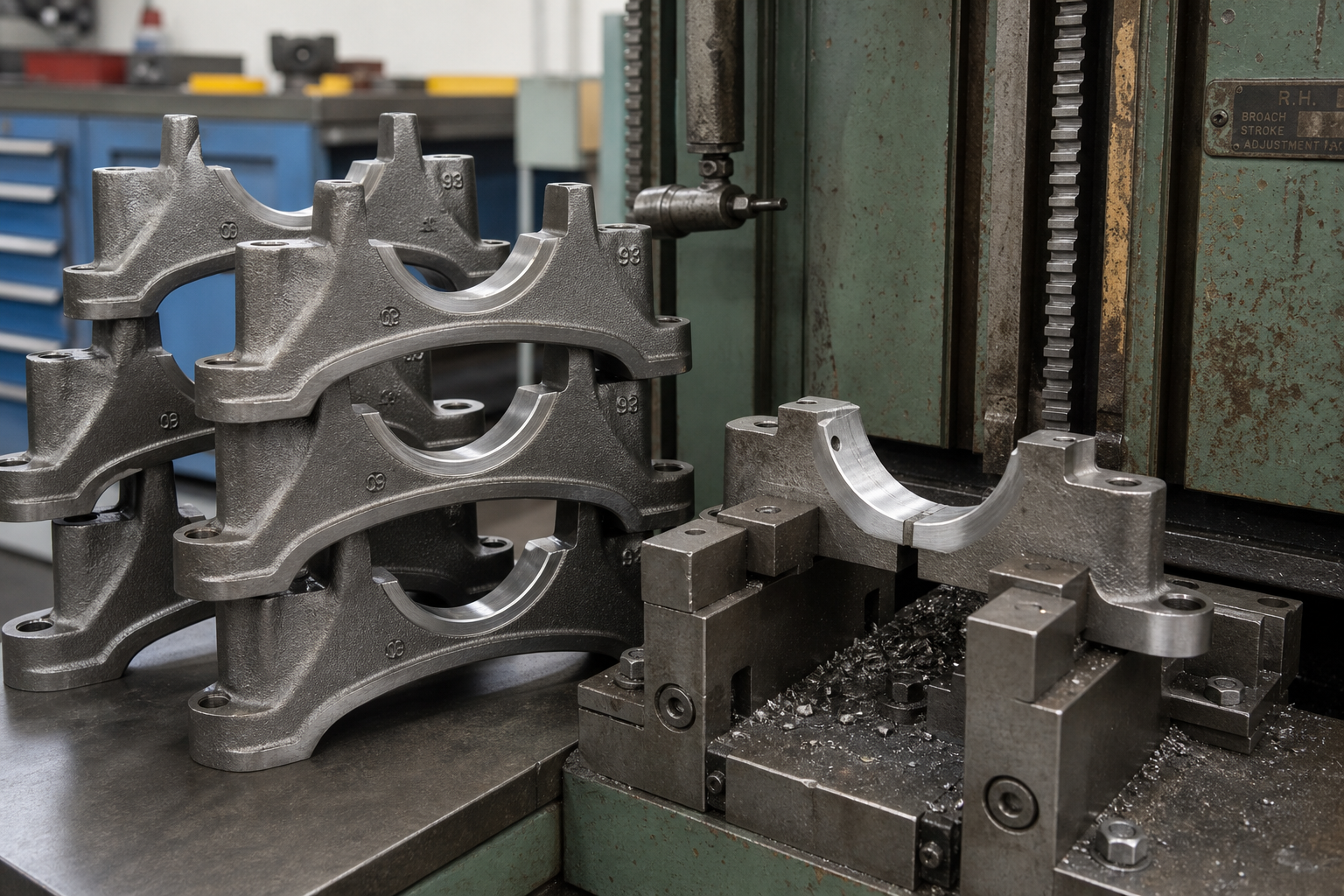
Broaching is a machining process that removes material from a workpiece using a multi-toothed cutting tool called a broach. Unlike milling or shaping, which remove material through many passes, a broach roughs, semi-finishes and finishes a surface in a single stroke. That combination of speed, dimensional accuracy and smooth surface finish makes broaching one of the most productive precision machining processes for mass production.
In this complete guide, you will learn how the broaching process works step by step, the main broaching methods and broach types, the machines that carry them out, which materials can be broached, and where the process is used across the automotive, aerospace, energy and agricultural industries.
What Is Broaching?
A brochagem é uma operação de maquinagem que remove material utilizando uma ferramenta dentada conhecida como brocha. Existem duas formas principais de brochagem: linear e rotativa. O procedimento mais típico é a brochagem linear, que consiste em fazer passar a brocha contra a superfície da peça de trabalho para gerar o corte.
Brochas lineares are used in a broaching machine. Brochagem rotativa involves rotating and pressing the broach into the workpiece to create an axisymmetric form, and a rotary broach is used in lathes and screw machines. Both techniques complete the cut in a single pass of the broach, making them extremely efficient.

The defining characteristic of the process is that the entire shape is produced in one pass. Where a milling or shaping operation would need a series of cuts, setups, or tool changes, the broach carries a complete sequence of cutting edges in a single tool, each tooth slightly larger or differently shaped than the one before it. This is why broaching competes so strongly on cost per part once volumes are high, and why the process occupies a distinct niche in production machining: it delivers form accuracy that is difficult to reach with general-purpose machines, at cycle times they cannot match.
Broaching is used for precise machining, particularly on unusual forms. Machined surfaces include circular and non-circular holes, splines, keyways, and flat surfaces. Typical workpieces include small to medium-sized castings, forgings, screw machine components, and stampings. Even though broaches can be costly, they are typically preferred over alternative methods when utilized for large-scale manufacturing runs. To see how the tool, the machine and the workpiece come together in practice, see our companion article on what a broaching machine is.
How Does the Broaching Process Work?
Every broaching operation, whether internal or external, relies on the same basic set of components:
- Broach: the long, multi-toothed tool that serves as the major component in the broaching process. It is intended to gradually carve the required form into the workpiece.
- Peça de trabalho: the material that goes through the broaching procedure, usually a metal such as steel, aluminum, or brass.
- Broaching machine: the machinery that secures the workpiece and drives the broach through the material.
- Jogo: a device that holds the workpiece in place during cutting. Fixtures provide stability and precision throughout the stroke.
- Cutting fluid: frequently applied during broaching to minimize friction, disperse heat, and increase overall process efficiency.
Machining takes place through the broach’s progressive teeth. Each tooth stands slightly taller or wider than its predecessor, so every tooth removes a small, predictable chip and passes the work to the next. The stroke direction, whether push or pull, depends on the machine and on whether the tool works in compression or tension.
The process itself then follows four stages:
Setup and Fixturing
Before the actual broaching procedure, careful preparation is required. A fixture on the broaching machine holds the workpiece securely in place. Proper alignment is required to ensure precision in the finished product.
Seleção de brocas
Choosing the proper broach is an important decision. Broaches exist in a variety of forms and sizes, and the right choice depends on the required feature and the material of the workpiece.
The Broaching Operation
The broach is guided through the workpiece, removing material with each tooth as it advances. The operation is frequently finished in a single stroke, which makes it extremely efficient. The cutting motion may be linear or rotary, depending on the type of broaching equipment and broach utilized.
Inspeção
Following the broaching process, the workpiece is thoroughly inspected to ensure that all required dimensions and tolerances are satisfied. Any necessary modifications can be made at this point.
Types of Broaching Methods
Broaching provides parts with very smooth surfaces and dimensional accuracy because a broaching tool carries roughing, semi-finish, and finishing teeth that can complete the machining of a rough surface in a single stroke. A broach is a cutting instrument with many cutting edges that works similarly to a sharp chisel. In some circumstances, broach teeth are placed diagonally to complete shearing cuts, resulting in a sliding or skewing action.
Linear and Rotary Broaching
Of the numerous broach cutting methods, linear broaching is the most prevalent. The tool moves linearly across the workpiece surface, creating cuts as it passes from one end to the other. Rotary broaching, also known as wobble broaching, differs in that the cutting tool is tilted at a 1° angle to the workpiece’s midline while rotating, producing a chiseling or scalloping effect that generates polygonal forms on the inside or outside of a part. For a full treatment of this method, see our guide on rotary broaching.

Brochagem por tração
Pull broaching involves holding the workpiece in place while the broach is drawn through. The broaches used in this technique are lengthy and require a particular pull head. The tensile stress from pulling strengthens rather than loads the broach in compression. The procedure is often used for interior or internal broaching, although it may also be utilized for surface broaching. Pull broaches carry a large number of teeth and provide a longer cut.

Pull broaching can be done vertically, horizontally, or straight through the workpiece. It is used to flatten automobile cylinder blocks and cylinder heads in high-volume engine plants.
Brochagem por pressão
A push broaching tool is shorter so that it can withstand the compressive forces exerted as it passes through the workpiece. It has fewer teeth, which could otherwise bend or break under compression. Push broaching generates shorter cuts, making it suitable for smaller parts, and it is a popular choice for surface broaching, where the tools are known as surface broaching tools. For a detailed side-by-side comparison of the two approaches, see push broaching vs. pull broaching.
Brochagem contínua
Continuous broaching keeps the broach fixed in the broaching machine while the workpieces are moved continually past it. The motion of the workpiece may be linear, horizontal, or rotational. This method is commonly employed to broach a substantial quantity of similar workpieces in one setup.
Brochagem interna
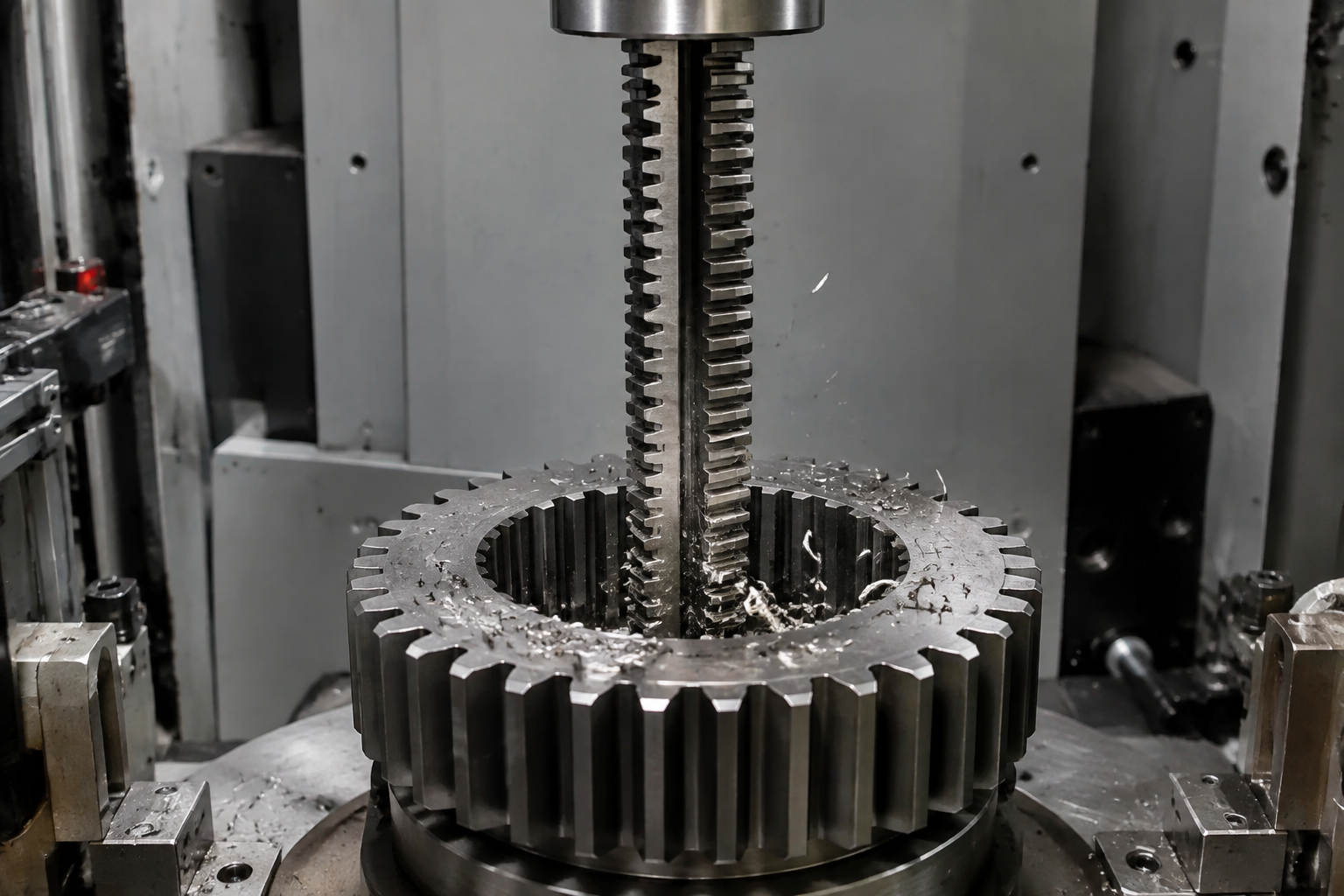
Internal broaching, also known as hole broaching, removes material from the interior surface of a workpiece. Before the process begins, a starter hole is drilled into the workpiece in a step known as blank preparing. Internal broaching is used to expand, broaden, and resize holes, and the tool carries teeth that gradually increase in size to produce an excellent finish. Because the workpiece must first be prepared with a pilot hole, internal broaching is usually a finishing operation rather than a roughing one.
Internal broaching is often performed on automated equipment such as CNC machines, and the procedure can be executed with either a push or a pull action. Internal broaches are commonly categorized as round or spline types.
Brochagem externa
External broaching, also known as surface broaching, removes material from the exterior of a workpiece. External broaching tools, like internal broaching tools, have teeth that gradually grow in size. External broaching employs a guided ram with a broach retaining device, and the cutting force is delivered along the whole length of the broach.
External broaches machine flat and formed surfaces. Flat surface broaching passes the tool over the workpiece to obtain the required surface, while form surface broaching generates a variety of curves and shapes, including serrated profiles, angular splines, gear forms, fir-tree root slots, compressor slots, and keyways.
Brochagem cega

Blind broaching is the broaching procedure in which the tool does not entirely travel through the component, resulting in a blind cavity. Blind broaching is performed on parts that are not supposed to have a through-hole. Keyways can be designed for blind broaching, with the tool coming to a halt partway through the bore.
Common Types of Broaches
Broaches or broaching tools come in various shapes and types, each designed for specific applications and cutting requirements. Below are the most common broaching tool shapes, although custom broaches are widely used in the manufacturing industry.

Brochas de chaveta
Almost all keyways in machine tools and parts are cut using a keyway broach, a small, flat bar with cutting teeth spaced along one surface. These broaches can cut both internal and external keyways. Internal keyways often require a slotted bushing or horn fitted to the hole, with the keyway broach being pushed through the horn and guided by its slot. We cover this in depth in our guide to keyway broaching.
Brocas estriadas
Spline broaching, sometimes called round broaching, produces round, plain, or irregular splines and spiral tooth shapes. A spline broach cuts a series of ridges or teeth around the perimeter of a pre-cut hole, and it is an effective way to create serrated, straight, and involute splines. Splined broaches are extremely important in the automotive sector because splines are used extensively in driveshafts, gearboxes, and other power-transmitting components. The ridges along the spline’s perimeter provide an effective way of transmitting torque, as the mating component fits with no wiggle space. See our spline broaching guide for details, and for gear teeth specifically, read broaching vs. hobbing.
Brochas redondas
The round broach is the simplest sort of broach: a circular bar that creates holes similar to those generated by a drill press. The distinction is that a broach cut is faster, cleaner, and allows for tighter tolerances. Round broaches are ideal for producing precise holes in high-volume mass manufacturing.
Brocas de superfície
The slab broach is the most basic surface broach, a general-purpose instrument that cuts flat surfaces. Surface broaches are used to achieve a smooth and uniform finish on machined flats, and their finishing teeth are designed to size the surface in the same stroke as the roughing teeth.
Other Broach Shapes
- Internal broaches cut interior forms such as round, hexagonal, spline or keyway profiles inside a pre-drilled hole.
- External broaches machine the outside of a workpiece, producing flats, hexagons and other external geometries.
- Square broaches cut square holes or forms, often in applications that demand a perfect square aperture.
- Hexagonal broaches carve hexagonal holes for bolts, nuts, and other hexagonal-shaped components.
- Dovetail broaches create dovetail-shaped grooves or slots for sliding or locking mechanisms.
- Involute gear broaches cut involute gear teeth, where accurate tooth profiles provide smooth gear engagement.
- Serrated broaches cut a series of notches or teeth for applications that need gripping or locking.
- Taper broaches create tapered holes or forms where a progressive change in diameter is required.
- Oval broaches cut oval or elliptical forms where a non-circular aperture is required.
The preferred broach type is determined by parameters such as the desired feature, workpiece material, and unique production constraints. For a closer look into tool design and sizing, see our Complete Guide to Broaches.
Types of Broaching Machines
The broaching machine moves the broach or the workpiece, either by pushing or pulling, while maintaining the workpiece’s position to guarantee precision. Broaching machines come in several distinct configurations.
Horizontal Broaching Machines
Nearly all horizontal broaching machines are of the pull type: the broach is first fed through the workpiece, and when it emerges from the opposite side, a hook engages the pilot and pulls it all the way through. These machines take up more floor space due to their horizontal layout, but they have enough power and stroke length to work on large parts. They are suitable for round, spline, slot, or keyway broaching, as well as a variety of other interior shapes. Our horizontal broaching machine guide covers the configuration in detail.
Vertical Broaching Machines
Vertical broaching machines push or pull the broach along a vertical axis. They take up less floor space than horizontal machines and are widely used for surface broaching operations. Most operators prefer hydraulic power for vertical machines because it is less expensive. Vertical broaching is ideal for applications where the broach is not especially long or heavy. For a fuller comparison, read the difference between horizontal and vertical broaching machines, or see our vertical broaching machine guide.
Surface and External Broaching Machines
Whereas vertical and horizontal machines are often associated with interior cuts, a surface broaching machine is designed for cuts along one face or edge of a component. If a metal disc requires a notch cut out of its edge, it is set in place on a surface broaching machine, and the broach glides along a vertical or horizontal guided track while its teeth make the necessary cut. The portion that drives the broach is known as the ram. External broaching machines are sometimes referred to by the same name, since they manipulate the outside surfaces of a workpiece, including contour broaching of concave, convex, or other shaped surfaces to very precise tolerances. Our surface broaching machine guide explains the machine types used for these operations.
Internal Broaching Machines
Internal broaching shapes the interior surface of a circular hole, slot, or groove, and the work is not tied to one machine type: internal broaching may be performed on any of the machines above. It is the standard method for producing internal gears and for refining gun barrel bores.
During internal broaching, the workpiece is secured in a dedicated device known as a work holder integrated into the broaching machine. The elevator raises the broach above the work holding and then lowers it through the workpiece. After passing through, the machine’s puller, which can be described as a hook, securely seizes the pilot of the broach. The elevator then disengages the upper part of the pilot, allowing the puller to smoothly draw the broach all the way through the workpiece. The workpiece is extracted from the machine, and the broach is elevated to re-engage the elevator for the next cycle.
Máquinas de brochagem rotativa
Rotary broaching differs from the other methods in that it uses the wobble motion described above to create precise polygonal forms on the inside or outside of a part. Rotary broaching can be performed on a lathe or mill using a horizontal or vertical spindle that is allowed to spin freely. The process can generate forms such as hexagons, squares, serrations, keyways, involute splines, spur gear forms, digits, and letters.
What Materials Can Be Broached?
The selection of materials in broaching is determined by the characteristics of both the broach tool and the workpiece. Broach tools, as cutting implements, are commonly crafted from durable and abrasion-resistant materials to endure the pressures exerted during cutting. The choice of workpiece material varies widely by industry and application. Materials frequently machined by broaching include:
- Steel alloys: carbon steel, alloy steel, and tool steel are frequently broached, particularly in the automotive and aerospace sectors.
- Aluminum: aluminum and its alloys are widely used where lightweight components are needed, such as in aerospace and automotive applications.
- Brass and bronze: used where corrosion resistance and good electrical conductivity are crucial, such as in electronic components.
- Stainless steel: renowned for its corrosion resistance and frequently used where hygiene and durability matter most, such as medical equipment.
- Cast iron: widely employed across industries due to its excellent castability and machinability.
For a complete material-by-material breakdown including cutter recommendations, see what materials can be broached.
Vantagens da brochagem
Manufacturers choose broaching because it combines the accuracy of a finishing process with the throughput of a mass-production process:
- Very high output rate compared to milling, planing, and boring.
- Excellent dimensional and form accuracy with a smooth surface finish.
- Roughing and finishing in one stroke with the same cutter.
- Short cycle time combined with high precision.
- Extremely suitable and inexpensive for mass production.
- Operation and control are simple; broaching requires little operator skill.
- Both internal and external surfaces can be finished by the same method.
- The process holds a tolerance of ±0.0075 mm and achieves a surface finish of around 0.8 microns.
- Cutting fluid is drawn into the cut by the broach itself, so lubrication is delivered exactly where it is most effective.
Desvantagens da brochagem
The main limitations of the process are tooling cost and part geometry:
- A broach is a tool with many cutting edges, and preparing those edges is expensive. The initial tooling cost is high.
- Broaching has a size constraint for the workpiece; it is not suitable for very large parts.
- Broaching is not feasible on surfaces that have obstructions the tool cannot pass.
- Because it removes only small amounts of material, broaching is limited to finishing and precise sizing; removing large stocks is not practical.
- The workpiece must be securely fastened to preserve precision and surface quality, so clamping devices need regular maintenance and incur costs.
Where these limitations matter, it helps to weigh broaching directly against the alternatives, for example broaching vs. milling for internal keyways and profiles.
Common Broaching Applications
Automotive
The automotive business relies on fast, precise mass production, and broaching sits at the center of it. A wide range of ferrous and nonferrous metals used in vehicles can be broached, along with suitable plastics. Typical broached parts include front and rear differentials, parking brake components, gearboxes, and engine production components, produced with round, square, standard keyway, and bespoke broaches.
Turbines and Aerospace
Turbines are essential components in the aerospace, automotive, marine, and energy sectors. Turbine broaching uses special-purpose broaches, usually on horizontal broaching machines, to machine the fir-tree and other profiled root forms that attach blades to discs. Because these parts operate under extreme loads, the tight tolerances that broaching provides are a requirement rather than a preference.
Agricultural Equipment
Farm machinery must tolerate high levels of strain, heavy use, and harsh conditions. Broaching is used on components of cultivators, plows, rollers, slurry spreaders, reapers, harvesters, balers, loaders, and mixers. Both large and small parts are broached, and strict tolerances are frequently required to guarantee lifespan and minimal mechanical strain.
Military and Defense
Defense programs impose stringent standards on the parts used in land, air, and sea vehicles, and those parts are produced in quantity. Various types of broaches are used to produce such components rapidly, repeatably, and at controlled cost.
Beyond these industries, broaching is a standard method for precision mechanical components of all kinds: internal gears, gun barrel bores, screw machine parts, stampings, and small to medium castings and forgings all pass through broaching machines when their forms demand tight tolerances at production volumes.
How to Choose a Broaching Machine
Choosing the right machine starts with the part: the size of the workpiece, the feature to be cut (internal keyway, spline, or external surface), the material and its hardness, and the production volume all point toward a specific machine class and stroke requirement. A job shop cutting occasional keyways has very different needs from a plant broaching transmission components around the clock.
We walk through the full decision process in our article on how to choose the right broaching machine, and budget planning is covered in the broaching machine price guide.
Frequently Asked Questions
What is broaching in machining?
Broaching in machining is a material-removal process that uses a long, multi-toothed tool called a broach. As the broach passes across or through the workpiece, each successive tooth removes a small amount of material, so the finished shape is generated in a single stroke. It is commonly used for keyways, splines, non-circular holes, and flat or shaped surfaces, and it exists in linear and rotary forms.
How does broaching work?
The workpiece is fixtured on a broaching machine, and the broach is pushed or pulled past it in one continuous stroke. The roughing teeth at the front of the broach remove most of the stock, the semi-finishing teeth bring the form close to size, and the finishing teeth at the rear set the final dimensions and surface finish. Internal broaching starts from a pre-drilled pilot hole, while external broaching cuts directly on the outside of the part.
What is the purpose of broaching?
The purpose of broaching is to produce precise, repeatable internal or external forms at high production rates. It combines roughing and finishing in one stroke, holds tolerances in the range of ±0.0075 mm, and achieves surface finishes around 0.8 microns, which makes it especially economical for mass-produced parts.
What are the disadvantages of broaching?
The main disadvantages are the high initial cost of broach tooling, limits on workpiece size, the inability to cut surfaces with obstructions, suitability only for removing small amounts of stock, and the need for well-maintained clamping fixtures to protect accuracy. These constraints make broaching a poor fit for one-off parts or very large workpieces.
What materials can be broached?
Most machinable metals can be broached, including carbon and alloy steels, stainless steel, aluminum alloys, brass and bronze, and cast iron, along with certain plastics. The workpiece must be machinable and rigid enough to withstand the cutting forces of a full broaching stroke, and harder materials call for more robust broach tooling and slower cutting speeds.
Keep Exploring
Broaching is, at its core, a simple idea executed with precision hardware: a series of progressively sized cutting edges that finish a form in one stroke. Understanding that idea makes every downstream decision easier, from selecting the right broach and machine class to judging whether a part is a good candidate for the process at all.
BroachingMach is a specialist broaching machine manufacturer in China building vertical, horizontal, and surface broaching machines for automotive, aerospace, and general industrial production. If you are evaluating a machine for a specific part, our engineering team can review your drawing and recommend a configuration.
To keep exploring the topic, browse our in-depth article categories: