Track Link Manufacturing Process: Where Drawing-Defined Surface Broaching Fits
A track link is one component of a crawler undercarriage track chain, but there is no single manufacturing route for every design. The customer drawing determines the material, features, datums, heat-treatment condition, tolerances and inspection requirements before milling, boring, surface broaching, grinding or another route can be selected.
This article uses track link as the primary name and track chain link as a clear alternative. Some older supplier content uses chain rail link; that term is retained only as a terminology note.
The exact surface broached in the previously published example has not been confirmed by a marked drawing or an attributable in-process image. This guide therefore treats only a drawing-defined external surface as a candidate for broaching. It is not a claim that every track link is broached or that the pictured equipment achieved a particular result.

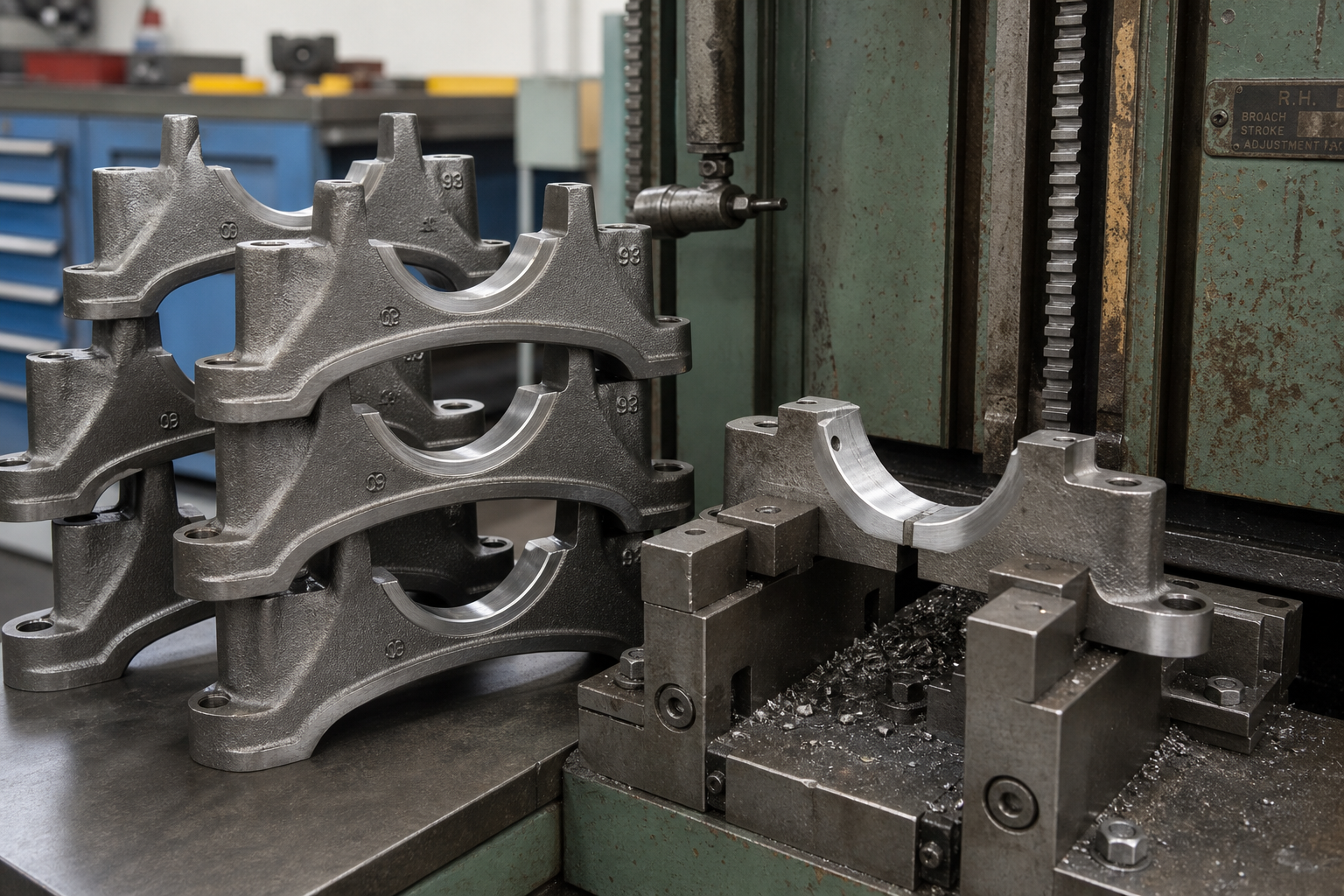
BroachingMach-hosted equipment-floor photograph. It provides manufacturing-cell context; the visible equipment is not identified here as processing a track link and does not prove a particular operation or result.
What Is a Track Link?
A track link works with neighboring links, pins, bushings and the track shoe in an articulated crawler track chain. Geometry and required properties vary by undercarriage design. Features may include pin and bushing bores, shoe-mounting holes or faces and open external areas, but the drawing remains authoritative.
Public sources also separate a single link from the assembled chain. A Cat parts listing identifies an individual product as a track link, while ITM describes track chains as assemblies. A published track-link manufacturing patent distinguishes a rail surface from a track-shoe mounting surface. That evidence supports the terminology and shows that these are different surfaces; it does not identify which surface, if any, BroachingMach broached in the earlier example.
Do not rename an unconfirmed face as a “tooth surface,” “nut surface,” “bolt surface” or “rail face” because one term appeared in old content. The quotation, tool drawing, fixture drawing and inspection plan should use the same approved feature name. A marked drawing showing the target surface, cutting direction and governing datums is more useful than a generic workpiece label.
Start With the Part Drawing, Not the Machine
Machine selection should begin only after the application team can answer the following questions:
- What is the part number, drawing revision and approved workpiece name?
- Which exact feature or surface is being considered for broaching?
- Which datums control that feature, and how is its location inspected?
- What material specification applies, and what is the hardness at the proposed cutting stage?
- Is the starting part forged, cast, cut from bar or supplied by another route?
- How much stock is present across production-intent blanks, including local variation?
- What tolerance, profile, flatness, position and surface-finish requirements apply?
- Is the part handed, and what features change between variants?
- What annual volume, batch size and changeover pattern must the cell support?
- Which operations occur before and after the proposed broaching step?
- What control plan, traceability and sample-approval requirements apply?
Track pitch may help identify a component family, but pitch alone cannot determine broach length, cutting force, fixture design or machine capacity. Two links with a similar pitch can have different materials, section sizes, stock allowances, target surfaces and datum strategies. A machine should therefore be sized from the complete cutting application rather than a catalog label.
A Drawing-Led Track Link Manufacturing Route
A high-level process route can help organize an engineering review, but it should remain conditional until the drawing, material specification and production plan are available.
1. Receive and identify the blank
Confirm part identity, lot traceability, drawing revision and blank condition. Review scale, distortion, surface condition, hardness and stock where they affect machining, using representative production-intent blanks.
2. Establish machining datums
Prepare the surfaces or bores that later fixtures will locate. Face milling, double-sided milling or another operation may fit, but the process sheet must distinguish temporary rough locating points from finished drawing datums.
3. Machine bores and mounting features
Use drilling, boring, reaming, milling or tapping as required by the drawing. A combined machine may reduce transfers, but only if its fixture preserves feature relationships and permits reliable chip removal and inspection.
4. Apply the specified heat treatment
Heat treatment may occur before, between or after machining. Identify material condition at every cutting step; expected distortion and post-treatment finishing needs determine the sequence. Do not carry a soft-machining assumption into a hardened part without a new tool and force review.
5. Finish the drawing-defined external feature
Surface broaching may fit an open, accessible and well-supported feature at suitable repeat volume. Milling or grinding may be better when stock varies, geometry changes, access is restricted or material condition lies outside the validated broaching range.
6. Deburr, clean and protect
Apply only the drawing-defined edge break or chamfer, then remove chips and residue before inspection. Use temporary corrosion protection when the material and logistics plan require it.
7. Inspect and release
Verify only the drawing-required features and relationships. Define the measurement system, sampling, acceptance and reaction plan in the control plan.
Where Drawing-Defined Surface Broaching Fits
Surface broaching is treated here only as a candidate process for an open external feature explicitly identified on the customer drawing. This article does not claim that every track link has a broached pad, bolt surface, joint face, rail face, tooth surface or nut surface. The feature name, datum references, material condition, stock allowance, tolerance, surface-finish requirement, batch volume and inspection method must be confirmed before a broach, fixture or machine is specified.
Surface broaching uses progressively arranged teeth to remove stock across an accessible external area. The term does not establish whether a particular tool is pulled, pushed or moved in another guided arrangement. The surface broaching machine guide explains the broader process.

BroachingMach-hosted photograph of a surface-broaching machine. The image does not establish which track-link feature, if any, is being cut, and it is not evidence of a specific tolerance, force or cycle time.
A target surface is a stronger candidate when:
- The cutting path is open and provides safe tool approach, travel and runout.
- The feature can be supported close to the cut without blocking the tool.
- Production blanks have controlled stock on the target area.
- The datum scheme allows the fixture to locate the part repeatedly.
- The fixture can resist cutting force and any turning moment without distorting the link.
- Material and hardness at the cutting stage are compatible with the validated tool design.
- The required geometry and finish are suitable for progressive-tooth cutting.
- Volume supports dedicated tooling and chips can leave the cutting zone reliably.
Surface broaching should be reconsidered when the feature is blind or obstructed, stock varies beyond the planned tooth load, the part lacks a stable support path, the target surface is already hardened beyond the proven tool capability, or frequent design changes would make dedicated tooling uneconomic. In those cases, milling, grinding or a revised blank may offer a more controllable route.
Compare complete routes: cutting time, tool maintenance, loading, cleaning, changeover, inspection, downtime and nonconformance cost. A fast stroke alone does not prove a lower cost per accepted part.
Datum Strategy, Fixture Support and Load Path
A broach cuts relative to the surfaces that physically locate the workpiece. The fixture plan should identify the constraints and show how the cutting reaction returns into the machine. Rough locating points may not be suitable for a final drawing-controlled surface.
If machined bores become locators, confirm their condition before broaching. Burrs, chips, scale or heat-treatment distortion can shift the link even when nominal dimensions appear correct. External locating faces need the same review.

Conceptual fixture-stage view from a BroachingMach-hosted image. It illustrates the need to review workpiece support and access, but it does not identify the exact track-link surface, locator scheme or achieved result.
Clamping should hold the part against its locators without compensating for a poor seat. Excess pressure can bend the workpiece or mask debris. Place support close to the cutting reaction and resist any moment created by an offset cut.
For handed parts, identify and verify change parts after installation. Fixture flexibility is useful only when it preserves the datum relationship.
Broach and Machine Selection Inputs
The broach supplier needs more than the finished surface dimensions. Tool design depends on the total and local stock removal, cutting width and length, number of simultaneously engaged teeth, tooth progression, chip space, material condition, guidance, finishing strategy and resharpening plan.
Cutting force should be calculated or tested for the actual engagement. A hydraulic pressure value is not a substitute for available machine force because actuator geometry and system losses affect the relationship. The application review should compare the expected force curve with rated machine capability over the required cutting speed and stroke. The site's broaching-machine tonnage guide describes the inputs that need to be considered.
The machine review should cover:
- usable force, travel and safe loading clearance;
- tool length, workpiece envelope, guidance and machine daylight;
- rigidity, side-load resistance and cutting-speed control;
- chip evacuation, fluid management and overload reaction; and
- tool handling, changeover, guarding and operator access.
Available broaching-machine configurations can be screened only after these application inputs are known. A machine family page identifies a candidate architecture; it does not prove that a listed machine fits a particular track link.
Heat Treatment and Tool-Life Boundaries
Track-link material must balance the properties required by the customer specification. This article does not prescribe a steel grade, alloy addition, furnace program, case depth or hardness. Those values should come from the governing drawing, material standard, heat-treatment specification and validated process records.
For broaching, the most important question is the material condition where and when the teeth cut. Hardness variation, scale, a hardened layer entering the cut or inconsistent stock can change cutting load and edge life. If heat treatment occurs before surface finishing, representative hardened parts should be included in tool trials. If broaching occurs earlier, later heat-treatment distortion must be included in the final acceptance plan.
Tool life should be defined by evidence such as force trend, dimensional change, surface condition and inspected tooth wear, not a universal number of pieces. The reaction plan should distinguish normal resharpening, an abnormal-force stop, chipped teeth, part mislocation and a measurement-system issue. The broach breakage prevention guide provides broader troubleshooting context, but the approved limits must be application-specific.
Inspection and Process Control
An inspection plan begins with drawing characteristics, not available sensors. It may cover bore size and form, feature location, profile or flatness, surface roughness, hardness and required nondestructive examination. Only specified characteristics are acceptance requirements.

Track links are visible in BroachingMach-hosted inspection-equipment imagery. The photograph does not establish the sensor type, measurement accuracy, acceptance limits, sampling frequency or production capability.
Measurement capability must match tolerance and surface condition. Resolution is not accuracy, uncertainty or gauge repeatability and reproducibility. Contact gauges, air gauges, CMMs, form instruments and optical systems suit different characteristics; do not infer a method from a generic photograph.
Capability targets and sampling rules are project-specific. Do not publish a universal Cpk threshold or adjust a process automatically without diagnosis. Record part and lot identity, tool identity, equipment revision, measured values, abnormal events and dispositions as required.
Magnetic-particle inspection may be specified for suitable ferromagnetic material. Its method, examination area, acceptance criteria, qualification and frequency must follow the applicable standard and customer requirements; it is not a guarantee of finding every internal defect.
Common Risks and the Questions to Ask
Cutting force rises during production
Check tooth condition, chip packing, material hardness, local stock, lubrication, alignment and part seating before changing a process parameter. Compare the force trace with an accepted baseline if the machine records one.
The surface shifts relative to the bores
Verify the complete datum chain. Inspect locator wear, bore condition, chips under the part, clamp sequence and deformation after unclamping. Confirm that the measurement setup references the same drawing datums as the manufacturing fixture.
Surface finish deteriorates
Review edge condition, tooth loading, workpiece support, chatter, recutting of chips and material variation. Do not assume that cutting speed alone caused the change.
Tool life varies between lots
Compare material certificates, hardness distribution, scale, blank stock and coolant condition. A parts-per-tool target is meaningful only when the incoming and operating conditions are controlled.
Changeover takes too long
Separate tool handling, fixture conversion, program selection, first-piece inspection and approval time. Standardize only the elements that have been verified; a faster changeover is not acceptable if it weakens feature identification or datum control.
Surface Broaching, Milling or Grinding?
| Decision factor | Surface broaching may fit when | Milling or grinding may deserve priority when |
|---|---|---|
| Geometry | The feature is open and follows a suitable straight cutting path | Access is restricted or geometry changes frequently |
| Volume | Repetition supports dedicated tooling and fixture development | Volume is low or product life is uncertain |
| Blank | Stock is stable and controlled | Stock variation requires flexible removal |
| Support | The part can be located and supported close to the cut | The load path would distort or move the part |
| Material state | Hardness and surface condition are validated for the broach | The required final condition favors abrasive finishing or another cutter |
| Changeover | A defined part family can use a controlled setup | Many unrelated variants require frequent reconfiguration |
This comparison is a qualification tool, not a promise that one method will always deliver better accuracy, finish or cost. Representative trials and inspection of accepted parts should close the decision.
RFQ Checklist for a Track-Link Surface-Broaching Review
To evaluate a track-link application, provide:
- the controlled 2D drawing and available 3D model;
- a marked view of the exact surface or feature being considered;
- part number, revision and preferred public workpiece name;
- material specification and hardness at the proposed cutting stage;
- blank drawing, supplier route and representative sample parts;
- measured stock distribution on the target surface;
- drawing datums, tolerances and surface-finish requirements;
- annual volume, batch size, takt objective and expected product life;
- left-hand, right-hand or other part variants;
- upstream and downstream operations, including heat treatment;
- current fixture or datum concept, if one exists;
- inspection method, control plan and sample-approval requirements;
- loading, automation, traceability and factory-layout constraints; and
- any existing machine limits that must be respected.
BroachingMach can use this information for an engineering review of candidate tooling, fixture and machine architecture. Start with the broach-tooling design overview or contact the engineering team with the marked drawing. A useful first response may be that milling, grinding or a revised blank is more suitable; application review should select the process rather than force the part into a predetermined machine.
Frequently Asked Questions
Is every track link surface broached?
No. The route depends on the drawing, material condition, blank, tolerance, production volume and available alternatives. Some open external features may be candidates for surface broaching; other links may be completed by milling, grinding or different processes.
Which surface of a track link is broached?
The exact surface must be identified on the customer drawing. This article does not confirm a pad, bolt surface, joint face, rail/contact face, tooth surface or nut surface for the prior example. A marked drawing or an attributable in-process image is required before using a specific feature name.
Are “track link,” “track chain link” and “chain rail link” the same?
This article uses track link as the main term and track chain link as a clear alternative. Chain rail link appears only because some older supplier content uses it. The approved drawing and customer terminology should control the quotation and project documents.
Can a hardened track link be broached?
Do not decide from the word “hardened” alone. The tool supplier needs the actual material, hardness distribution, target feature, stock, tool concept and acceptance requirements. A validated route may be possible for a specific condition, while another condition may require broaching before heat treatment or finishing by a different process.
Does track pitch determine the required broaching machine?
No. Pitch is only one family descriptor. Force, stroke, tool length, workpiece envelope, support, cutting speed and fixture requirements come from the actual feature, stock, material and production plan.
What evidence is needed before publishing a track-link case study?
At minimum, use an authorized and attributable part or process image, a confirmed workpiece name, the exact marked feature, a documented process route and approved performance data. Without those items, content should remain an evidence-bounded engineering guide rather than claim a completed customer result.
Conclusion
Track-link manufacturing is drawing-led. Establish the workpiece name, target feature, datums, material condition, stock, volume and inspection plan before comparing processes. Surface broaching can fit a suitable open external feature only when the tool, fixture, machine and measurement system are validated together.
For this BroachingMach Post, the exact broached surface has not been confirmed. Until marked or attributable evidence establishes it, surface broaching remains a drawing-defined candidate—not proof that any named track-link surface was broached.