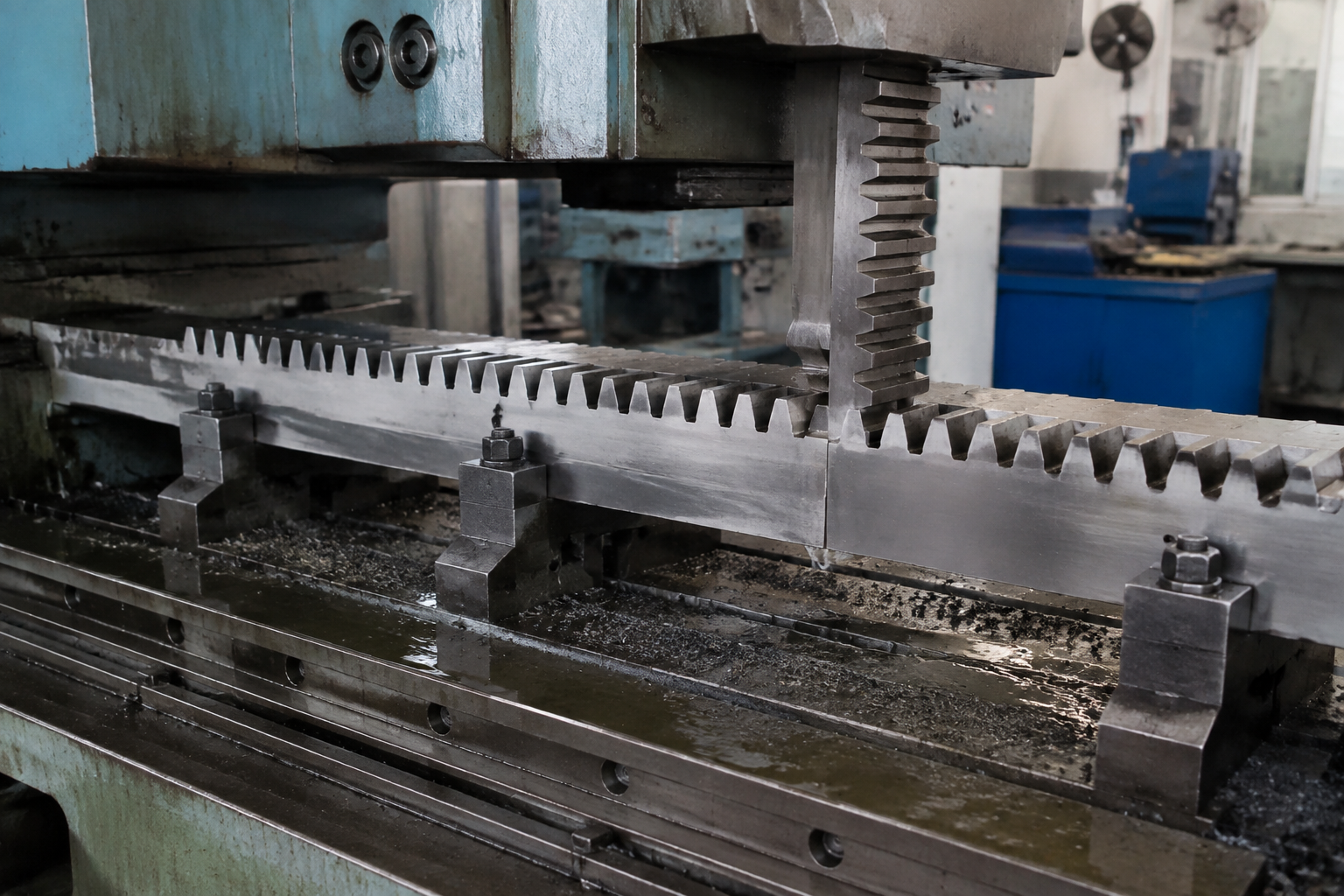
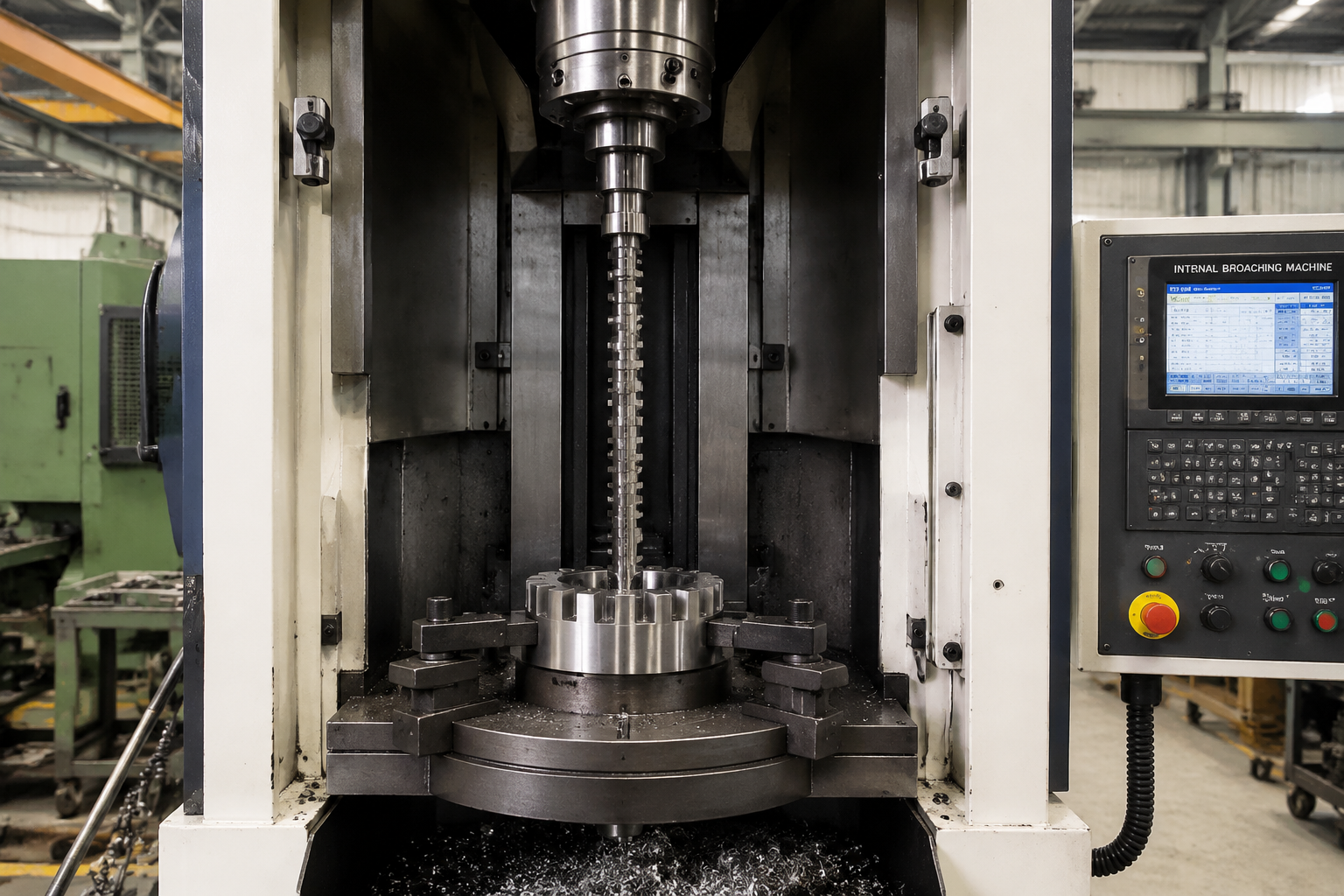
Broaching machines fall into two broad families. Internal broaching machines cut features inside a hole that has already been drilled or bored in the workpiece — keyways, spline holes, polygon bores and precision hole forms. External broaching machines cut features on the outside of the workpiece — flats, slots, contoured profiles, gear teeth and blade root forms. Both families use the same cutting principle, a multi-toothed broach that finishes the surface in a single stroke, but almost everything else differs: the tooling, the fixturing, the machine layout and the industries they serve.
This guide compares the two families side by side: how each process works, what each one produces, which máquina brochadora configurations carry out each process, and the key technical differences that decide which one a given part needs. Because the push-versus-pull question applies across both families, we cover that distinction here as well, with a short version in this article and a link to the full comparison for readers who need the complete picture.

Internal vs. External Broaching at a Glance
The table below summarizes the differences before we go into detail.
| Aspect | Internal broaching | External broaching |
|---|---|---|
| Where the tool cuts | Inside a pre-machined pilot hole | On the outer surfaces of the part |
| Typical features | Keyways, spline holes, polygon bores, hole finishing | Flats, slots, profiles, external splines, gear teeth |
| Broach form | Long bar-type broach that passes through the bore | Flat blades or insert cartridges mounted on a ram |
| Workpiece location | Located by its own bore; the broach follows the hole | Fully constrained in a dedicated fixture |
| Common machines | Vertical pull-down / pull-up, horizontal internal | Surface broaching machines, pot broaching machines |
| Chip environment | Chips form inside the bore and must be flushed out | Chips are thrown clear of the open cutting zone |
| Typical users | Gear and transmission shops, fluid power, fasteners | Automotive powertrain lines, aerospace, machinery |
How Internal Broaching Works
Internal broaching always starts from a hole that already exists. The part is drilled or bored to a pilot diameter, then the broach — a long, bar-shaped tool whose teeth rise in small steps from the front pilot to the rear pilot — is passed through that hole along its axis. Each tooth removes a thin, predictable layer of metal, and the sequence of teeth combines roughing, semi-finishing and finishing in a single pass. By the time the last teeth pass through, the hole has grown into its final form: a keyway, a spline, a hexagon, or a precision-finished bore.
Because the broach is guided by the workpiece’s own pilot hole, the finished feature is naturally concentric and square with the existing bore. This “self-locating” behavior is one of the process’s biggest advantages: there is no separate alignment step, and the feature cannot drift relative to the hole it lives in.
Machine size follows from the cut, not the part. The pulling force required grows with the tooth rise per tooth, the number of teeth engaged at once, the length of cut and the strength of the material — a deep spline in alloy steel needs several times the tonnage of the same feature in free-cutting steel or aluminum. When sizing an internal machine, the calculation should always be done for the most demanding part you intend to run, with margin left for the broach wearing into its final sharpening life.
What Internal Broaching Produces
The most common internal broaching tasks are keyways in hubs, pulleys and gears, and spline holes that connect shafts to gears, sprockets and couplings. Beyond those two staples, the process produces internal gear teeth, square and hexagonal sockets, double-keyway and multi-spline bores, rifling forms, and finished precision bores in which a single stroke replaces a boring and reaming sequence. If the feature lives inside a hole and runs along the hole’s axis, internal broaching is almost always the fastest way to produce it accurately at volume.
Typical Workpieces and Industries
Classic internal broaching workpieces include transmission gears and output shafts with internal splines, connecting rod big-end and small-end bores, engine block crankshaft bores, pump housings and valve bodies, hex sockets in fittings and fastener blanks, and hub bores of every size. The industries behind them are equally recognizable: automotive drivetrain manufacturing is the largest user, followed by fluid power (pumps, valves, cylinders), agricultural and construction machinery, and general machine shops producing gears, sprockets and couplings in batches.
Machines Used for Internal Broaching
Three machine configurations dominate internal work. Vertical internal broaching machines, in pull-down or pull-up arrangement, are the most common: the ram travels vertically, the floor footprint is small, and tonnage suits gears, hubs and fittings in medium batches — our vertical broaching machine guide covers them in detail. Máquinas de brochado interno horizontales shine where the feature is long or the workpiece is heavy: the long horizontal stroke handles long spline bores and deep holes that would need an impractically tall vertical machine, and parts like the máquina de brochado interna horizontal family are built around exactly these jobs (see also the horizontal broaching machine guide). Hydraulic pull-down machines such as the hydraulic pull-down internal broaching machine deliver steady tonnage through the full stroke, which matters for heavy-cut splines.
For a deeper treatment of machine structure, broach design and operating procedure for this family, read the companion article Internal Broaching Machine: The Complete Guide.
How External Broaching Works
External broaching reverses the geometry. The cutting teeth no longer hide inside a bore; they sit on flat blades or insert cartridges mounted on a machine ram, and the ram sweeps the tooling across the outside of a clamped workpiece in one linear pass. Each tooth takes its share of the stock, and the finished surface — a flat, a profile, a slot or a tooth form — emerges complete at the end of the stroke. Because the cutting zone is open, chips clear easily, coolant reaches every edge, and operators can watch the cut in progress.
What External Broaching Produces
External broaching produces flat mounting pads, contoured profiles, slots and grooves, external splines and gear teeth, steering rack tooth forms, crankshaft journal forms, and turbine disk blade-root slots. Wherever an outside surface has a defined cross-section that repeats along a straight line, an external broach can usually generate it in one stroke with better consistency than a milling sequence.
The comparison with milling is what drives most conversions to external broaching. A milled surface of the same width needs multiple passes, multiple setups for roughing and finishing, and each pass introduces its own opportunity for deviation; a broached surface needs one stroke and produces the same form on every part for the life of the tooling. At hundreds of parts per shift, the stroke-time saving compounds into the single largest cost reduction on the line — which is exactly why high-volume automotive and aerospace plants adopt surface broaching first and never return.
The Surface Broaching Family
In practice, most external work is done on surface broaching machines, which are the industrial backbone of the family. Automotive plants use them to face cylinder block decks and cylinder heads, cut timing surfaces and machine pump and converter housings; suppliers use them for rack teeth, linkage profiles and bracket faces. The dedicated surface broaching machine guide explains machine layouts, tooling and applications, and the surface broaching machine category on this site lists the available configurations.
Pot Broaching: High-Volume External Broaching
One branch of the external family deserves separate mention. In pot broaching, the tooling is turned inside out: a ring of cutting inserts — the “pot” — surrounds the part, and the workpiece is pulled through the entire ring in a single stroke. All teeth around the circumference cut simultaneously, so a finished external spline or pinion form emerges complete, concentric with the part’s own axis, in a very short cycle. That combination of speed and concentricity makes pot broaching the standard choice for high-volume external splines and small gear shafts. The process, tooling and machine requirements are covered in the pot broaching process and tooling guide.
Machines Used for External Broaching
External work runs on vertical and horizontal surface broaching machines with single or opposed rams, on pot broaching machines for round-part forms, and on special-purpose machines built around one high-volume part. Horizontal layouts suit long parts and transfer-line integration; vertical layouts save floor space and suit shorter strokes. Machine structure, tooling and selection criteria for this family are covered in the companion article External Broaching Machine: The Complete Guide.
Key Differences Between Internal and External Broaching
Tooling
An internal broach is a long, one-piece (or built-up) bar whose full tooth sequence is ground into the tool itself; it is a custom, feature-specific asset with a significant lead time. External broaches are usually assemblies — blades and indexable inserts held in a ram-mounted tool holder — so a damaged or worn tooth can be replaced individually instead of regrinding the whole tool. This difference drives both the tooling budget and the maintenance routine for each family.
The tooling economics also differ in shape. An internal broach is bought once and amortized over the whole production run, so its unit cost falls steadily as volume grows — a keyway broach running tens of thousands of hubs costs pennies per part. External insert tooling is bought and consumed continuously, but each purchase is small and delivery is quick. In budgeting terms: internal broaching front-loads tooling cost and rewards volume; external broaching spreads it in small increments for the life of the line.
Location and Fixturing
Internal broaching locates the workpiece by its own bore: the broach’s pilots enter the hole before cutting begins, so the feature is generated in place with no separate alignment. External broaching locates the workpiece entirely in a fixture; every dimension of the finished surface depends on how precisely the part is clamped relative to the ram. In practice this means internal work tolerates simpler workholding, while external work lives and dies by fixture quality.
Accuracy and Surface Finish
Both families deliver tight-tolerance, fine-finish surfaces that compete with grinding. Internal broaching accuracy is governed by the broach’s own manufacturing quality and the fit of its pilots in the pilot hole; external accuracy is governed by tool setting and ram guidance. Either way, the single-stroke nature of the process — one pass, no repositioning between roughing and finishing — is what gives broached surfaces their consistency from part to part.
Chips, Coolant and Changeover
Inside a bore, chips have nowhere to go: coolant must flush them out ahead of the finishing teeth, or they will score the finished surface — which is why internal machines pay close attention to coolant delivery and chip evacuation. Externally, the cutting zone is open and chips are thrown clear, so flushing is simpler. Changeover tells the opposite story: swapping an internal broach means handling a long precision bar and its work support, while an external tooling change is often a matter of swapping or re-shimming blades, which is why external lines absorb product changeovers more gracefully.
Push vs. Pull Broaching: The Second Axis of Difference
“Internal or external?” answers where the tool cuts. A second, independent question — “push or pull?” — answers how the force is applied, and it matters most for internal work. Here is the short version.
Push Broaching in Brief
In push broaching, the machine drives the broach through the hole under compression, like a column. A column can buckle, so push broaches must stay short and stocky — as a rule of thumb the length-to-diameter ratio is kept to roughly 4:1 or less. That sets a hard limit on how much stock and how long a feature one push broach can handle. In exchange, push broaching runs on simple, inexpensive equipment: short-stroke vertical machines and even hydraulic presses, which makes it the default for short keyways, small batches, toolroom and repair work.
Pull Broaching in Brief
In pull broaching, the broach is tensioned and drawn through the hole. Tension cannot buckle the tool, so pull broaches can be long, slender and carry many more teeth — long keyways, deep spline bores and heavy stock removal all become practical. This is why production internal broaching machines, vertical pull-down and pull-up alike, are overwhelmingly pull machines: they trade a slightly more complex tool-holding arrangement (puller head, front and rear pilots) for unlimited feature length and higher per-stroke stock capacity.
How the Two Axes Combine
The two distinctions are independent. Internal broaching can be pushed or pulled, chosen by feature length and batch size. External broaching barely feels the question: surface broach blades are rigidly bolted to the ram, and pot broaching pulls the workpiece through the tooling, so compression-versus-tension is essentially an internal-tooling decision. Note also that push/pull says nothing about machine orientation — pull-type machines are built both vertical and horizontal (most horizontal internal machines are pull-type), and push work shows up on verticals and presses alike. For the complete comparison of tool design, length limits, accuracy and selection criteria, read Push Broaching vs. Pull Broaching.
How to Choose: A Decision Framework
Four questions take a part from blank to machine choice.
- 1. Where is the feature? Inside an existing bore — keyway, spline, polygon, bore finish — choose internal broaching. On an outside surface — flat, slot, profile, external teeth — choose external (surface) broaching. This first question alone resolves the machine family.
- 2. How long is the internal feature? Short keyway, small batch or repair work: a short push broach on a vertical machine or press is economical. Long spline, deep bore or heavy stock: a pull machine — vertical pull-down for medium parts, horizontal internal for long or heavy ones — removes the length limit.
- 3. What is the volume? Job-shop volumes favor general-purpose vertical machines that switch between parts quickly. Sustained high volumes favor dedicated pull machines internally, and surface or pot machines externally — pot broaching in particular when the part is a round external form produced in the tens of thousands.
- 4. How big is the part and the floor? Large, heavy workpieces point to horizontal layouts, which accept the part at handling height and allow long strokes. Medium parts and limited floor space point to vertical machines, which stack the stroke vertically and keep the footprint small.
Many real parts, of course, need both families. A gear shaft with an internal spline bore and external gear teeth is the classic case: production normally broaches the internal feature first, then re-fixture the part for the external teeth — and because the internal broaching referenced the bore itself, the external fixture can locate on that finished spline to keep tooth-to-spline alignment tight. Some high-volume cells go further and combine the two, with pot broaching machines offered alongside internal stations in a single line, so both features complete within one part cycle. If your part mixes internal and external features, plan the sequence and datums before buying either machine.
Once these four answers narrow the field, the final comparison is conventional: machine tonnage and stroke against your largest part, tooling cost against total production volume, and the supplier’s ability to support the machine over its service life. When in doubt, put the part print and volumes in front of the machine tool manufacturer — an experienced application engineer will confirm the family, the push/pull choice and the tonnage in one review.
Preguntas frecuentes
What is the difference between internal and external broaching?
Internal broaching cuts features inside a pre-machined hole using a bar-type broach that passes through the bore, producing keyways, spline holes and finished bores that are automatically concentric with the pilot hole. External broaching cuts features on the outside of the workpiece using blades mounted on a ram, producing flats, slots, profiles and external tooth forms whose position depends on the fixture. Both finish the feature in a single stroke.
What is the difference between pull broaching and push broaching?
Push broaching forces the broach through the hole under compression, so the tool must remain short (length-to-diameter roughly 4:1 or less) to avoid buckling; it suits short keyways, small batches and inexpensive presses. Pull broaching draws the broach through under tension, which cannot buckle, so the tool can be long and carry many teeth; it suits long splines, deep bores and production volumes. Pull machines dominate production internal broaching; push work is common in toolrooms and short-run keyway jobs.
Which is more common?
By variety of users, internal broaching — above all keyway broaching — is the more common activity, and vertical internal machines are the most widely installed broaching machines in general shops. By scale of deployment, external surface broaching is concentrated but massive: automotive powertrain lines run banks of surface broaching stations around the clock. In short: internal dominates the count of workshops, external dominates the count of high-volume cutting stations.
Can one machine do both?
Yes, within limits. Many vertical broaching machines accept internal tooling (pull-up or pull-down, with a through-hole workholding plate) and external tooling on the ram, so a job shop can cover both families with one machine by changing tooling. Horizontal machines can likewise be configured with internal and external stations. The trade-offs are setup time between families and compromises in stroke and tonnage, which is why high-volume plants almost always dedicate separate machines to each.
Conclusión
Internal and external broaching machines share one cutting principle and split almost everything else: the internal family cuts inside existing bores with self-locating bar broaches on vertical and horizontal pull machines, while the external family cuts outside surfaces with ram-mounted blades on surface and pot machines. Match the machine family to where your feature lives, the push/pull choice to feature length and volume, and the layout to part size — and the right machine follows directly from the part print. To see both families side by side, browse the full broaching machines catalog, or contact the manufacturer with your part drawing for a specific recommendation.