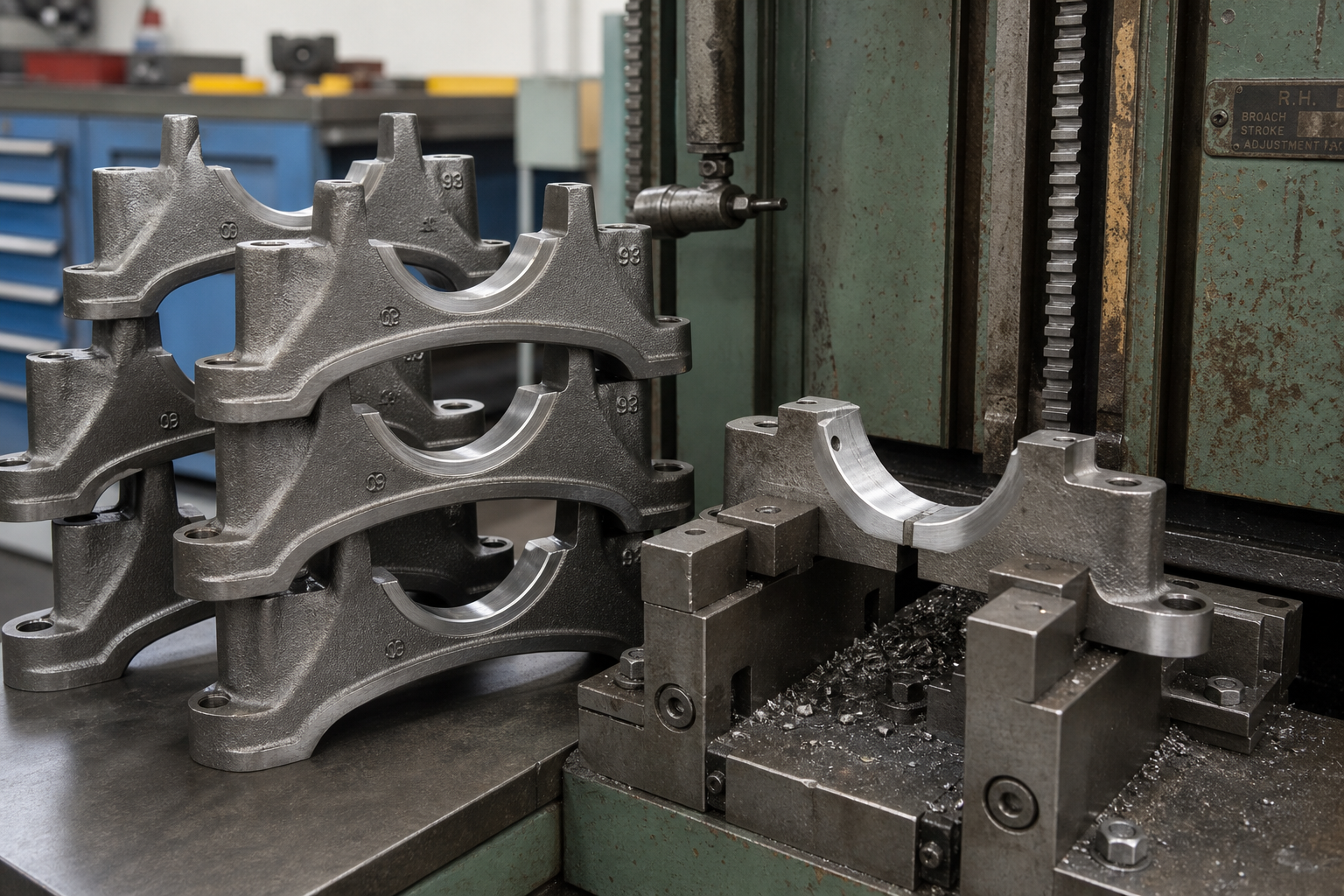
A surface broaching machine is a machine tool that cuts flat, angled, or contoured shapes on the outside of a workpiece using a multi-toothed tool called a broach. Instead of removing material through many passes the way a mill does, a surface broaching machine removes it in a single linear stroke, roughing and finishing the surface at the same time. That combination of speed, accuracy, and repeatability has made surface broaching a standard process in automotive powertrain plants and other high-volume production environments.
This article is a beginner-level introduction to the machine: what it is, how the cutting action works, the main types of surface broaches, why manufacturers choose the process over milling, and the parts it typically produces. If you already know the basics and are evaluating machines for a specific production line, our surface broaching machine guide goes deeper into machine types, workholding, and how to specify stroke, tonnage, and speed for an application.

What Is a Surface Broaching Machine?
Surface broaching is the umbrella term for any broaching operation that machines the exterior surface of a component, which is why it is also called external broaching. It is the counterpart of internal broaching, which cuts shapes inside a pre-drilled hole. A surface broaching machine is any broaching machine configured for that external work: it clamps the workpiece in a fixture and drives a toothed broach along a guided track so that the teeth pass over the outside faces of the part, removing a precise layer of material with every tooth in contact.
The “surface” in the name does not limit the machine to flat faces. Depending on the broach mounted on it, one machine can cut flat surfaces, slots, steps, angled chamfers, convex or concave contours, serrations, and external splines. If you are new to the process itself, our introduction to what broaching is covers the general principle, and the broaching machine family page shows the full range of machine configurations.

Because the broach carries the complete form of the finished surface in its tooth profile, the machine itself does not need to interpolate a path the way a CNC mill does. The shape is built into the tool, the tool is guided by the machine, and the machine’s job is to deliver steady stroke force against the cut. This is why surface broaching competes so strongly on cost per part once volumes are high, and why it is usually specified for production runs rather than one-off machining. You can see the machine configurations built for this work on our surface broaching machine product page.
How Does a Surface Broaching Machine Work?
The working principle is easy to picture once you see the broach as a row of cutting edges in sequence. A surface broach is a long steel tool with teeth spaced along one face. Each tooth stands slightly taller, or slightly wider, than the tooth in front of it. When the machine drives the broach across the workpiece, the first teeth take the deepest bites and remove the bulk of the stock, and each following tooth takes over where the previous one left off, shaving the surface progressively closer to its final form. By the time the last teeth pass, the surface has been roughed, semi-finished, and finished — in one uninterrupted stroke.
The tooth sequence is conventionally divided into three zones. The roughing teeth at the front remove most of the material in heavy, equal chips. The semi-finishing (transition) teeth reduce the chip load gradually and bring the surface close to its final dimension. The finishing teeth at the rear all cut at the same final height, so they size the surface, set its geometry, and generate the smooth finish in the same pass. No separate finishing operation or tool change is needed, which is the root of most of the process’s economic advantages.
Two mechanical details distinguish surface broaching from internal broaching. First, the cutting force acts in one direction only, pressing into the workpiece rather than pulling outward from a hole, so the part must be held rigidly against that force. Surface broaching machines therefore use robust hydraulic or mechanical fixtures that clamp the workpiece from behind and take the full cutting load. Second, the broach is mounted on a guided component called the ram, which travels along precision guideways and delivers the stroke. The stroke can be oriented vertically, which saves floor space and lets chips fall clear of the cut, or horizontally, which suits long broaches and large parts.
A typical production cycle is short and simple. The operator, or a loading robot, places the workpiece in the fixture. The fixture clamps it. The ram advances the broach across the surface in a few seconds, cutting fluid flushing the chips away. The fixture opens, the finished part is removed, and the next blank is loaded. Because the tool and fixture stay on the machine, there is no programming between parts and no tool calibration for the operator to perform — the first part and the ten-thousandth part are cut by exactly the same teeth, which is why the process shows almost no variation from operator to operator.
Two performance numbers describe what a given machine can do. The stroke length determines how long a surface the machine can cut in one pass, and therefore how large a part family fits on it. The tonnage (pull or push force) determines how much total cutting force the machine can deliver, which limits the number of teeth that can be engaged in the cut at once, and with it the width of surface and hardness of material that can be broached. Cutting speed itself is modest compared to milling — the emphasis of the process is on completing the whole form in one pass, not on high spindle speeds — and most surface broaching machines drive the ram hydraulically, which gives smooth, shock-free force that protects the broach teeth at the start of the cut.
Main Components of a Surface Broaching Machine
Although surface broaching machines are built in vertical, horizontal, and special-purpose configurations, they share the same core set of components:
- Machine frame and guideways: a rigid base that carries the cutting reaction forces and precision guideways along which the ram travels. Frame stiffness is what keeps the broach tracking true over thousands of cycles.
- Ram: the driven member that holds and moves the broach (or, on some machines, moves the workpiece past a stationary broach). The ram defines the stroke length of the machine.
- Broach holder: the interface that clamps the broach to the ram repeatably, so the tool returns to the same position after every regrind and reinstallation.
- Workholding fixture: a dedicated fixture that locates the part against locating surfaces and clamps it so the one-directional cutting force pushes the workpiece into its supports, never away from them.
- Hydraulic power unit: the pump, valves, and cylinder that generate the smooth ram motion and usually also power the fixture clamping.
Understanding these components is enough to follow most machine specifications. Fixture design in detail — chip evacuation, thin-wall support, and part families on one fixture — is covered in the workholding chapter of the surface broaching machine guide.
Types of Surface Broaches
Surface broaching is carried out by several broach styles, each matched to a family of surface forms:
- Slab broaches cut flat surfaces on the outside of a workpiece and are the general-purpose starting point of the family.
- Slot broaches cut open slots and grooves from the outside, often replacing a milling operation on production volumes.
- Contour broaches cut formed profiles — convex curves, concave radii, and compound shapes that would demand multi-axis milling.
- Pot broaches encircle a cylindrical workpiece with an annular ring of teeth and cut external forms as the part passes through, which suits shafts and pinions.
- Straddle broaches mount a pair of slab broaches that cut two opposite faces of a workpiece simultaneously, holding width and parallelism in one pass.

For tool materials, tooth geometry, and reconditioning, see our complete guide to broaches.
Why Manufacturers Choose Surface Broaching
Surface broaching is usually compared against milling, and the comparison comes down to five advantages that all trace back to the single-stroke principle:
- Short cycle time. A surface that takes a milling operation three to four minutes to complete is typically broached in around thirty seconds — roughly one-fifth of the machining time per part.
- High output with less equipment and labor. Because each machine finishes parts so quickly, a production line reaches its target volume with fewer machines and fewer operators than a milling equivalent.
- Precision in one stroke. Roughing and finishing happen in the same pass, so there is no separate finishing operation. Broached surfaces achieve dimensions and smoothness comparable to fine milling.
- Minimal operator skill. The form lives in the tool, not in a program. Once the broach and fixture are set on the machine, the operator loads and unloads; results do not vary between operators.
- Low cost per part at volume. Less machine time, fewer machines, less labor, and stable repeatability combine into a unit cost that milling struggles to match on high-volume external features.
The trade-off is that a surface broach is a dedicated tool: it cuts one part family well and nothing else, and its upfront cost is only justified when volumes are high enough to amortize it. For a detailed treatment of where the process wins and loses against milling, see the comparison in our surface broaching machine guide.
What Parts Are Made on Surface Broaching Machines?
Most machinable metals can be surface broached — cast iron, carbon and alloy steels, stainless steel, aluminum alloys, brass, and suitable plastics. In practice, the process concentrates on parts produced in large quantities with external features that demand tight tolerances. Beyond automotive powertrain parts, the same economics apply to turbine discs in aerospace engines, where the fir-tree root forms that hold blades in their discs are broached because the profiles must repeat exactly on every slot around the circumference. Four examples stand for the whole field:
The cylinder block is the classic case: the deck face and bearing joint faces of an engine block are broached flat in one pass on transfer lines, setting the reference planes for every later operation. Our article on cylinder block broaching walks through the surfaces and the line integration. The connecting rod is another: its bolt-face flats, slot, and mating features are broached so the rod and cap reassemble without shift, covered in connecting rod broaching. The steering knuckle in a vehicle’s suspension has mounting pads and pinion bores machined externally to alignment-critical tolerances. And the external spline — the toothed shaft profile that transmits torque in gearboxes and driveshafts — is a signature surface broaching application, produced at production volume by the techniques described in our article on special shaft tooth broaching.
A close cousin of the process deserves a mention here. Turn broaching machines cut crankshaft and camshaft journals by rotating the workpiece while circular cutter segments orbit it, combining broaching’s single-pass economics with turning’s rotational motion. For how that variant works, see the turn broaching guide.
Surface Broaching vs. Internal Broaching
Because the two branches of the process share one name, they are often confused. The differences follow directly from where the tool cuts. Internal broaching passes a broach through a pre-drilled pilot hole, so the workpiece itself surrounds and supports the tool and no external clamping is needed; it produces keyways, splines, and shaped holes. Surface broaching cuts on the outside of the part, so the cutting force pushes the workpiece away from the tool and a rigid fixture must hold it; it produces flats, slots, steps, contours, and external splines. The machines differ accordingly — internal work is dominated by pull-type vertical and horizontal machines, while surface work favors ram-driven machines with integrated fixtures.
For a side-by-side breakdown of working principles, structural differences, and how to choose between the two machine types, read internal broaching machine vs. external broaching machine.
Frequently Asked Questions
What is a surface broaching machine?
A surface broaching machine is a machine tool that machines the exterior surfaces of a workpiece with a multi-toothed broach. The workpiece is clamped in a fixture and a ram drives the broach across its outside faces in one linear stroke, cutting flat surfaces, slots, contours, or external splines. It is the external counterpart of internal broaching and is used mainly in high-volume production of automotive, aerospace, and general industrial components.
How does a surface broaching machine work?
The broach carries a sequence of progressively sized teeth. The roughing teeth at the front remove most of the stock, semi-finishing teeth bring the surface close to size, and the finishing teeth set the final dimension and finish — all in one stroke. Cutting force acts in a single direction, so the workpiece is held in a rigid hydraulic fixture while the guided ram travels vertically or horizontally across the part. A cycle typically takes seconds and requires no programming or tool calibration by the operator.
What is the difference between surface broaching and internal broaching?
Surface (external) broaching cuts on the outside of a workpiece and needs a fixture to resist the one-directional cutting force; it produces flats, slots, contours, and external splines. Internal broaching pulls or pushes a broach through a pre-drilled hole, where the workpiece supports the tool itself; it produces keyways, internal splines, and shaped holes. The two also favor different machine layouts: ram-driven machines with fixtures for surface work, pull-type machines for internal work.
What parts are typically surface broached?
Typical parts include engine cylinder blocks (deck faces and bearing joint faces), connecting rods (bolt faces and slots), steering knuckles (mounting pads and pinion features), external splined shafts, gear and pinion teeth, turbine blade root forms, and fastener flats and slots. In general, any high-volume part with an external flat, slot, step, or profile that must repeat within tight tolerances is a candidate for surface broaching.
Summary
A surface broaching machine is, in essence, a single-stroke solution for exterior surfaces: the form is built into a progressive-tooth broach, the machine supplies the stroke and the clamping, and the result is a finished surface in seconds with near-perfect repeatability. Whether the application points to a vertical or a horizontal machine depends on the stroke length, tonnage, and speed the part demands — decisions covered in depth in the surface broaching machine guide.
BroachingMach builds surface broaching machines for automotive, aerospace, and general industrial production. If you have a part drawing and want to know whether surface broaching fits it, our engineering team can review the application and recommend a machine configuration. To continue reading, browse more articles in Broaching Machines.