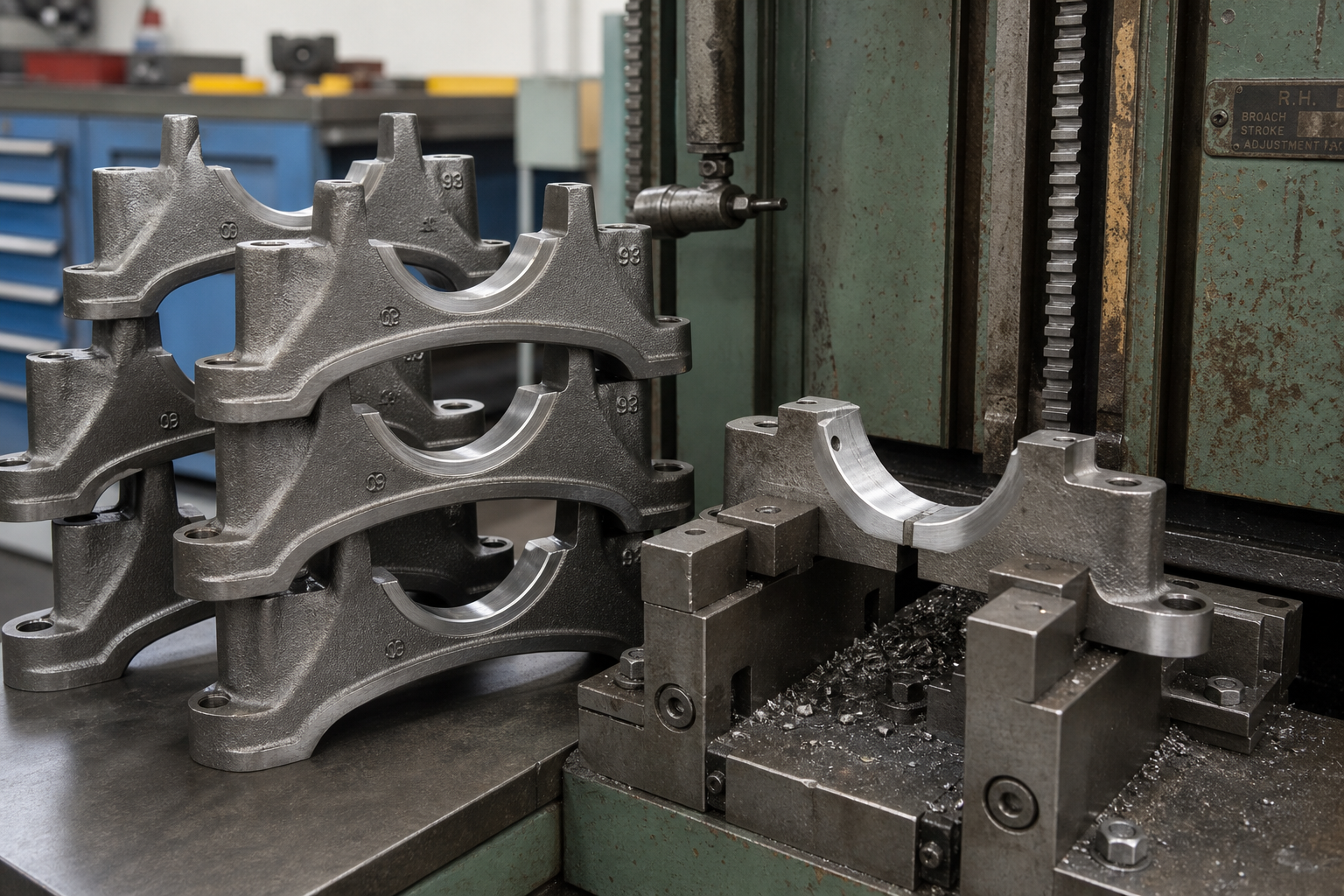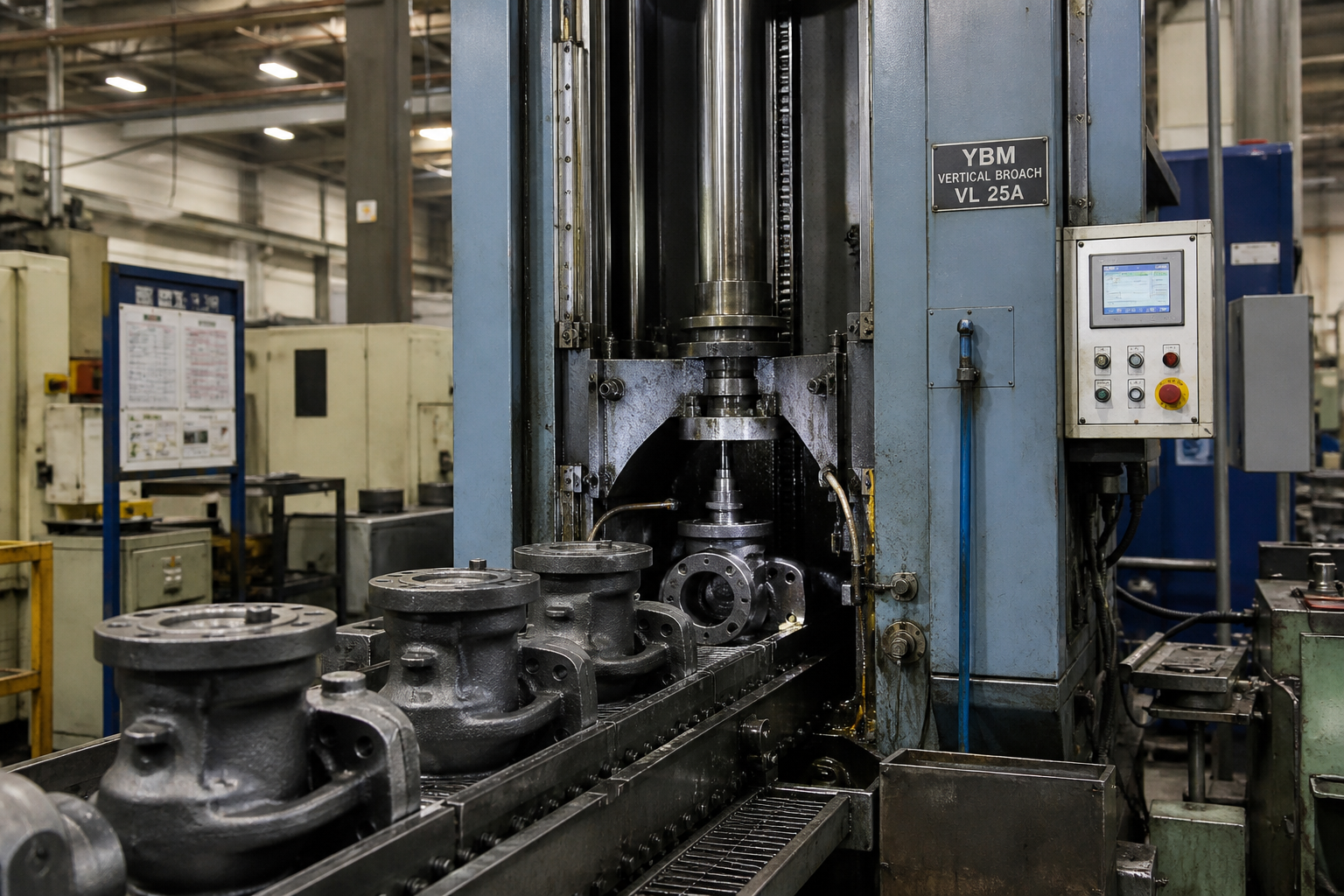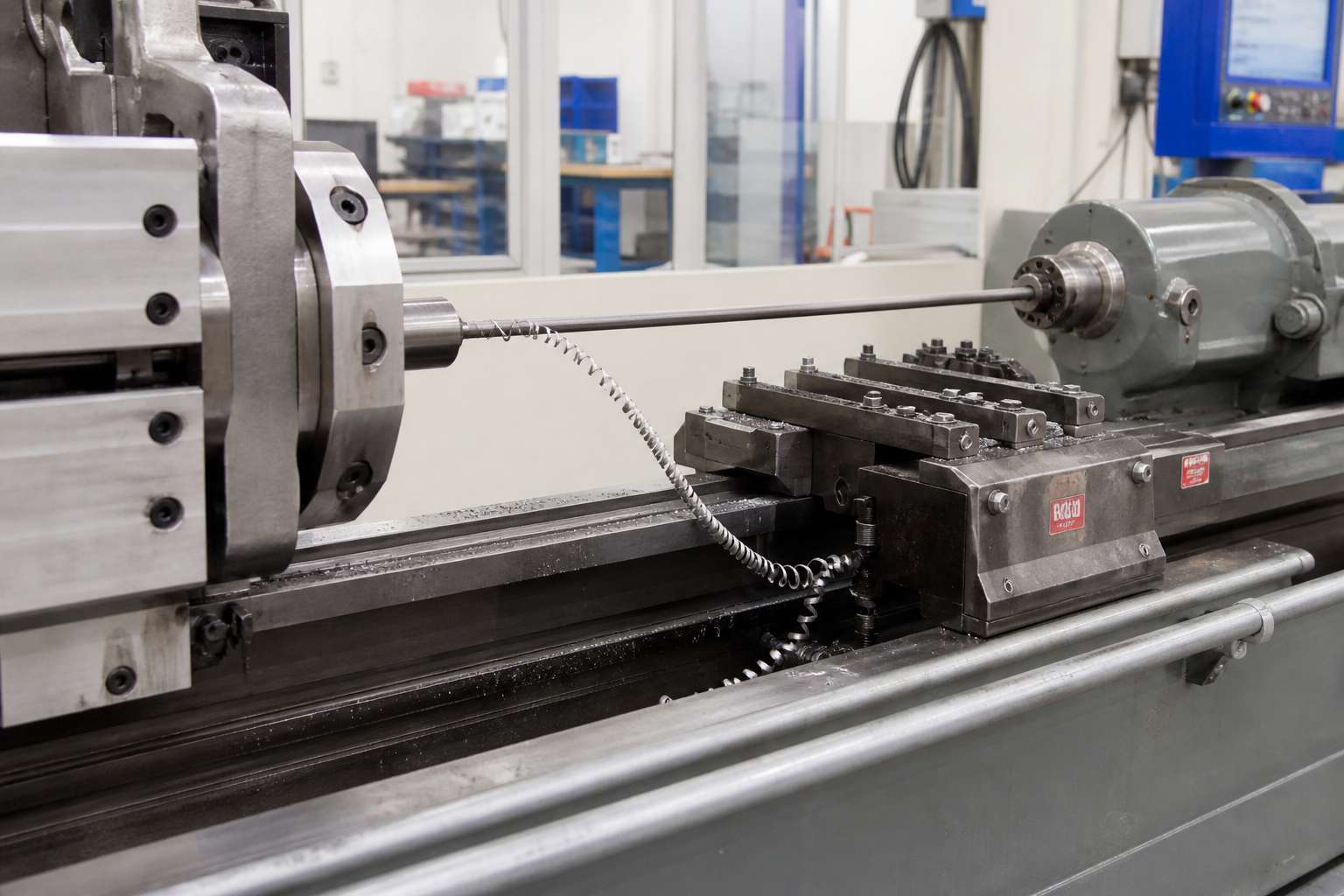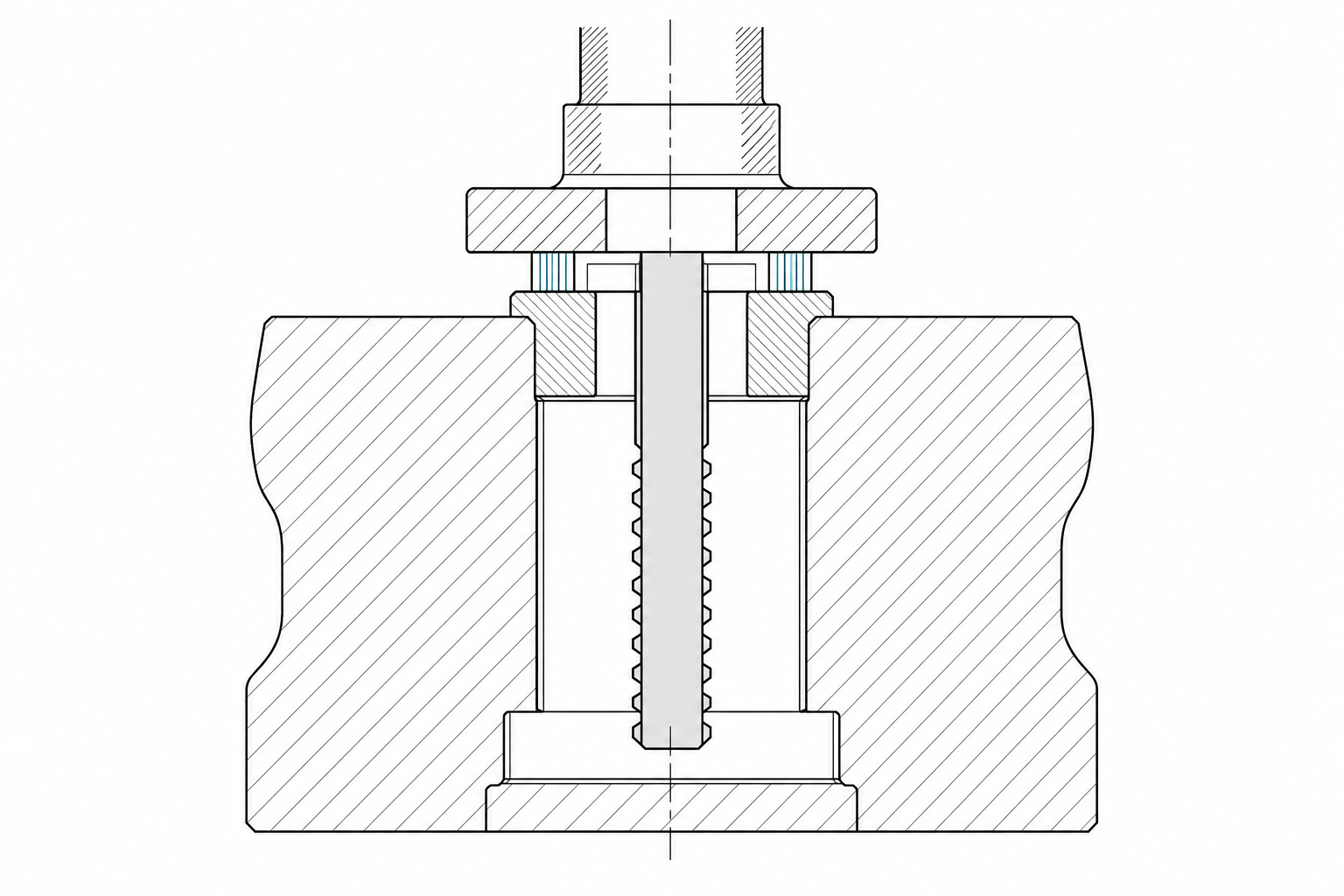
A keyway broaching machine cuts an internal keyway — the rectangular slot inside a pulley, gear, sprocket or coupling hub that receives the key — in a single stroke. A multi-tooth broach is guided through the pre-machined bore by a bushing, each tooth lifts a thin chip to deepen the slot, and seconds later the keyway is complete to depth, width and position. the keyway is complete to depth, width and position. No indexing, no multiple passes, no secondary cleanup. That is the process at the heart of high-volume hub making.
We cover the process itself in depth elsewhere: our complete guide to keyway broaching explains how keyway broaches are designed and how the cut progresses tooth by tooth, and our keyway broaching set guide covers the manual side — arbor presses and the broach-and-bushing sets that repair shops and low-volume producers use. This guide is about the machine: the dedicated equipment spectrum, the tooling system around it, real cycle times, and how to plan production when keyways stop being an occasional job and become your daily output.
What Is a Keyway Broaching Machine?
A keyway broaching machine is a machine tool built specifically to drive a keyway broach through a workpiece bore — internal broaching in its most common form. The machine has one critical motion: a ram that pulls (or sometimes pushes) the broach along a straight, rigidly guided path. The workpiece sits on a fixture over a guide bushing; the bushing pilots the broach, backs up the cut and keeps the tool square to the bore. Everything else — table, stroke control, return speed, automation — exists to repeat that one motion as fast and as consistently as possible.
Unlike a machining center, a keyway broaching machine does not interpolate the slot into existence. The slot’s geometry is copied from the broach: tooth widths set the keyway width, the tooth stack sets the depth, and the broach’s alignment in the bushing sets the slot’s position relative to the bore. The machine contributes force, stroke and — above all — a straight tool path. That is why broached keyways repeat so well in production: part one thousand is cut by the same teeth, in the same sequence, as part one. For tooth rise and chip formation behind that cut, see the keyway broaching process guide.
From Arbor Press to Dedicated Machine: The Equipment Spectrum
Not every shop that cuts keyways needs a dedicated machine, and understanding the spectrum is the fastest way to understand what a keyway broaching machine buys you. Production equipment falls along a clear progression:
- Arbor press with a broach set. The entry point. A keyed bushing drops into a press plate, the operator pushes the broach through with the press arm, and a follower returns it. Fine for occasional keyways, repair work, and batch sizes measured in dozens — the classic scenario our keyway broaching set guide is written for.
- Hydraulic press with keyway tooling. More force, less operator effort, enough stroke for longer broaches — but still a general-purpose machine doing keyway duty, with part handling, alignment and return stroke all manual.
- Dedicated vertical keyway broaching machine. The first true production step. The machine is built around the job: purpose-designed ram travel, bushing-ready work table, automatic broach return, and cycle logic that treats load, stroke and unload as one sequence.
- CNC keyway broaching machine. Programmable stroke and positioning, quick-change tooling, indexing capability for multiple keyways — the machine that carries the process from “fast cutting” to “unattended production cell.”
Each step up attacks a different constraint. The press-to-machine step replaces operator muscle and alignment judgment with machine-guided force — that is what makes output consistent shift after shift. The machine-to-CNC step replaces setup time and manual handling with program changes and automation. Where you sit on that spectrum is a volume and precision question; we return to it below.
Types of Keyway Broaching Machines
Three machine families do the overwhelming majority of the world’s internal keyway cutting. They overlap less than buyers expect, and choosing the right one is mostly a question of volume, keyway geometry and batch variety.
| Machine type | How it cuts | Typical use | Strengths and limits |
|---|---|---|---|
| Vertical keyway broaching machine | Ram pulls the broach down through the part in one stroke; bushing guides the tool | Through-bores in production hubs: pulleys, gears, sprockets, couplings | Fastest keyway per part; consistent results; needs a through-bore and a broach per keyway size |
| CNC keyway broaching machine | Same single-stroke broach cut, with programmable stroke, positioning and indexing | Mixed parts, multiple keyways per part, families of bores, automated cells | Quick changeover between programs; multi-slot capability in one setup; higher investment |
| Keyseater (slotting-type keyway machine) | Single tool reciprocates and feeds sideways, enlarging the slot stroke by stroke | Blind bores, very large workpieces, one-off and repair keyways | Cuts where a broach cannot pass; much slower than broaching; finish depends on the tool and operator |
The dedicated vertical machine is the volume workhorse: load the hub onto the bushing, initiate the cycle, and the keyway is finished before the part has cooled. Modern CNC keyway machines extend this with servo-driven rams, programmable depth and stroke profiles, automatic broach clamping and interfaces for part feeding. On our keyway broaching machine product page you can see the configurations we build for hub manufacturers, from single-station manual-load machines to multi-station automated versions.
Keyseater versus broaching machine. A keyseater cuts a keyway the way a shaper cuts a flat — one reciprocating tool, one small feed per stroke, the slot built up gradually. That makes it far slower than a broach for a through-bore, but it reaches geometry a broach cannot: keyways that terminate at a shoulder, and bores in workpieces too large to bring to a broaching machine. If your parts are blind, large or one-of-a-kind, read our comparison of broaching vs. keyseating for internal keyways before committing either way — choosing the wrong family is an expensive mistake that no tooling can fix.
Blind keyways. A standard keyway broach must pass completely through the bore, which is why blind keyways traditionally go to keyseaters. Broaching-based answers exist for some blind geometries — specialized blind-keyway tooling and process variants — and we treat the options, and their limits, in blind keyway broaching.
Tooling: Bushings, Quick-Change Broach Holders and Indexing Fixtures
The machine is only one third of the system. The other two thirds — guide bushings and workholding — determine whether all that machine rigidity actually reaches the cut.
Guide bushings. The bushing is the heart of keyway broaching tooling. Its OD fits the workpiece bore, its ID carries a slot that pilots the broach and backs the cutting forces. Because the bushing establishes the relationship between bore and keyway, every bore diameter you produce needs its own bushing — the same principle that governs manual broach sets, as our broaching set guide explains. On a production machine the stakes are higher: one worn bushing silently degrades every keyway that passes through it.
Quick-change broach holders. The broach mounts to the ram through a retainer; quick-change couplings turn broach swaps from a bolt-by-bolt job into a seconds-long change. If your machine runs more than one keyway width or bore size per day, quick-change tooling is one of the cheapest cycle-time reductions available, because it attacks changeover rather than cut time.
Indexing and multi-station fixtures. Many hubs need more than one keyway: double keyways at 180 degrees are common in couplings and high-torque drives, and some designs call for three or four slots. An indexing fixture rotates the part a programmed angle between strokes, cutting all keyways in one setup — one load, one clamp, multiple finished slots. That matters twice over: it multiplies throughput without multiplying machines, and it keeps angular relationships between slots controlled by the fixture rather than by operator re-orientation. The general principles — location against cutting force, support under the cut, repeatability — are the same ones we lay out in our broaching fixture design guide.
Cycle Time and Production Planning
The cut itself is rarely the bottleneck. A single keyway stroke takes seconds; the rest of the cycle is part logistics. A manual cycle breaks down into: orient the part and place it over the bushing, initiate the stroke, wait for the ram down-and-return cycle, lift the part off — broach still inside — strip the two apart, set the part aside. Each element is short, but all are operator-paced, and that is where the seconds add up.
So production planning for keyway broaching is mostly a plan for what happens around the stroke:
- Load and unload. The broach stays in the finished part until it is stripped — build a stripping step into the station layout, from a simple back-stop bar to an automatic stripper.
- Batch changeover. Bushing, broach and possibly fixture changes between parts; quick-change tooling and preset fixtures keep this at minutes, not shifts.
- Broach maintenance windows. Broaches cut thousands of keyways between regrinds, but regrinding needs a scheduled slot — a dull broach forces tonnage up and quality down. Plan reconditioning as capacity, not downtime.
- Operator loading. One operator can often serve more than one station; balancing man-to-machine ratios is where most cells gain their first productivity step.
Automation upgrade path. The sequence is well trodden. First, powered clamping and cycle interlocks remove hands from the danger zone and standardize cycle time. Next, a shuttle or two-position table lets the operator load one part while the machine cuts another, hiding load time inside the cut. For small hubs, vibratory bowl feeding delivers parts to the bushing automatically; for larger parts, a pick-and-place gantry or robot handles load, strip and unload. The endpoint is an unattended cell — machine, feeding, conveying and broach-wear monitoring running as one system. Each step can be added to a suitable base machine later; confirm retrofit-friendliness with your builder at purchase time.
Keyway Standards and Machine Capacity
Keyway dimensions are not custom geometry — they follow national standards, and matching machine capacity to those standards is a specification exercise. In inch-series practice, keys and keyways follow ANSI standards (the B17 family); in metric practice, DIN standards (notably DIN 6885 for parallel keys). Across both systems, common square and rectangular keyway widths run from around 3 mm (1/8 in) at the small end to 25 mm (1 in) and above for large shafts. Our keyway dimensions and standards reference tabulates the width-depth-tolerance combinations by shaft diameter.
Three machine-side capacities must line up with the keyway you need to cut. Force: wider keyways in tougher material need more cutting force, sized against the broach’s tooth count and chip load. Stroke: the ram must carry the broach fully through the bore and back with clearance — longer bores need longer broaches and longer stroke. Tooling envelope: the bushing must fit the table and the workpiece must clear the column through the full stroke. Specifying all three against your full part family — not just today’s part — keeps the machine productive for years instead of outgrown in one.
Holding Symmetry: The Accuracy Equation
The tolerance that matters most on a broached keyway is usually not width or depth — those are ground into the broach. It is symmetry: how precisely the keyway centers on the bore’s axis and how square the slot walls stand to the part face. Miss symmetry and the key binds or the hub tilts on the shaft. Four factors control it:
Machine guideway accuracy. The ram’s path is the slot’s path. Worn, loose or out-of-square guideways put that error into every keyway. This is a core difference between a production keyway machine and a general-purpose press doing keyway duty: the dedicated machine’s structure is built around one straight, stiff tool path.
Bushing fit and wear. The bushing transfers the bore-to-keyway relationship. Excess clearance to the bore — or wear from thousands of cycles — lets the broach drift sideways, and symmetry walks with it. Bushings are consumables: track their condition, rotate them out on a schedule, and treat a sudden symmetry complaint as a bushing problem first, a broach problem second.
Broach condition. Uneven tooth wear or a poor regrind cuts uneven side loads that push the tool against the bushing slot. Regrind quality is an accuracy input, not just a tool-life input.
Workpiece seating. Burrs on the bore mouth, chips under the part or an out-of-square fixture face tilt the bore relative to the stroke. Air-blow seating and periodic fixture-face checks are cheap insurance. The full workholding methodology is covered in our broaching fixture design guide.
When to Upgrade from a Broach Set to a Keyway Broaching Machine
Our keyway broaching set guide closes with an honest admission: press-and-set tooling has a ceiling. This guide is what lies above it. Four signals tell you the ceiling has arrived:
1. Weekly keyway hours. When keyway cutting occupies a press and an operator for a meaningful share of every week — rather than an occasional afternoon — the labor arithmetic flips. A dedicated machine with a short automatic cycle produces more keyways per labor hour than a press, every time, and the gap widens with automation.
2. Repeatability complaints. Press setups depend on the operator repeating alignment judgment part after part. If inspection is chasing symmetry or width variation that traces to setup rather than tool wear, a machine-guided broach removes the variation at its source.
3. Batch sizes growing, not shrinking. Broach sets suit dozens; machines suit thousands. When one customer order equals a week of press time, the machine pays for itself on schedule and capacity, not just cost per part.
4. Keyway variety. Variety also argues for the machine — if it is a CNC machine with quick-change tooling. Six bore sizes on a press means six manual setups; on a CNC keyway machine it means six programs and bushing swaps measured in minutes.
The clean test is a simple comparison: annual labor hours currently spent on keyway work at loaded labor rates, against machine investment spread over its service life, adjusted for the capacity and consistency gained. Most shops land on the same conclusion at the same threshold — once keyways are a production line rather than a task, the production machine wins. For the investment picture, our broaching machine price guide breaks down what drives cost.
Typical Workpieces: Pulleys, Gears, Sprockets and Couplings
Keyway broaching machines exist because of round parts with holes in the middle. The classic families:
- Pulleys. V-belt and timing pulley hubs take standard-width keyways, often across a wide range of bore sizes from one blank design — a natural fit for a machine with interchangeable bushings. Our pulley hub keyway broaching walkthrough shows the process on a real part family.
- Gears. Spur and helical gear blanks in bore-ready condition get their keyway as a final machining step before assembly — high volumes, tight symmetry requirements, the exact case production keyway machines are built for.
- Sprockets. Chain sprockets share the pulley pattern: standard bores, standard keys, large batches.
- Couplings. Rigid and flexible couplings frequently specify double keyways at 180 degrees for higher torque capacity — the showcase application for indexing fixtures, cutting both slots in one setup.
- Flanges, flywheels and rotors. Any hub-form part with a through-bore and a key seat is a broaching candidate.
Frequently Asked Questions
What is a keyway broaching machine used for?
It is used to cut internal keyways — the slots inside bores that accept shaft keys — in production parts such as pulleys, gears, sprockets and couplings. One stroke of a multi-tooth broach finishes the keyway to width, depth and position, which is why the process anchors high-volume hub machining. The same machine family also cuts other internal profiles (splines, polygons) with proper tooling.
How do you choose a keyway broaching machine?
Start from your part family, not the machine catalog. Match force and stroke to your largest bore and longest broach; confirm the tooling envelope fits your biggest workpiece; count your bore sizes to size the bushing inventory; weigh CNC control and indexing if you run multiple keyways per part or frequent changeovers. If any parts have blind bores, evaluate a keyseater alongside the broaching machine before deciding.
How much does a keyway broaching machine cost?
At the entry level, a press plus a broach set is a low-four-figure tooling purchase. Dedicated keyway broaching machines are capital equipment: basic vertical machines occupy the tens-of-thousands range, and CNC machines with indexing fixtures and feeding climb well beyond that. Because price moves with stroke, force, control level and tooling, we maintain a detailed breakdown in our broaching machine price guide.
How deep a keyway can a broaching machine cut?
Depth is a broach design question, not a machine axis. Standard hub keyways are proportional to key width — on the order of half the key’s width in depth — and the broach is ground to reach full depth in its single pass. Deeper slots need more tooth steps, which lengthens the broach, which demands more stroke and force; that trade-off, not the machine alone, sets the practical limit. Where a design exceeds what one pass can economically cut, the options are multi-pass broaching with stepped tooling or a different process such as keyseating.
Plan Your Keyway Broaching Production
A keyway broaching machine is a volume decision wrapped around a precision process: the broach fixes the slot geometry, the bushing fixes its relationship to the bore, and the machine fixes how often and how consistently that happens. Get the three aligned and a hub line runs for years with regrinds and bushing changes as its only routine care.
We build keyway broaching machines for exactly this work, from single-station manual-load verticals to CNC machines with indexing and feeding for unattended cells — see the configurations on our keyway broaching machine page. Send us a part print and your annual volumes, and our engineers will review the geometry, recommend the machine and tooling package, and lay out the cycle time you can expect in production.