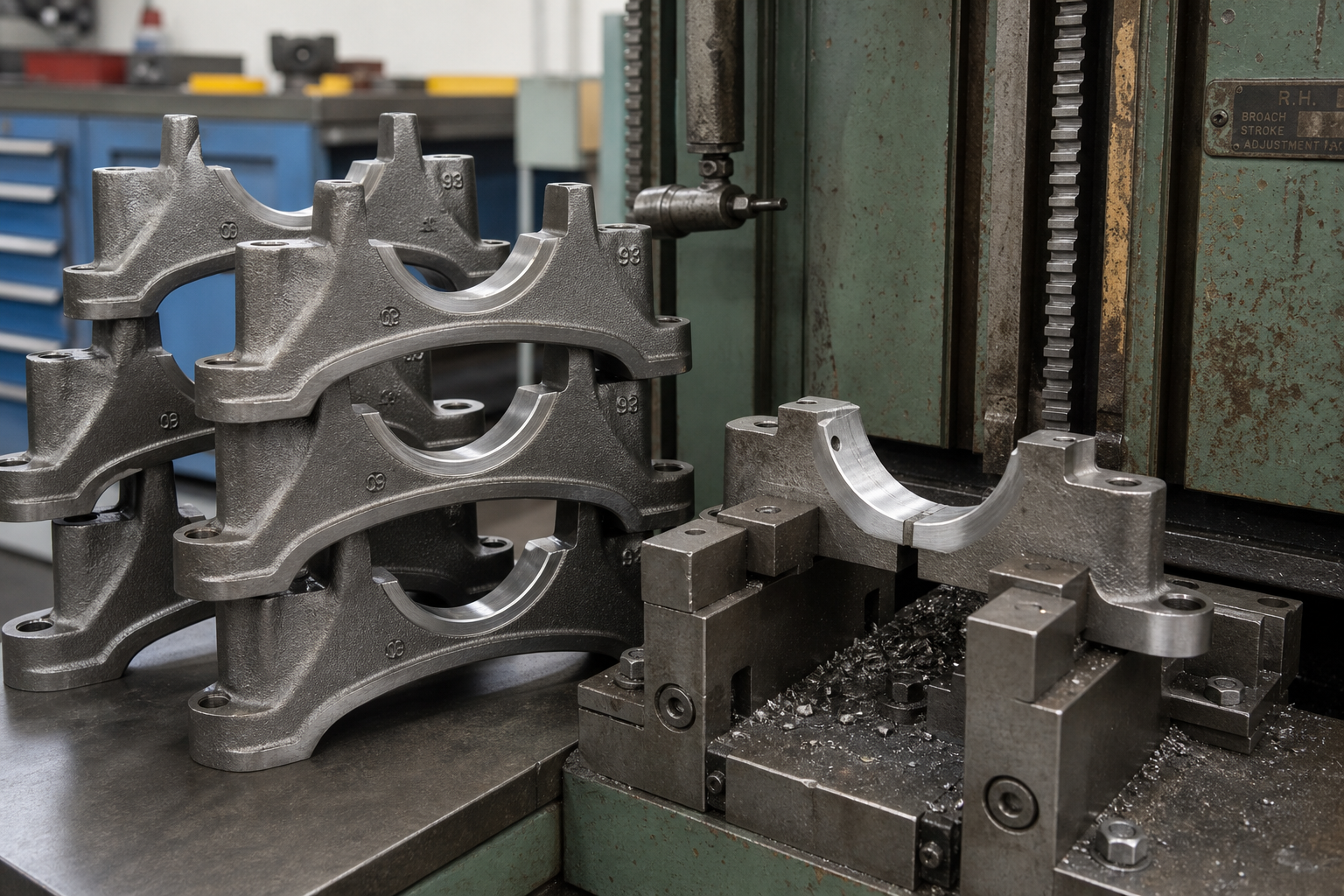
Horizontal broaching is a metal-cutting process in which a multi-toothed broach is driven through or across a workpiece in a single horizontal stroke, parallel to the shop floor. Each tooth on the broach stands slightly taller or wider than the one before it, so one pass of the tool removes stock in thin, controlled slices and delivers a finished form — a keyway, a spline, a hexagon, a flat surface — with no secondary operation. The machine that performs it, the horizontal broaching machine, is the configuration of choice for long strokes, heavy workpieces, and in-line production flow.
This article explains what horizontal broaching is, how a horizontal broaching machine works, the main machine types, and the parts and industries that depend on the process. It is a primer: if you already know the basics and are comparing machines to buy, our horizontal broaching machine guide covers selection at full depth — specifications, floor space, automation, and applications. And if the process itself is new to you, start with our introduction to what broaching is before reading on.

What Is Horizontal Broaching?
Broaching is a machining process that uses a long, multi-toothed cutting tool — the broach — to remove material in one linear pass. In horizontal broaching, that pass runs on a level axis: the broach travels parallel to the floor, either pulled through a hole in the workpiece (internal broaching) or guided across its exterior (surface broaching). The orientation is the only thing that separates the process from vertical broaching, where the same tool travels up or down an upright column. The cutting physics are identical in both layouts: progressive teeth, rising stock removal, one-pass completion.
Most horizontal broaching is pull broaching. The broach is gripped at its pull end and drawn through the workpiece, which puts the tool in tension. A pushed broach, by contrast, works in compression and can buckle under load, so push broaching is reserved for short, stubby tools on light work. Pull broaching is also why the horizontal layout suits long tools: a long broach laid on a level bed is supported along its full length by rollers and guides, whereas the same tool hung vertically fights its own weight. For the same reason, horizontal machines deliver strokes that vertical machines cannot match within a normal building height.
The forms cut are the classic broaching forms: internal keyways, splines and serrations, round and polygon holes (squares, hexagons, double-D profiles), and exterior flats, slots, steps, and dovetails. What sets broaching apart from other ways of producing those forms — milling, shaping, keyseating — is the single stroke. A milling cutter or a shaper tool needs pass after pass, feeding incrementally to depth; a broach carries the entire process plan in its tooth stack and finishes the feature in one motion. That difference is where the process gets its productivity, and it is the reason high-volume plants build whole lines around it.
What Is a Horizontal Broaching Machine?
A horizontal broaching machine is a machine tool built around a level bed: a long, rigid base that sits directly on the shop floor and carries the guide ways for a sliding ram. The workpiece is fixtured stationary at working height at the head of the bed, and the ram — connected to the drive inside the bed — grips the broach and pulls it through or past the part in one stroke. In its simplest description, the machine consists of a bed, a broach pilot or fixture, and a drive mechanism; every model is an elaboration of those three elements. Our horizontal broaching machine product pages show the configuration in detail across the range.
The construction has followed the same logic for decades, and the main components are worth knowing by name:
- The bed. A box-type structure, typically running about twice the stroke length, that anchors the whole machine to the floor. On modern machines it also houses the hydraulic power unit — the industry-standard drive for smooth, controllable pulling force at heavy loads.
- The ways and ram. Precision ways along the bed guide the ram, which is connected to the hydraulic drive and carries the full pulling force of the cut. The straightness of the ways under load sets the accuracy ceiling, because any bow in the ram’s path prints directly into the part.
- The work fixture or adapter. Mounted on the front vertical face of the bed, it locates the workpiece with its pre-machined pilot hole exactly on the stroke axis and reacts the cutting force.
- The broach coupling. At the front end of the ram, the coupling engages the broach’s pull end — the small end of the tool having been passed through the hole in the job first. Production machines increasingly use quick-change couplings so broaches swap between jobs in minutes.
- The rear support. Guides, rollers, or lifters at the rear of the mechanism support the pull end and the free length of the tool during entry, cutting, and return, keeping long broaches from sagging or nicking in handling.
Broaching machines are classified by their tonnage and stroke limitations, and those two numbers qualify a job before anything else: the tonnage must cover the total cutting load of all teeth engaged in the cut, and the stroke must carry the entire broach clear of the work. Complete ranges are available with standard strokes, tonnages, and cutting speeds for every broaching need, and special adapters extend the same machines to intricate work such as spiral broaching.
How Does a Horizontal Broaching Machine Work?
An internal pull cut proceeds in a fixed sequence. The workpiece is placed in the adapter with its pre-machined pilot hole aligned on the stroke axis. The small end of the broach is introduced through the pilot hole, the ram’s coupling engages the broach’s pull end, and the ram draws the entire tool through the part along the bed. Every successive tooth takes its thin slice of stock; the final finishing teeth cut at full size and set the surface finish. The part is unloaded, the ram returns at rapid traverse, and the next cycle begins — the feature is complete in that one cutting pass.
What makes one pass enough is the tooth stack. A broach is not a file with identical teeth: roughing teeth at the front do the heavy removal, semi-finishing teeth bring the form close, and the last rows of finishing teeth hold the final dimension and surface finish. Chip load per tooth is designed into the tool, so the machine has to supply only two things — enough force and a straight path. The tool carries the rest of the process plan. This division of labor is also why broaching outpaces milling or shaping for the same feature at volume: the whole depth of the form is done in one stroke rather than pass after pass.
One practical rule surprises newcomers: stroke length is not the same as cut length. The ram must pull the whole broach clear of the work, so a short feature cut with a long tool still demands a long stroke — and the machine’s stroke rating, not the length of the cut, decides which jobs it can run. When the required stroke climbs past what a building can stand vertically, the job lands on a horizontal bed almost by default.
Surface work on the same machine follows identical stroke logic with the tooling inverted: the broach passes across the clamped part’s exterior, and the fixture — not a pilot hole — must locate the part and react the full cutting force. The video below shows a typical horizontal pull cut in operation:
Types of Horizontal Broaching Machines
The horizontal layout serves three duties — internal, surface, and continuous broaching — and machine types are named for them. What follows is what each type is and does; for a selection-depth comparison of the three, including specifications, floor space, and automation, see the horizontal broaching machine guide.
Horizontal Internal Broaching Machines
The backbone of the category. The workpiece is fixtured at the head of the bed, and the ram pulls a broach through the pilot hole along the bed axis — the standard machine for internal keyways, splines and serrations, polygon bores, and shaped holes in gears, sprockets, hubs, pulleys, and pump components. Because a pulled broach works in tension and cannot buckle, this is the machine for deep bores and long internal splines: the features that stretch broaches to multi-meter length, where only a level bed can support the tool along its full reach.
Horizontal Surface Broaching Machines
Surface machines mount the broach on the ram and pass it across the exterior of a clamped part: flats, steps, dovetails, slots, and contours on workpieces too large, too long, or too heavy for a vertical envelope. Steering knuckles, control arms, and cylinder blocks are typical work. The long bed also makes the layout the natural home for constant-section forms machined along the length of a part — racks are the classic case, with teeth generated in one pass, as our rack broaching article shows.
Continuous (Chain-Type) Broaching Machines
The throughput extreme of the horizontal idea. The broaches stay fixed while fixtured workpieces ride an endless chain track past them, so loading and unloading overlap cutting and the line never stops for a stroke. Small and medium parts in very high volume — lever forks, link ends, pads and flats — are the classic workload, and one continuous machine can replace a battery of single-stroke machines on the same floor. Our continuous broaching machine article covers the working principle, types, and applications in full.
What Parts and Industries Use Horizontal Broaching?
Horizontal work clusters into three part profiles. Long-stroke parts: internal splines and keyways running deep in tubes, barrels, and long bores, where the required broach length rules out every other layout. Heavy parts: chassis and suspension castings, cylinder blocks and heads, and large valve and pump bodies — parts that load naturally from above at working height with the cranes, hoists, and roller conveyors most shops already own. Flow parts: components that arrive on a conveyor line at fixed height and should be broached without a lift, the native rhythm of automotive transfer lines.
The industries behind these parts are concentrated where precision forms meet volume. Automotive and truck drivelines lead: transmission gears with internal splines, wheel hubs, brake calipers, and steering components. Agricultural and construction machinery follow the same pattern with larger castings. General engineering and fluid power contribute pump housings, valve bodies, and cylinder components; aerospace brings turbine discs and high-value fittings; and hand-tool and hardware manufacturing relies on broaching for squares and hexagons in tight bores.
Workpiece materials span the machinable range: plain and alloy steels cut in their soft state before heat treatment, cast iron, aluminum alloys, and other non-ferrous metals. Hard broaching — cutting after heat treatment — exists as a specialized practice with its own tooling, but the bulk of horizontal work removes stock from soft parts at high speed. One automotive application deserves its own name: turn broaching, the continuous cutting of crankshaft main journals and connecting-rod journals as the workpiece rotates past form tools. It is a specialized horizontal-format process with its own tooling logic — see our turn broaching guide for how it works.
Horizontal vs. Vertical Broaching: The Short Version
The comparison comes down to one geometric choice with practical consequences. Both layouts cut the same forms with the same tools; what differs is the world around the cut:
| Factor | Horizontal machine | Vertical machine |
|---|---|---|
| Stroke direction | Ram travels level along a floor bed | Ram travels up or down a column |
| Stroke ceiling | Practically unlimited — beds extend along the floor | Bounded by building height or pit depth |
| Floor space | Long, low footprint; installs on a standard slab | Compact footprint; suits tight cells |
| Chip and coolant | Flushed and conveyed along the bed | Gravity pulls chips down and out of the cut |
| Best for | Long, heavy parts and in-line flow | Small-mid parts and automated cells |
The short version: horizontal wins when the part is heavy, long, or feeds a line; vertical wins when floor space is tight and parts are small. Our article on the difference between horizontal and vertical broaching machines breaks the comparison into seven factors with the engineering reason behind each; for the other configuration’s primer, see what vertical broaching is.
Advantages and Limitations of Horizontal Broaching
The practical strengths, in the order shops usually feel them:
- Long strokes without a building permit. Stroke grows outward along the floor, so the machine achieves significantly longer strokes than a vertical machine without being restricted by ceiling height — no pit, no special foundation.
- Heavy parts handled naturally. The work zone is open at both ends and from above; cranes, hoists, and rollers deliver and retrieve workpieces in the direction heavy parts prefer to move.
- A wide variety of cutting forms. Especially for internal work, one machine produces squares, hexagons, keyways, splines, and irregular profiles with elongated strokes.
- Quick, low-cost retooling. Horizontal machines are easily modified and retooled between jobs, which keeps tooling-related cost down when volumes are modest or part variety is high — and where the details of your broaching needs fit, an industrial broaching service can hold tooling expense near zero.
- Precise alignment, efficient cutting. Fixturing aligns the machine to the exact item being cut, so the cutting process runs with greater efficiency part after part.
- Extensible capability. Specialized adapters extend the same machines to intricate tasks such as spiral broaching.
The honest limits: the long bed claims floor space a vertical machine would not; chips do not leave the cut by themselves, so flushing, sloped beds, and chip conveyors are engineered items rather than free gifts of gravity; and for small parts in very high volume, a compact vertical cell or a continuous machine is usually the better fit. None of these are defects — they are the trade the layout makes for stroke length and part access.
Frequently Asked Questions
What is horizontal broaching?
Horizontal broaching is a machining process in which a multi-toothed broach is pulled through or across a workpiece in a single stroke parallel to the floor. Progressive teeth remove stock in controlled slices, so the form — a keyway, spline, hexagon, or flat — is finished in one pass. The machine that performs the process is a horizontal broaching machine.
How does a horizontal broaching machine work?
The workpiece is fixtured at the head of a level bed with its pre-machined pilot hole on the stroke axis. The ram engages the broach’s pull end and draws the whole tool through the part in one stroke; each tooth takes its designed slice of stock, and the finishing teeth set the final size and surface. The part is unloaded, the ram returns at rapid traverse, and the cycle repeats.
What parts are made by horizontal broaching?
Typical work includes internal keyways and splines in gears, sprockets, hubs, and pulleys; bores and forms in pump housings and valve bodies; flats, slots, and dovetails on chassis castings such as steering knuckles and control arms; cylinder blocks and heads; and deep features in tubes and barrels. Small parts in very high volume ride continuous chain broaching machines.
Horizontal vs. vertical broaching: which should I choose?
Neither is better overall — each wins on specific work. Choose horizontal for long strokes, heavy workpieces, and in-line conveyor flow; choose vertical for a compact footprint, gravity-assisted chip removal, and automated cells for small parts. Many plants run both. The full seven-factor comparison is in our article on the difference between horizontal and vertical broaching machines.
The Bottom Line
Horizontal broaching is the same one-stroke process pointed along the floor — and that single choice buys practically unlimited stroke, natural handling for heavy parts, and straight-line integration with production flow. If you are evaluating machines, browse our broaching machines range and the broaching machine category for current models, or contact BroachingMach — as a manufacturer we build horizontal internal, surface, and continuous machines and can match one to your parts, volumes, and building.