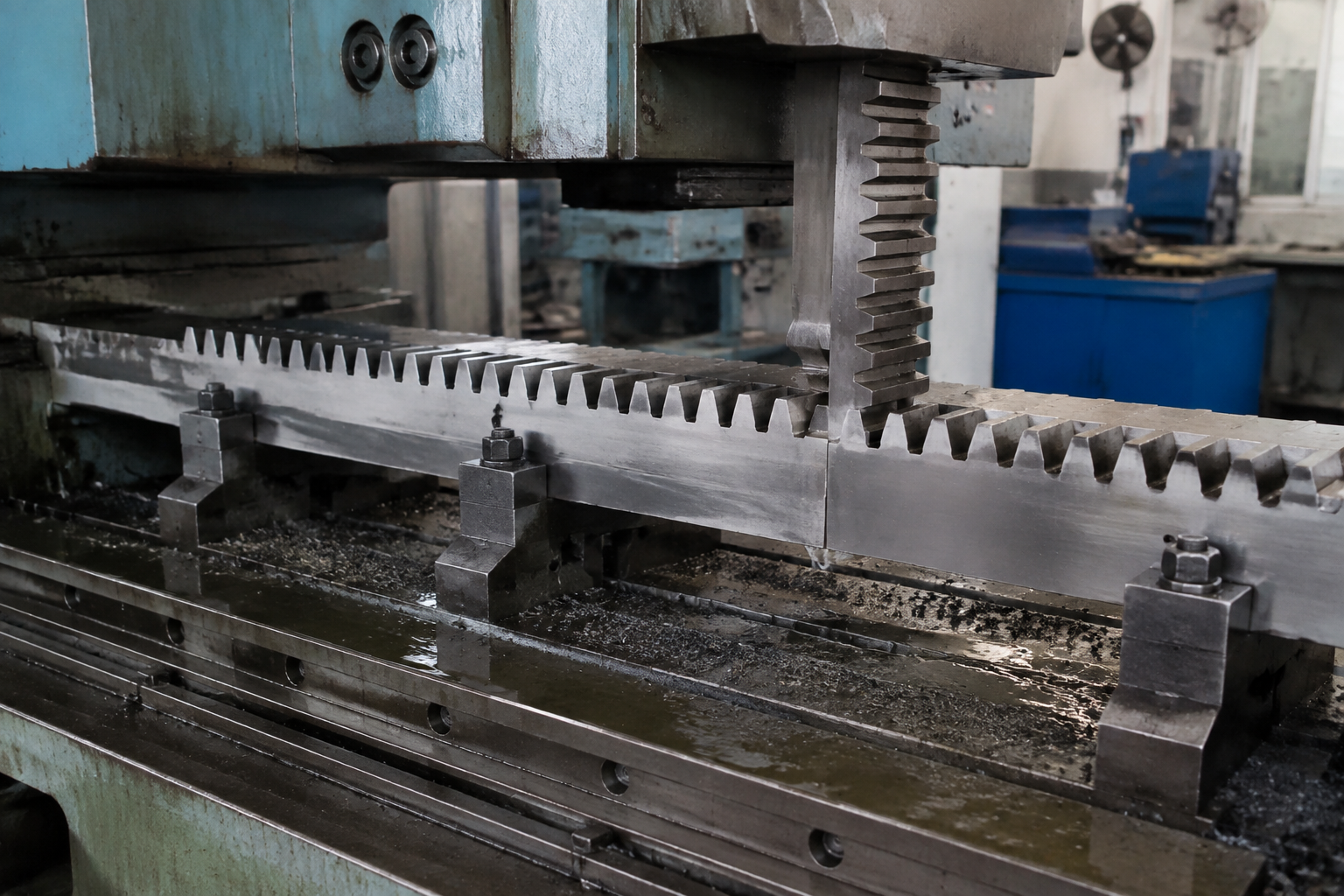
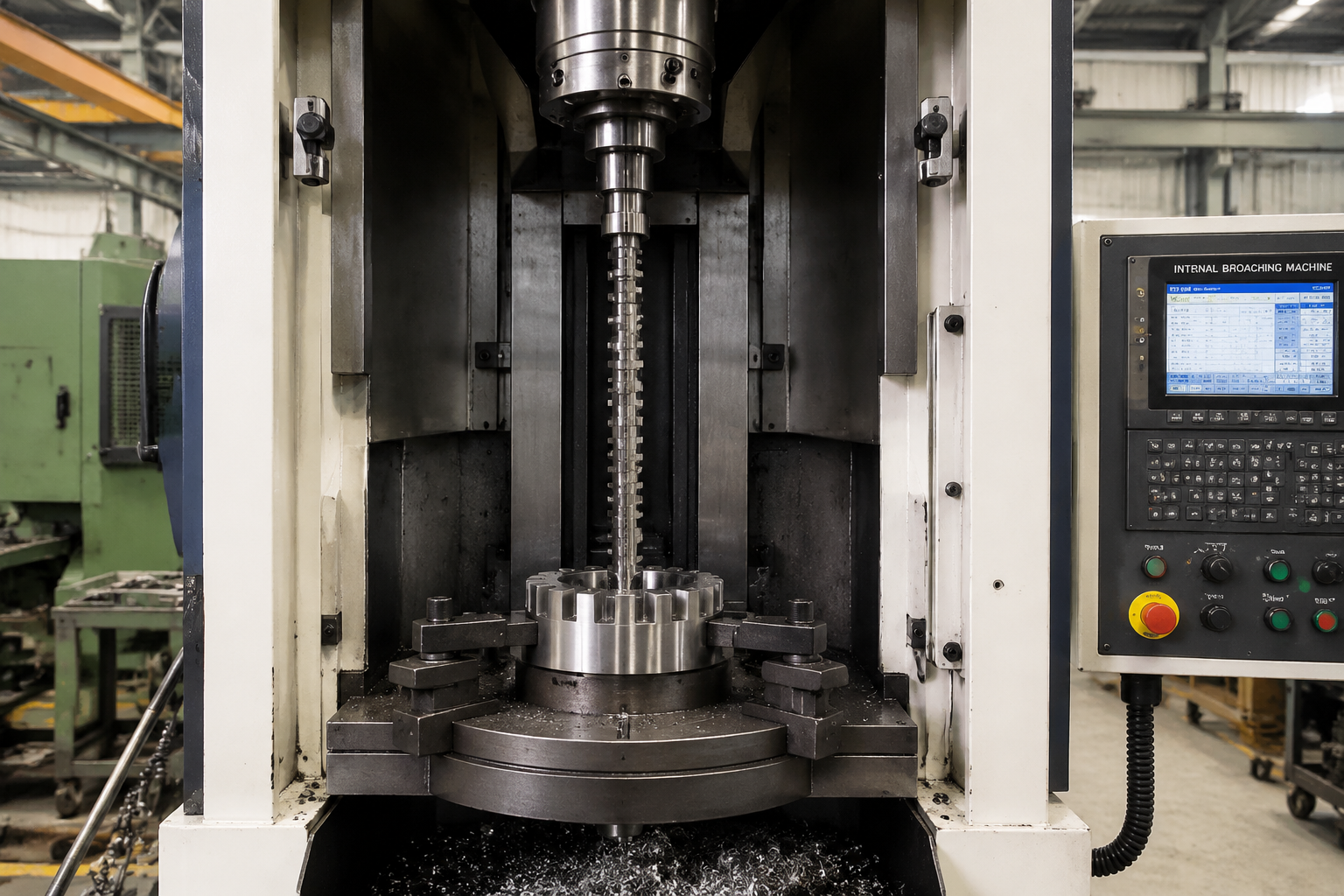
Vertical broaching is a machining process in which a long, multi-tooth cutting tool — a broach — is driven through a pre-machined hole or across an outside surface along a strictly vertical path, removing material in a single uninterrupted stroke. Each tooth on the broach stands slightly taller than the one before it, so the teeth share the work progressively: the first teeth rip out the bulk of the material, the middle teeth bring the form close, and the final teeth size and finish it. One stroke, one finished feature. That is the entire promise of the process, and the reason it occupies a permanent place on production floors.
The machine that delivers that stroke is the vertical broaching machine, and it is the most common broaching configuration in the world’s machine shops. This article is the process-level introduction: what vertical broaching is, how the cut actually works, what the main machine configurations look like, and what parts the process makes. It deliberately stops where selection engineering begins — if you need the machine itself in depth (configurations compared dimension by dimension, specifications, operation and maintenance), that lives in our companion piece, the vertical broaching machine complete guide. And if the whole process is new to you, start one level higher with our primer on what broaching is.

What Is Vertical Broaching?
The term carries two meanings that are worth separating, because buyers meet both in the same conversations. Vertical broaching the process is defined by the direction of the cutting stroke: the broach travels up or down, perpendicular to the floor, rather than horizontally along a bed. A vertical broaching machine is the machine tool built around that stroke — an upright column carrying a slide (the ram), a work table with fixturing, and a hydraulic or servo drive that moves the broach through the part. When engineers say “vertical broaching,” they usually mean both at once: the process as executed on that family of machines.
What the vertical orientation buys is geometry. Because the machine grows upward instead of outward, a long broach and a long stroke fit inside a compact footprint — a vertical machine typically occupies a fraction of the floor area that a horizontal machine of equal stroke demands. Because the stroke points down or up with the cutting zone open above the table, parts load and unload at a convenient working height, whether the “loader” is an operator with two hands or a pick-and-place unit fed by a bowl feeder. And because gravity acts along the stroke axis, chips and coolant leave the cut the way they naturally want to move. For a broader look at the machine families and where each fits, see our overview of what a broaching machine is.
How Does a Vertical Broaching Machine Work?
Underneath the frame, the working principle is the same for every vertical machine: convert one linear stroke of a multi-tooth tool into a finished form. The broach is a slender, precision-ground bar — round, square, or profile-shaped in section — clamped to the ram by a quick-change holder. The workpiece is fixtured on the table so that its existing hole (for internal work) or its outside surface (for surface work) sits exactly in the broach’s path. The drive then moves the ram through its stroke at a controlled speed and force, and the broach does the rest.
The cutting stroke, tooth by tooth
What makes broaching different from every other cutting process is that the “feed” is built into the tool. There is no axis feed, no tool change, and no second setup. The broach’s teeth step up in height along its length — the rise per tooth — so as the tool advances, each successive tooth cuts a slightly deeper layer of material than the tooth before it. Roughing teeth near the entry end take heavy bites and remove the bulk; semi-finishing teeth refine the form; the last few finishing teeth, all at final height, size the feature and set the surface finish. By the time the broach exits the work, the keyway, spline, polygon, or profile is complete — typically to closer consistency than a sequence of separate milling or shaping passes, because every tooth on the broach cuts in the same stroke under the same conditions.
One production cycle, four steps
Stripped to its essentials, a vertical broaching cycle looks like this:
- Load and locate. The operator or loader places the part in its fixture. For internal work, a pilot or bushing aligns the existing hole concentric with the broach path — broaching follows the hole it is given, so hole quality sets the ceiling on form accuracy.
- Pick up the broach. The ram’s holder engages the broach — from above on pull-down machines, from below on pull-up machines — and the fixture clamps the part against the cutting force to come.
- Cut in one stroke. The ram draws the broach through or across the part at a controlled speed while coolant flushes the cutting zone. Roughing, semi-finishing, and finishing happen inside this single pass.
- Return and unload. The broach retracts to its start position and the finished part comes off the fixture. On machines with rotary indexing tables or twin rams, the next part is already loading while the current one cuts, so the stations overlap in time.
Gravity, chips, and coolant
The vertical stroke direction pays a dividend that horizontal machines must engineer their way around: chips fall out of the cut by themselves. On a pull-down stroke, chips sheared from the work drop away from the cutting zone continuously, and coolant flushed from above carries them down and out — finished teeth stay clear of debris instead of dragging recut chips back through the bore. That natural cleanliness shows up directly as surface finish and tool life, and it matters most in difficult, stringy materials where chip packing is a real risk. The direction of the stroke also changes where the part sits and how it is held, which is the heart of the pull-up versus pull-down distinction — more on that in the next section, and in our dedicated comparison of pull-up vs pull-down broaching machines.
Types of Vertical Broaching Machines
“Vertical broaching machine” is a family name, not a single design. Four configurations cover nearly everything you will meet on spec sheets and equipment listings, and they differ along two axes: whether the broach is pulled (in tension) or pushed (in compression), and whether it cuts inside a hole or across an outside surface.
Pull-up machines
On a pull-up machine, the broach starts below the workpiece and climbs, finishing its stroke high in the frame. The part sits on the table where gravity seats it, and the loading station sits low — exactly where bowl feeders, chutes, and pick-and-place units prefer to work. This is the classic configuration for small, high-volume internal work: hex and square sockets in fittings, keyways in small bores, and similar parts measured in grams rather than kilograms.
Pull-down machines
On a pull-down machine, the broach hangs from an upper slide and is drawn downward through the part, from the work table toward the floor. Chips travel the way gravity wants them to, the work zone stays visible and accessible to the operator, and mid-size parts — transmission gears, sprockets, wheel hubs — load directly onto the table. The fixture must clamp the part against the downward pull, and the stroke consumes building height (or pit depth) rather than floor length. Where each layout wins, and why, is a decision with real consequences for fixturing, automation, and installation — our pull-up vs pull-down comparison walks through it dimension by dimension.
Push-type machines
Push-type vertical machines drive the broach in compression — pushed through the hole rather than pulled, whether forced down from above on a press or pushed up from below the part on an underdrive machine. A pushed tool can buckle the way a pulled one cannot, so push broaching is limited to short, stiff broaches and correspondingly shallow features: a square or hex impression in a through-hole, a short keyway, a small form on a press-line part. Within that envelope it is simple, fast, and often integrated into pressing or assembly operations rather than standing alone as a broaching cell.
Vertical surface machines
The configurations above cut inside holes. A vertical surface broaching machine applies the same single-stroke principle to outside surfaces: the ram carries broad, flat, or contoured surface broaches down across the face of a fixtured blank, cutting exterior flats, slots, steps, and profiles in one pass — cube blocks, lever faces, and similar prismatic parts. It is the vertical sibling of the horizontal surface machines that dominate large automotive castings. For that whole family, see our companion article on what a surface broaching machine is.
A note on scope: this section is a map, not a selection guide. Stroke, tonnage, drive type (hydraulic versus servo), tooling cost, and building constraints are what actually decide between these configurations — and each deserves more than a paragraph. The vertical broaching machine guide covers them in the depth a purchase decision requires, and our product pages list the vertical broaching machine models we build in each configuration.
What Parts Does Vertical Broaching Make?
Vertical broaching is an internal-dominant process: the majority of work puts the broach through a hole that has already been drilled, bored, or cast into the part. The classic internal features read like a catalog of mass-produced components:
- Keyways in bores — transmission gears, sprockets, pulleys, flywheels, and pump rotors.
- Internal splines — involute and straight-sided — in gears, clutch hubs, and shaft couplings.
- Polygon bores — hexagon and square sockets in fittings, fasteners, hand tools, and power-tool spindles.
- Round and shaped precision holes in wheel hubs, brake components, bushings, and bearing carriers.
- Helical forms — spiral splines and twist-locked profiles — cut with a helical broach and a part-rotation during the stroke.
- Deep grooves and slots in valve stems, valve bodies, and other flow-control components.
External work — flats, slots, and contoured profiles on outside surfaces — is the second, smaller share, run on vertical surface machines or with external broaches on internal machines where the part allows. The industries behind these parts are the ones that buy vertical machines in quantity: automotive and truck drivelines, aerospace actuation and engine components, hand and power tools, plumbing and hydraulic fittings, firearms, and general machine-shop work. What unites the workload is not the industry but the shape of the demand — a precision internal or external form, a hole or surface already prepared for the broach, and a volume that justifies tooling dedicated to one part. When the parts are outsourced instead, the same process runs at a broaching service; when they are made in-house, the broaching machines category is where the shopping starts.
Vertical vs. Horizontal Broaching: The Short Version
Broaching’s other great family lays the same stroke along a level bed. The two layouts cut equally well — the physics of a tooth removing a chip of metal do not care which way is up — and the choice between them is practical, not qualitative. In three sentences: vertical machines deliver their stroke inside a compact footprint, load parts at convenient station height, and let gravity clear the chips, which makes them the default for small and mid-size parts at volume. Horizontal machines extend their beds outward to offer practically unlimited stroke length, and their open, at-height work zones take heavy parts delivered by the cranes and rollers most shops already own, which makes them the default for long deep features and large castings. The building also votes: a vertical machine spends height (sometimes a pit), a horizontal machine spends floor.
That is the summary. The full decision — stroke, floor space, chip and coolant handling, workpiece handling, automation patterns, and cost — runs to seven factors with the engineering reasoning behind each, and it lives in our article on the difference between horizontal and vertical broaching machines; the process-level view of the other family is in what horizontal broaching is.
Why Manufacturers Choose Vertical Broaching
Every advantage below traces back to the two ideas this article opened with: the feed is built into the tool, and the stroke points along gravity. Together they produce a process that is difficult to beat on its home ground:
- One stroke, one finished feature. No tool changes, no second setup, no alternating roughing and finishing passes — cycle time is the stroke time plus load and unload.
- Consistent accuracy at volume. Every tooth cuts in the same stroke under the same conditions, so part-to-part variation stays small across a production run — which is why high-volume internal forms are broached rather than milled.
- Gravity-assisted chip and coolant management. Chips leave the cut continuously instead of traveling along a bed, protecting surface finish and tool life without elaborate flushing systems.
- A compact cell. The machine grows upward, so a long broach works inside a small footprint — floor space that horizontal machines spend on bed length stays available for other equipment.
- Automation-friendly loading. Parts enter the cell at station height, and pull-up machines put the loading station low, where bowl feeders and robots work naturally; indexing tables and twin-ram designs overlap load and cut cycles.
- Low cost per part. Tooling is a front-loaded investment that amortizes quickly at volume — and modular broach designs allow part variants on the same fundamental tool.
The honest counterweight is commitment: a broach is built for one feature on one family of parts, so the process rewards volume and punishes frequent part changeovers. That trade-off — along with tonnage sizing and drive selection — is covered from the buyer’s side in the complete vertical broaching machine guide.
Frequently Asked Questions
What is vertical broaching?
Vertical broaching is a machining process in which a multi-tooth broach is driven through a pre-machined hole or across an outside surface along a vertical path, removing material and finishing the form in a single stroke. Each tooth of the broach cuts a progressively deeper layer, so roughing and finishing happen inside one pass. The machine that performs it is a vertical broaching machine — an upright-column machine tool with a ram-driven slide, a work table, and a hydraulic or servo drive.
How does a vertical broaching machine work?
The part is loaded into a fixture that aligns its existing hole or surface with the broach path; the ram engages the broach; and the drive draws the tool through or across the workpiece at controlled speed and force. The broach’s teeth step up in height along its length, so each tooth removes one layer of material until the finishing teeth size and complete the feature. The broach then returns to its start position and the finished part is unloaded — often while the next part is already loading on an indexing table.
What is the difference between pull-up and pull-down broaching?
Both pull the broach through the part — the difference is direction. A pull-down machine draws the broach downward from an upper slide through the workpiece toward the floor, so chips fall away naturally and the work stays visible and accessible at table height. A pull-up machine starts the broach below the part and pulls it upward, letting gravity seat the workpiece and placing the loading station low, where automated feeders prefer to work. The choice drives fixturing, part handling, automation, and installation height; our pull-up vs pull-down comparison covers the full decision.
What parts are made by vertical broaching?
Typical work is internal and high-volume: keyways and internal splines in transmission gears, sprockets, and clutch hubs; hexagon and square sockets in fittings and hand tools; precision round and polygon bores in wheel hubs and brake components; helical splines; and deep grooves in valve components. External flats, slots, and profiles on smaller castings and forgings are cut on vertical surface machines. If a precision form sits inside a hole or across a prepared surface and runs at volume, it is a candidate for vertical broaching.
The Bottom Line
Vertical broaching is broaching pointed straight down — or straight up — and the orientation earns its popularity: a single-stroke process with the feed built into the tool, running inside a compact footprint, with gravity clearing the chips and parts loading where operators and robots can reach them. This article covered the process and its machine configurations at introduction depth; the natural next steps are the vertical broaching machine complete guide for selection and operation, and the broaching machines category for the models we build. If you have a specific part in hand, contact BroachingMach — as a broaching machine manufacturer, we can tell you quickly whether vertical broaching fits it, and which configuration it calls for.