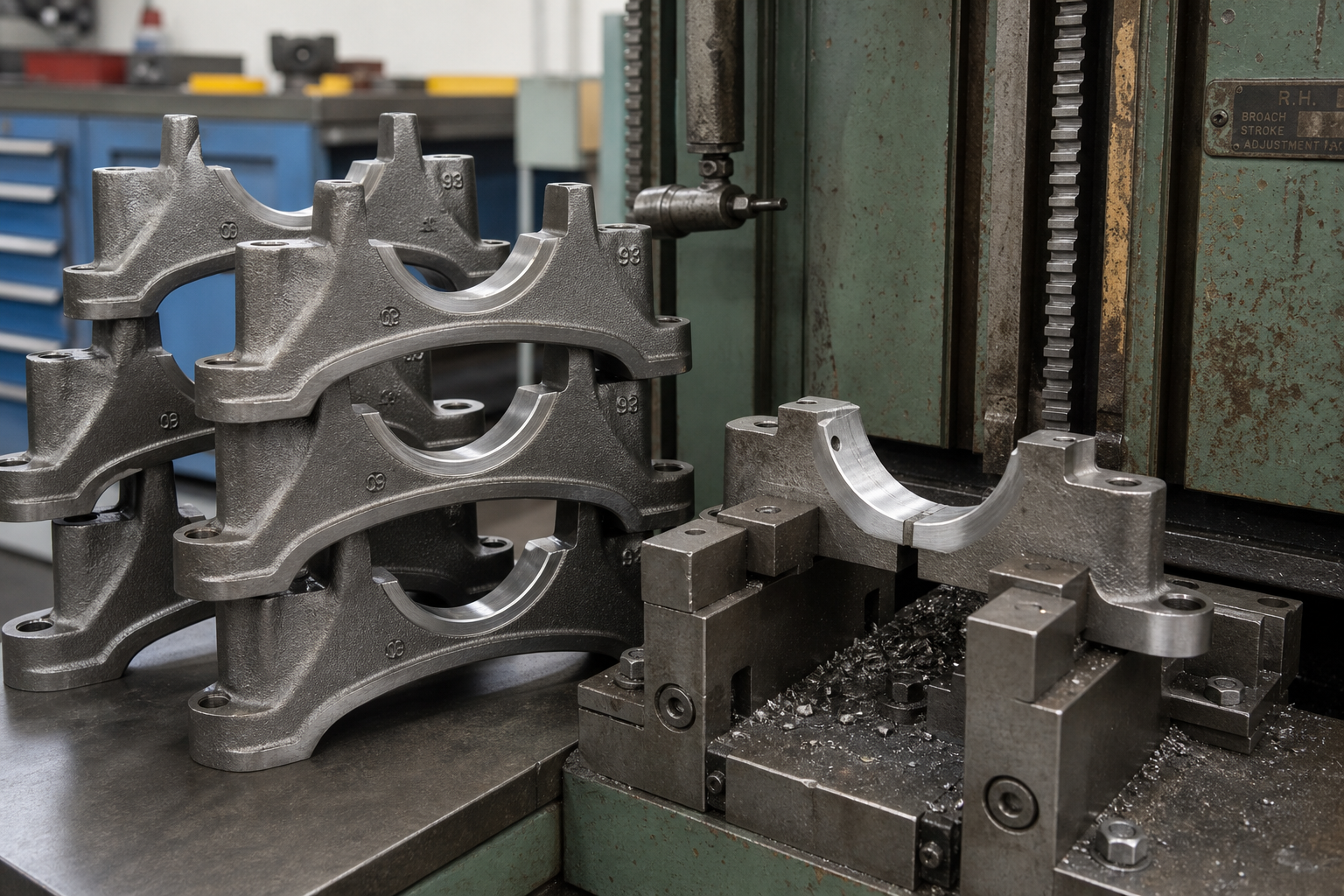
Conceptual illustration of an in-house keyway broaching cell. It is not a dimensional layout or a photograph of a BroachingMach installation.
Bringing keyway broaching in-house can shorten the route between turning, broaching and inspection, but it does not automatically reduce total cost. The decision depends on recurring demand, available machine capability, tooling and fixture requirements, quality ownership, operator knowledge and the cost of using internal capacity.
The practical question is not simply “buy a broaching machine or outsource?” A shop may add a single-point operation to an existing CNC, use a press with progressive tooling, install a dedicated machine, keep a specialist supplier, or combine internal capacity with external overflow.
This guide provides a make-vs-buy framework without assuming a universal production volume or payback period.
Short Answer: When Does In-House Keyway Broaching Make Sense?
In-house broaching is strongest when the same keyway or part family repeats, the process can be standardized, internal capacity is available and controlling lead time or datum relationships has real value. Outsourcing is often stronger when demand is irregular, profiles change frequently, parts need specialized equipment or the internal shop is already capacity-constrained.
Before approving equipment, confirm five things:
- The keyway geometry and material can be processed on the proposed platform.
- The complete process—not only the cutting stroke—fits the machine and fixture.
- Inspection can prove width, depth, position and functional fit.
- Expected demand can support tooling, setup, maintenance and training.
- A pilot run demonstrates stable quality and an acceptable internal cost.
If any one of these remains unknown, the correct next step is a controlled feasibility test, not a purchase based on a headline cycle time.
In-House vs Outsourced Keyway Broaching
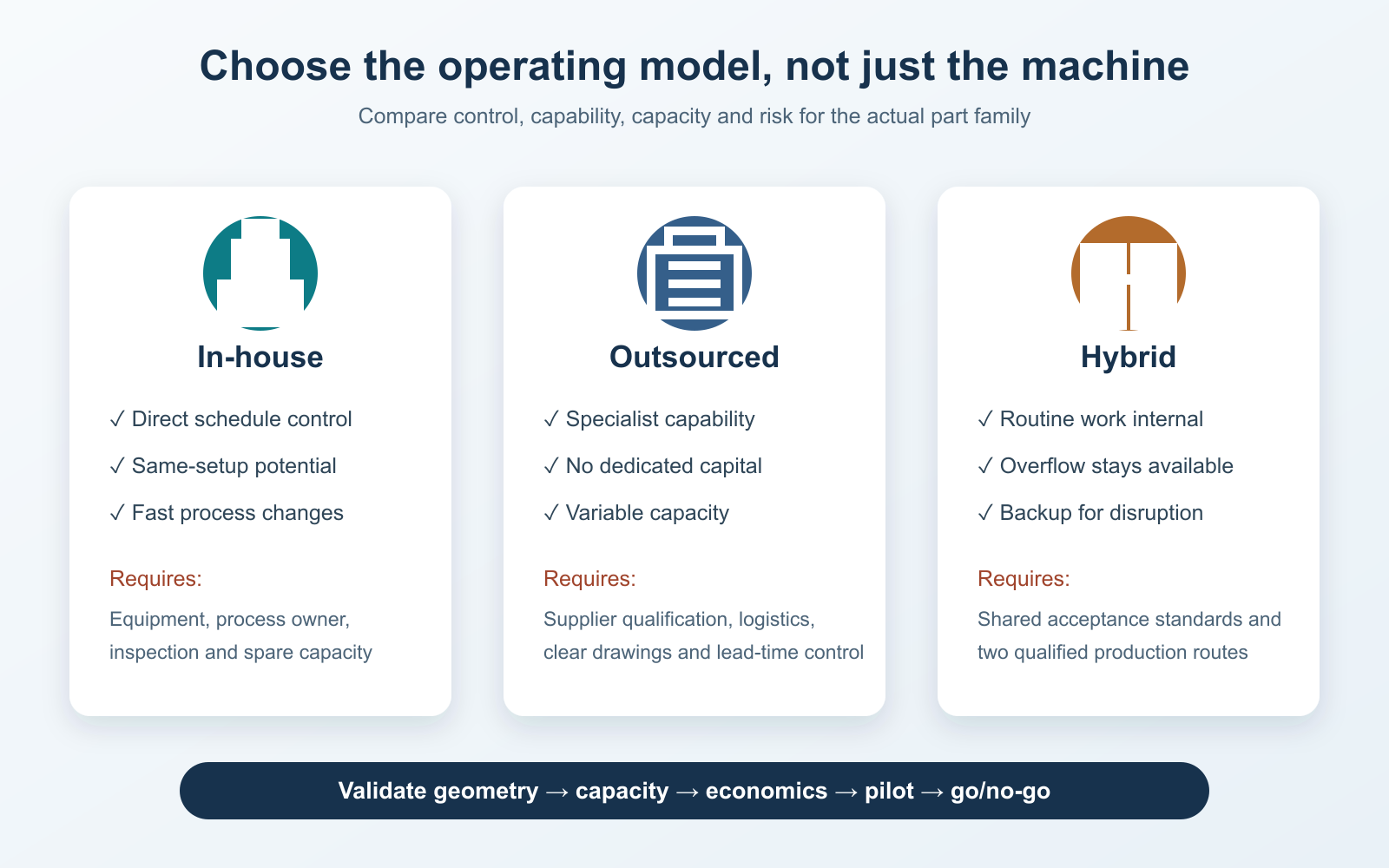
The best route depends on demand stability, process capability, capacity and risk. A hybrid model can protect peaks or unusual jobs.
| Factor | In-house | Outsourced | Hybrid |
|---|---|---|---|
| Lead-time control | Internal priorities can change quickly | Depends on supplier queue and transport | Routine work stays internal; peaks use external capacity |
| Capital requirement | Machine, holder, fixture and inspection may be needed | Usually no dedicated capital | Lower internal capacity may be sufficient |
| Unit-cost visibility | Requires accurate labor, overhead, tooling and scrap data | Quoted price is visible; handling and delay costs still matter | Two cost structures must be managed |
| Quality ownership | Process and inspection are controlled directly | Supplier controls the operation under agreed requirements | Internal standard must transfer clearly to the supplier |
| Technical breadth | Limited by installed machines and team knowledge | Specialist may cover more profiles, sizes and materials | Unusual or high-risk jobs remain external |
| Capacity risk | Broaching competes with other internal work | Supplier capacity can become the constraint | Overflow option reduces either constraint |
| Change response | Fast after the process is proven | Changes may require requoting and rescheduling | Engineering trials can be internal; volume can move later |
Outsourcing is not merely an extra line on the routing. It can provide specialist machines, established fixtures, process knowledge and spare capacity. In-house production is not merely the removal of a purchase order. It creates responsibility for tooling, programs, preventive maintenance, inspection, scrap and recovery after a breakdown.
Three Ways to Bring the Process In-House
Use an Existing CNC Lathe or Machining Center
A single-point or indexable broaching tool can make repeated linear strokes while the spindle is oriented and normally stopped. This can keep the keyway in the same setup as the bore and other turned or milled features.
This route can be attractive for prototypes, moderate quantities and part families with changing keyway sizes. However, machine suitability must be verified. Axis thrust, rigidity, holder alignment, spindle-orientation accuracy, available stroke, control behavior, chip evacuation and the machine builder's restrictions all matter.
The operation also occupies CNC time. A low capital requirement does not make the capacity free. Compare the contribution of the broaching cycle with the work displaced from the machine.
Use a Press and Progressive Keyway Broach
A push or pull broach with progressively rising teeth can cut a through keyway in one tool pass. A press-based route can be simple and productive when the feature is open, the bore and keyway sizes repeat and suitable bushings and fixtures are available.
The machine must supply adequate rated force and stroke with safe guidance. Use the actual tool geometry, material, keyway dimensions and lubrication assumptions when estimating force; the broaching-machine tonnage guide explains the variables that enter the calculation.
Progressive tooling is less flexible than single-point cutting when profiles change. Tool length, initial cost, storage, handling and resharpening should be included in the decision.
Install a Dedicated Broaching Machine
A dedicated vertical or horizontal machine can provide controlled force, guidance, stroke, work handling and automation for recurring production. This is usually the pathway to evaluate when annual demand, cycle-time pressure, part size or tooling requirements exceed a practical press or existing CNC setup.
Machine selection should begin with the workpiece and production route. Review force, stroke, daylight, tool handling, loading orientation, fixture access, chip and coolant management, control functions, guarding and service support. See how to choose the right broaching machine for the broader selection criteria.
A Readiness Test Before You Compare Prices
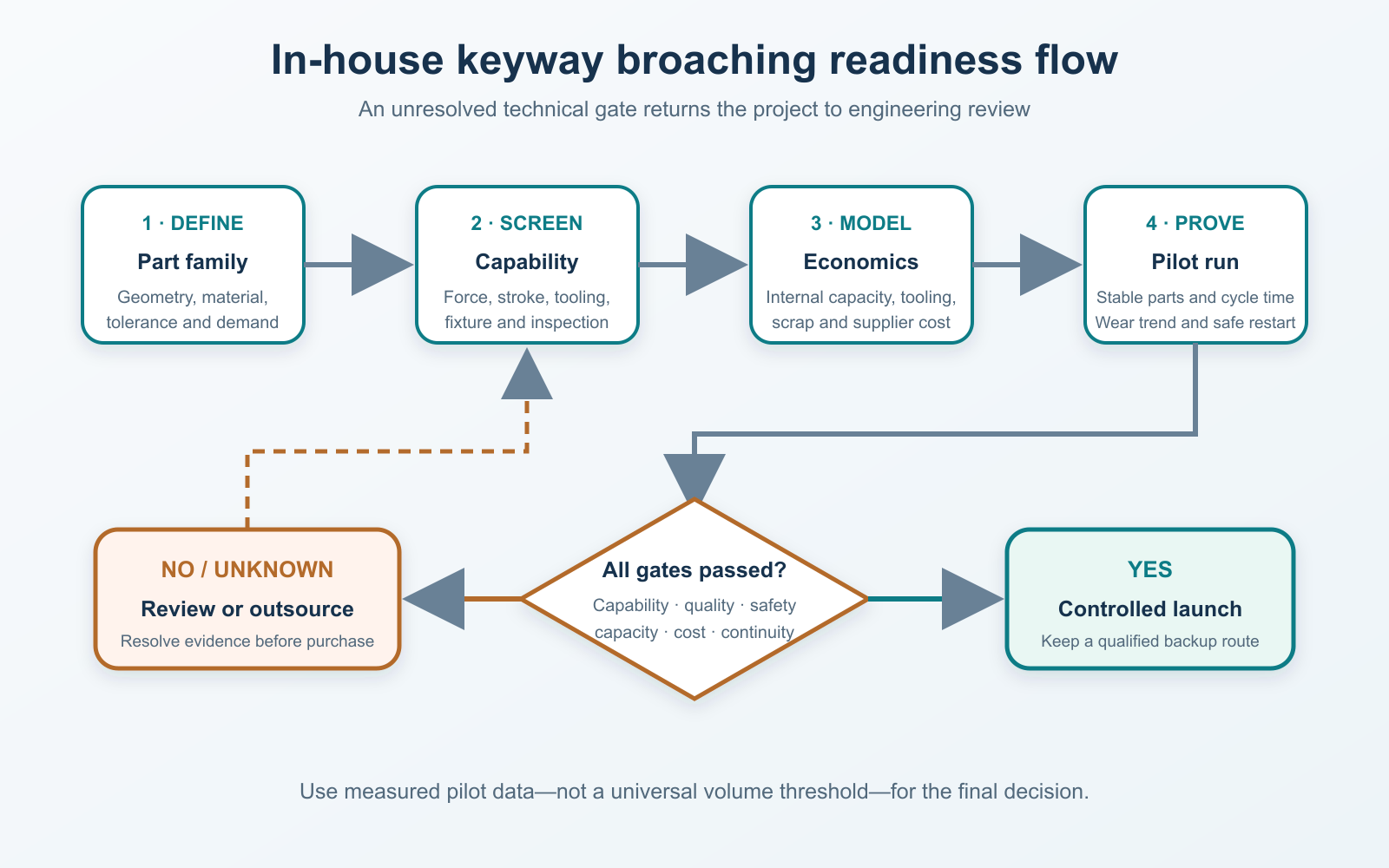
Move from geometry and capability to demand, economics and a pilot. An unresolved technical gate should return the project to engineering review.
Is the Demand Repetitive Enough?
Collect at least a representative history of part numbers, batch sizes, annual quantities, seasonal peaks and engineering changes. Group work by bore, keyway width, depth, length, material and tolerance. A large total volume spread across many unrelated profiles may not support common tooling or short setups.
Recurring families are more useful than one optimistic forecast. Also separate committed demand from quoted opportunities so that equipment is not justified by work that may never arrive.
Can the Proposed Machine Complete the Entire Operation?
Check more than force and stroke. The tool must enter the bore, remain aligned, complete the cut, clear the part and return safely. The fixture must support cutting load without distorting the bore or hiding the area to be inspected.
For blind features, the tool needs controlled stopping, chip space and a safe retraction path. Standard progressive keyway broaches are naturally suited to through features. A blind keyway may require single-point tooling, a relief groove, a cross-hole, a keyseater or another controlled-stroke process.
Can You Inspect the Result?
Define how the shop will verify:
- Keyway width and radial depth
- Position relative to the bore and other datums
- Angular orientation where required
- Surface condition and burrs
- Functional fit with the specified key or gage
- Bore distortion after broaching
Inspection time belongs in the internal cycle and cost model. If the drawing or acceptance method is ambiguous, resolve it before comparing supplier quotes with an internal estimate.
Is There a Process Owner?
Someone must own the tool record, setup instructions, program revision, first-off approval, wear limits, lubrication standard and response to abnormal cutting load. A machine without process ownership often becomes an occasional, high-variation operation.
Training should cover safe tool handling, alignment, chip control, inspection and the difference between correcting a symptom and changing multiple variables at once.
Build the Cost Model From Your Own Numbers
Do not rely on a universal “parts per year” threshold. Use the same time horizon and demand assumptions for every alternative.
Internal Annual Cost
Estimate:
Annual internal cost = annualized equipment and installation + tooling and reconditioning + fixtures + direct labor + occupied machine time + inspection + coolant and consumables + maintenance + expected scrap and downtime
Include engineering, prove-out and training. If an existing CNC will be used, apply a realistic rate for the capacity consumed. If a dedicated machine is considered, include foundation, power, guarding, lifting, floor space and integration where applicable.
Outsourced Annual Cost
Estimate:
Annual outsourced cost = quoted processing + transport and packaging + incoming inspection + purchasing and handling + expected expedite/rework cost + inventory carrying effect
Do not invent a delay cost. Model it only where production history shows that subcontract lead time creates work-in-process, premium freight, missed shipments or lost flexibility.
Compare Scenarios, Not One Forecast
Calculate low, expected and high demand. Then test changes in:
- Tool life and resharpening frequency
- Setup and inspection time
- Scrap rate
- Machine utilization
- Supplier price and lead time
- Internal labor and overhead
- Product mix
The decision is more reliable when it remains acceptable across a reasonable range, rather than only at one optimistic volume.
Equipment and Process Requirements
The exact package depends on the selected method, but an in-house cell may require:
- Broaching machine, press or validated CNC platform
- Broach, single-point insert or custom form tool
- Pull head, toolholder, guide, bushing or retrieval system
- Rigid workholding with correct load support
- Coolant or cutting fluid delivery and filtration
- Chip collection and safe cleanout
- Force, load or condition monitoring
- Width, depth and functional inspection equipment
- Tool storage, protection and handling
- Setup sheets, programs and maintenance instructions
For progressive broaching, inspect tooth condition and alignment before a damaged edge creates defects across later teeth. The guide on avoiding broach breakage covers common load, alignment and maintenance risks. Lubrication must match the material, tool and process; use the broaching cutting-fluid guide as a starting point, then validate the actual application.
Quality, Capacity and Workforce Risks
Quality Ownership Moves Inside
Same-setup machining may improve datum control, but only if the holder, program, fixture and inspection are repeatable. Track the first-off result, trend critical dimensions and record tool condition. Do not wait for a failed functional assembly to define the wear limit.
Internal Capacity Can Become the New Queue
An internal operation can still be late if it depends on one occupied CNC, one trained operator or one tool. Model peak demand and recovery after tool damage or machine downtime. A spare tool or approved supplier may be more valuable than maximizing theoretical utilization.
Knowledge Must Survive Beyond One Operator
Document alignment, cutting increments, stroke limits, lubrication, chip checks and inspection. When defects occur, use a structured process such as the broaching troubleshooting guide instead of changing feed, alignment and coolant simultaneously.

BroachingMach CNC vertical side broaching machine with mortise and groove, shown as an example of a related dedicated platform. Suitability for an actual keyway requires review of the part, tool, force, stroke, fixture and production target.
Run a Pilot Before the Final Go/No-Go Decision
A useful pilot should reproduce the proposed production method, not only prove that one keyway can be cut.
- Freeze the part revision, material condition and acceptance method.
- Confirm machine, tool, holder, fixture, lubrication and chip-control assumptions.
- Establish a safe initial process and record every parameter.
- Measure first-off parts for width, depth, position, bore condition and functional fit.
- Run enough consecutive parts to expose thermal, chip and wear behavior.
- Record cycle time by element: load, align, cut, unload, inspect and clean.
- Inspect the tool and compare cutting load or machine feedback through the run.
- Test a normal restart after a tool change or planned interruption.
- Calculate cost with measured time, tool consumption and scrap—not target values.
- Define acceptance gates before deciding.
Possible gates include dimensional capability, stable load, acceptable tool condition, safe handling, repeatable setup and a cost range that remains competitive under expected demand.
When Outsourcing Is Still the Better Choice
Continue outsourcing when:
- Demand is low, irregular or difficult to forecast.
- The part mix needs many unrelated custom broaches.
- The material, hardness, length or profile needs specialized equipment.
- Internal CNC capacity is more valuable for other operations.
- The shop cannot support the required inspection or process engineering.
- A qualified supplier already provides stable quality and acceptable lead time.
- Capital, installation or training would delay a short-lived program.
- Business continuity requires a process outside the current facility.
A hybrid strategy can be stronger than a binary choice. Keep recurring, proven families inside while using a specialist for unusual profiles, overflow, backup and development work.
Decision Matrix
Score each factor using evidence from the actual part family.
| Question | Favors in-house | Favors outsourcing |
|---|---|---|
| Is demand recurring and stable? | Repeated families and committed volume | Irregular jobs or uncertain forecast |
| Is capability already available? | Suitable machine, staff and inspection exist | Specialized machine or knowledge is missing |
| Is internal capacity available? | Broaching fits without displacing higher-value work | Current bottleneck would become worse |
| Does same-setup control matter? | Keyway relationship to other features is critical | Separate operation does not create quality risk |
| Can tooling be standardized? | Common sizes, fixtures or holders across families | Many unique profiles and short programs |
| Is rapid response valuable? | Prototypes, revisions or rush work are frequent | Supplier lead time is already acceptable |
| Is continuity protected? | Spare tools, maintenance and backup route exist | Single machine or operator creates high exposure |
No single row should decide the project. Use the matrix to expose the assumptions that need proof.
Information to Prepare for a Machine or Tooling Review
Provide:
- Part drawing and 3D model
- Bore diameter and length
- Keyway width, radial depth, length and end condition
- Through or blind geometry and available relief
- Material, hardness and heat-treatment state
- Tolerance, surface finish and datum relationships
- Annual volume, batch size and production horizon
- Current route, cycle time, supplier lead time and defect history
- Available machine force, stroke, axes, holder interface and control
- Loading, fixture and automation requirements
- Inspection method and acceptance gages
- Coolant, filtration and chip-control constraints
- Floor space, utilities and installation limits
BroachingMach's keyway broaching machine category shows related machine configurations. An engineering review should match the drawing and production route to the machine rather than select from a category name alone.
Frequently Asked Questions
Is keyway broaching in-house always cheaper?
No. The answer changes with demand, product mix, occupied machine time, tooling, inspection, maintenance, scrap and supplier performance. Compare complete annual costs using measured or supportable assumptions.
Can a CNC lathe broach a keyway?
Some CNC lathes can use a rigid single-point tool and repeated linear strokes, but capability must be confirmed with the machine builder's limits, axis thrust, alignment, stroke, control and holder requirements. “CNC” alone does not prove suitability.
Do I need a dedicated broaching machine?
Not always. Existing-CNC tooling or a press may fit some part families. A dedicated machine becomes more attractive when force, stroke, rigidity, cycle time, automation or recurring volume exceeds those alternatives.
What is the first step in a make-or-buy study?
Build a part-family demand table and define the real feature and inspection requirements. Then screen feasible process routes before requesting comparable internal and supplier costs.
Should I eliminate my outside broaching supplier?
Usually not before the internal process is proven. An approved supplier can protect peak demand, unusual jobs and business continuity even after routine work moves in-house.
Make the Decision With a Real Part and a Measured Pilot
The strongest in-house case combines repeatable demand, a technically suitable process, available capacity, documented ownership and a pilot that proves quality and cost. The strongest outsource case uses a qualified specialist where internal equipment or utilization would be difficult to justify.
Review the complete guide to broaches for tooling fundamentals, then contact BroachingMach with the part drawing, material, volume, force and stroke requirements for an application-specific review.